Table of contentsShowHide
- 1.What Is a Full-syllabus Test?
- 2.Chapter-wise vs Full-syllabus Tests: Key Differences
- 3.Which Test Should You Take at Each Stage?
- 4.A Practical CA Inter Test Plan
- 5.During First-time Learning: Test Each Chapter
- 6.During Revision: Combine Old and New Topics
- 7.After Syllabus Coverage: Attempt Full-syllabus Papers
- 8.Sample Schedule: Chapter-wise to Full Syllabus
- 9.How to Analyse Your Test Results
- 10.How a CA Inter Test Series Can Support Preparation
- 11.Common Mistakes to Avoid
- 12.How to Choose the Right Balance
- 13.Conclusion
Preparing for CA Intermediate means managing a wide syllabus while learning how to apply concepts accurately under exam conditions. Reading notes and watching lectures are important, but students also need regular practice to check what they remember, how well they solve questions, and where they lose marks.
Two common options are chapter-wise tests and full-syllabus tests. Both have a place in a good preparation plan, but they serve different purposes. A well-planned CA Inter Test Series should help you use each type at the right stage instead of treating one as a replacement for the
A chapter-wise test focuses on one chapter or a small group of related topics. It is usually taken soon after studying a topic or during the first revision. Because the scope is limited, you can check whether you understand the key concepts, remember important provisions or formulas, and know how to approach typical questions.
These tests are especially useful when a subject contains detailed concepts that build on one another. They help you identify confusion early, while the relevant class notes and study material are still familiar. Instead of discovering a weak topic during the final revision, you can fix it before moving on.
What Is a Full-syllabus Test?
A full-syllabus test covers the subject broadly and asks you to move between different chapters, concepts, and question types. It is designed to feel closer to the challenge of an actual examination, where you must decide what to attempt, manage time, and recall material without knowing which chapter will appear next.
Full-syllabus practice is valuable after you have covered a substantial part of the syllabus and revised it. It helps test retention across topics, not just understanding immediately after a class. It can also show whether you spend too long on difficult questions or leave easy marks because of poor time allocation.
Chapter-wise vs Full-syllabus Tests: Key Differences
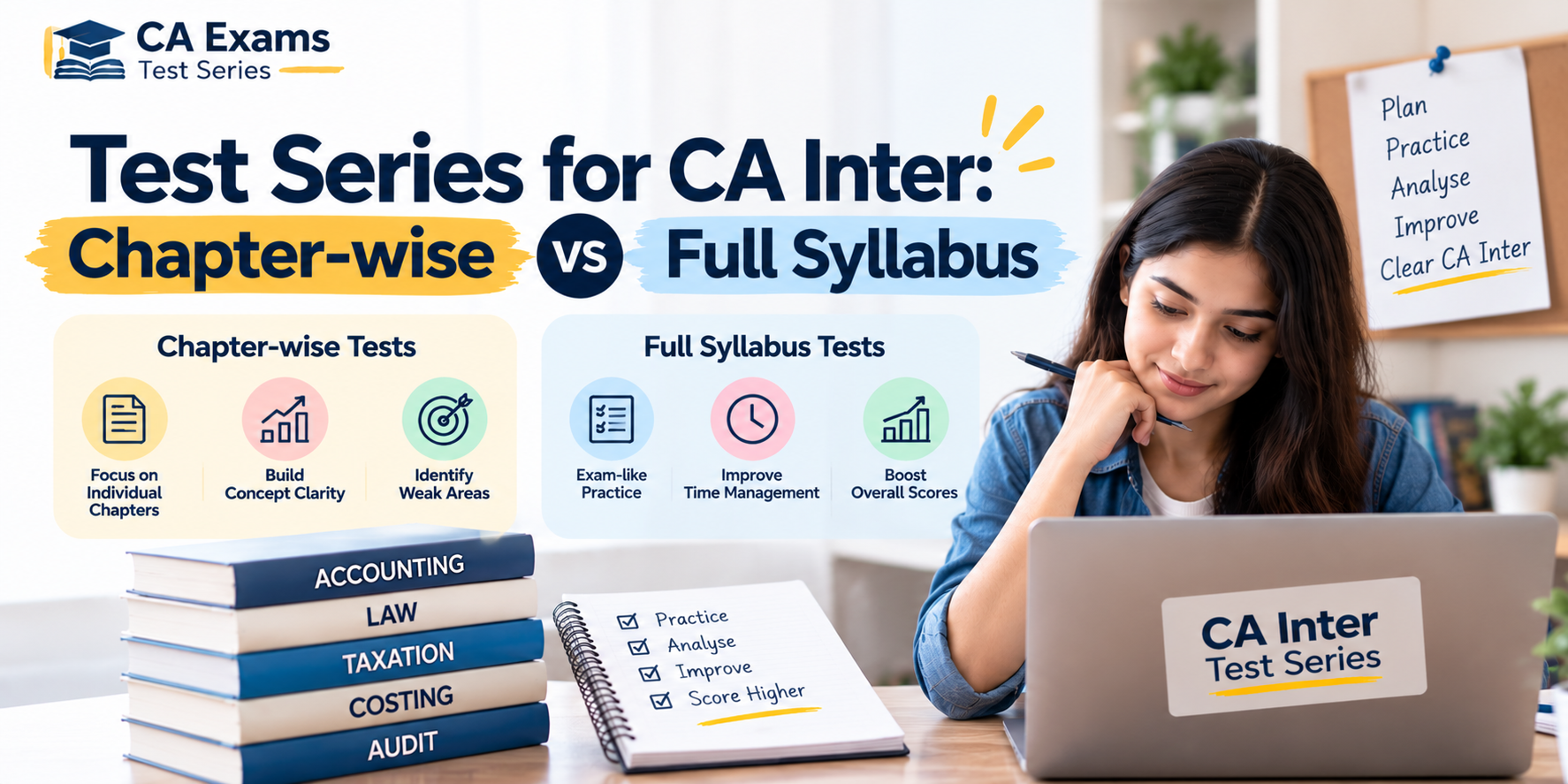
The main difference is the purpose of the test. Chapter-wise tests diagnose topic-level understanding, while full-syllabus tests check how well you can combine recall, question selection, and time management across the paper. Neither is automatically better; the useful choice depends on your preparation stage.
| Comparison | Chapter-wise test | Full-syllabus test |
|---|---|---|
| Main purpose | Check understanding of a specific topic | Check recall and application across the subject |
| Best stage | After a chapter or during early revision | After substantial syllabus coverage and revision |
| What it reveals | Topic-level gaps and question-solving errors | Timing, question selection, retention, and paper completion |
| Main limitation | May not test mixed-topic recall | Less useful if too much of the syllabus is still untouched |
Which Test Should You Take at Each Stage?
At the beginning, focus on short tests after completing a chapter or topic. Once you have covered several chapters, mix in cumulative tests that include older material. When you complete a meaningful portion of the syllabus and begin revision, introduce full-length papers. As the examination approaches, use both types according to the weaknesses revealed by your earlier attempts.
Do not wait until the entire syllabus is complete before doing any timed practice. Equally, do not rely only on chapter-wise tests right up to the examination. The transition should be gradual: topic practice, cumulative practice, then full-syllabus mock tests and targeted revision.
A Practical CA Inter Test Plan
Your plan should be realistic and flexible. The sample schedule below is a starting point; adjust it to your subject, exam date, syllabus coverage, and available study hours.
During First-time Learning: Test Each Chapter
After finishing a chapter, solve a small set of questions without looking at the solution. Use a timer where appropriate, then check the method and identify any steps you missed. If you repeatedly need to refer to notes, revisit the concept before moving on.
Keep the review focused. Write down the topic, the mistake, and the correction in a short error log. This avoids making long notes that you never revisit. Reattempt difficult questions after a gap to check whether you can solve them independently.
During Revision: Combine Old and New Topics
Once you have studied several chapters, introduce cumulative tests. These can include recently completed chapters as well as topics studied earlier. This helps prevent the common problem of remembering a chapter for a few days and then forgetting it as the syllabus moves forward.
Use cumulative practice to strengthen recall and connections between topics. If a chapter-wise test went well but a mixed test does not, the issue may be retrieval or question selection rather than the concept itself. Adjust revision accordingly.
After Syllabus Coverage: Attempt Full-syllabus Papers
When you have covered a substantial part of the subject and completed a revision cycle, schedule a full-syllabus test under exam-like conditions. Attempt the paper in one sitting, follow the time limit, and avoid checking notes during the test.
Review the result carefully. Look beyond the total score: note questions you could not attempt, errors that were avoidable, chapters that need another revision, and time spent on individual questions. The next study session should address the most important findings from this review.
Sample Schedule: Chapter-wise to Full Syllabus
Use this table as a flexible guide rather than a strict rule. If you are short on time, prioritise the test type that addresses your biggest current weakness.
| Stage | Suggested test | Purpose |
|---|---|---|
| After each chapter | Short chapter-wise test | Correct concept and application errors |
| After 3–4 chapters | Cumulative mixed-topic test | Refresh older topics and practise recall |
| After major syllabus coverage | One diagnostic full-syllabus paper | Find broad weaknesses and timing issues |
| During revision | Full paper plus targeted chapter tests | Balance exam practice with focused correction |
| Final weeks | Selective full mocks and weak-topic practice | Improve readiness without sacrificing revision |
How to Analyse Your Test Results
Analysis turns a test from a score-checking exercise into a learning tool. Review your answers and classify mistakes into categories such as concept gaps, forgotten rules or formulas, calculation errors, misreading the requirement, incomplete answers, presentation issues, and poor time management.
Choose two or three corrections to focus on before the next test. Rework incorrect questions, revise the relevant concept, and attempt a similar question without help. If the same error appears repeatedly, schedule a specific revision session rather than simply writing another test.
Track a few useful measures over time: whether you completed the paper, which topics repeatedly caused difficulty, how often you made avoidable mistakes, and whether your answers were presented clearly. These details can show progress even when scores fluctuate from test to test.
How a CA Inter Test Series Can Support Preparation
A structured CA Inter Test Series can help you organise practice across chapters and full papers. When comparing options, check whether the papers align with the applicable syllabus and exam pattern, whether instructions and solutions are clear, and whether evaluation feedback helps you understand how to improve.
Choose a test schedule you can follow consistently. A long list of tests is not helpful if you do not have time to attempt them properly and review the results. Build time for checking answers, revising weak areas, and repeating difficult questions into the plan from the start.
Use the CA Inter Test Series alongside your study material, classes, and revision notes. Tests should reveal what needs more work; they should not replace learning the concepts or reviewing the prescribed material. The goal is to make your preparation more targeted, not to add pressure without a clear benefit.
Common Mistakes to Avoid
One mistake is taking only chapter-wise tests. They can create confidence because you know which topic is being tested, but the actual exam requires you to identify the relevant concept on your own. Add cumulative and full-syllabus practice as your preparation develops.
Another mistake is attempting full-syllabus papers too early and then judging your ability only by the score. If large parts of the syllabus are still untouched, the result may say more about coverage than exam readiness. Use early diagnostic tests carefully and interpret them in context.
Do not check answers while attempting a timed paper, skip review because the score seems acceptable, or repeat tests without correcting mistakes. Avoid comparing your scores directly with classmates unless the test conditions and preparation stages are similar. Your own error pattern is a more useful guide.
How to Choose the Right Balance
If you are still learning chapters or repeatedly making concept-level mistakes, give more time to chapter-wise tests. If you understand the material but forget it across weeks, use cumulative tests and spaced revision. If you have completed revision but struggle to finish papers or choose questions, increase full-syllabus practice.
A balanced plan usually moves from focused practice to mixed practice and then to full papers. Keep some chapter-wise tests in the final phase if a particular topic remains weak, but make sure you also practise the experience of answering a complete paper under a time limit.
Conclusion
Chapter-wise and full-syllabus tests work best as parts of the same preparation strategy. Chapter-wise tests help you strengthen individual topics, while full-syllabus tests develop recall across the subject, time management, and exam readiness. Use each type at the right stage, analyse every attempt, and let your mistakes guide the next revision session.
FAQs
Is a chapter-wise test better than a full-syllabus test for CA Inter?
Neither is better in every situation. Chapter-wise tests help you check concepts after studying a topic, while full-syllabus tests assess recall, question selection, and time management across the subject. Use both at different stages.
When should I start chapter-wise tests for CA Intermediate?
Start after completing a chapter or a meaningful topic. Attempt questions without notes, review mistakes, and revisit concepts you could not apply independently before moving to the next stage.
When should I attempt a full-syllabus CA Inter mock test?
Attempt a full-syllabus paper after you have covered a substantial portion of the subject and completed enough revision to make the test useful. Schedule it under timed, exam-like conditions.
How many chapter-wise tests should I take?
There is no fixed required number. Take enough to confirm that you can solve the important question types from each chapter, and add extra practice for topics where mistakes keep recurring.
Can I prepare for CA Inter using only chapter-wise tests?
Chapter-wise tests are useful for learning, but relying on them alone may leave you underprepared for mixed questions and full-paper timing. Include cumulative tests and full-syllabus mocks as your revision progresses.
What should I do after scoring poorly in a test?
Identify whether the problem came from understanding, recall, calculation, presentation, or timing. Revise the main weak areas, reattempt incorrect questions, and use a later test to check whether the same errors have reduced.
Should I take a full-syllabus test before completing the syllabus?
You can use an early diagnostic paper to understand your current position, but interpret the score in light of incomplete coverage. For regular full-syllabus practice, first cover and revise a substantial part of the subject.
How can a CA Inter Test Series improve my preparation?
A suitable test series gives structure to practice and helps you check performance under timed conditions. Its value depends on relevant papers, clear solutions, useful evaluation, and how carefully you act on the feedback.
How much time should I spend reviewing a mock test?
Spend enough time to understand why errors happened and how to correct them. Rework incorrect questions, revise the concepts involved, and record recurring mistakes so they can be checked again during revision.
What is the best test strategy in the last month before CA Inter?
Use a mix of full-syllabus mocks, cumulative practice, and targeted chapter-wise tests. Leave time between full papers for analysis and revision, and focus on correcting recurring mistakes rather than increasing test count alone.