Table of contentsShowHide
- 1.Why fundamentals matter
- 2.Begin with the applicable syllabus
- 3.Build accounting concepts step by step
- 4.Develop clarity in Business Laws
- 5.Strengthen quantitative aptitude
- 6.Connect economics with examples
- 7.Use active recall
- 8.Practise illustrations before advanced questions
- 9.Create a weekly revision cycle
- 10.Assess progress with CA Exams Test Series
- 11.Quick Reference Table
- 12.Conclusion
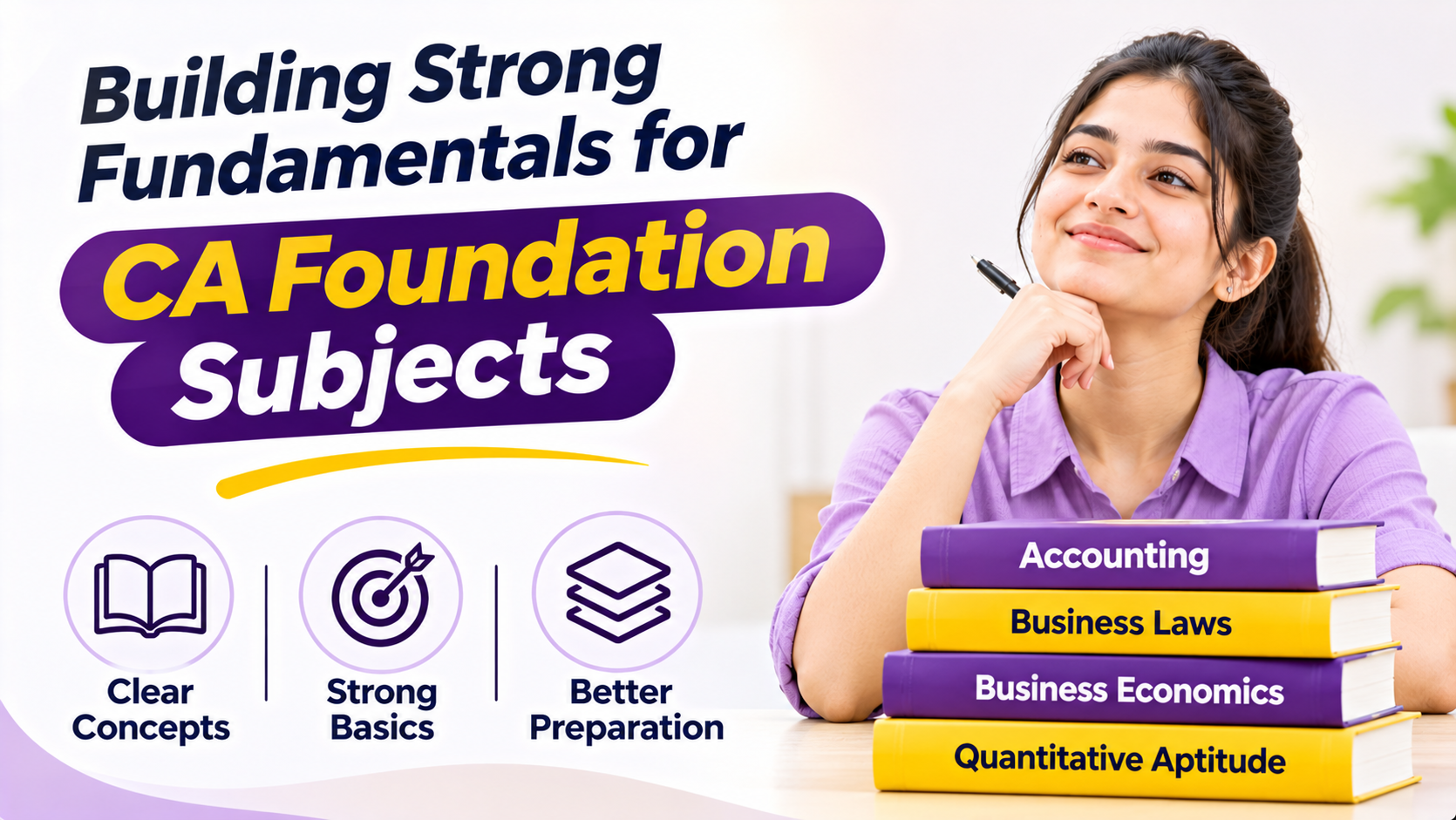
CA Foundation is the stage where students begin developing the academic habits required for the Chartered Accountancy course. The subjects introduce ideas and methods that may be new to students from different school backgrounds. Memorising topics without understanding their base can make later chapters difficult.
Strong fundamentals come from understanding why a concept works, practising it in different forms and revisiting it at planned intervals. A steady approach helps students build confidence across subjects instead of depending only on last-minute revision.
Why fundamentals matter
Fundamentals are the concepts, definitions, rules and methods on which advanced learning depends. In accounting, students need to understand the logic behind entries before attempting complex adjustments. In quantitative aptitude, basic methods support speed and accuracy. In law, understanding a provision helps with application.
When the base is weak, a student may remember a solved example but struggle when figures or facts change. Strong fundamentals make learning transferable: you can apply a principle to a new question instead of memorising one answer.
Begin with the applicable syllabus
Review the ICAI syllabus and study material relevant to your examination attempt. Divide each subject into chapters and smaller learning units. This gives you a clear view of what needs to be covered and prevents large chapters from becoming vague daily targets.
Use prescribed material as your main reference. Lectures and supplementary explanations can help resolve specific doubts, but switching between too many sources may create confusion. Complete core explanations and illustrations first.
Build accounting concepts step by step
Start with the accounting equation, debit and credit rules, journal entries and ledger posting. Move gradually to trial balance and the topics that depend on these basics. Do not skip the reasoning behind an illustration simply because the final entry looks familiar.
After studying an example, close the solution and solve a similar question independently. Explain why each account is debited or credited. If you cannot explain the logic, revisit the concept before increasing the difficulty.
Develop clarity in Business Laws
Law preparation requires more than remembering isolated words. Read a provision carefully, identify its essential elements and understand the conditions in which it applies. Make short notes in plain language while retaining important legal terms and distinctions.
For application questions, identify the facts, connect them with the relevant principle and reach a reasoned conclusion. Revise definitions and provisions at planned intervals rather than trying to memorise an entire chapter in one sitting.
Strengthen quantitative aptitude
Quantitative aptitude and logical reasoning improve through repeated problem-solving. Understand the method and when it applies, solve basic questions and then attempt mixed or timed sets. Maintain a record of formulas and common calculation errors.
Do not measure progress only by the number of questions completed. Identify whether an incorrect answer came from concept selection, formula choice, calculation or misreading. Rework the question after a gap to confirm that the method is understood.
Connect economics with examples
Economics becomes easier when definitions and theories are connected with familiar business or market situations. After learning a concept, identify a simple example that illustrates it. The example supports understanding but does not replace the technical explanation.
Prepare comparison notes for concepts that are easy to confuse. Practise explaining relationships without looking at the book. During revision, focus on the logic linking concepts rather than memorising disconnected paragraphs.
Use active recall
Repeated reading can create familiarity without proving that you can recall a topic independently. After studying a section, close the book and write the key points, explain the concept aloud or solve a question. Compare your response with the material and correct omissions.
Use short prompts for definitions, formulas and distinctions. Revisit difficult prompts more often and reduce the frequency when recall becomes reliable. This keeps revision active and measurable.
Practise illustrations before advanced questions
Illustrations show how a rule or concept is applied. Work through them carefully, then attempt the question yourself without looking at the solution. Once the standard method is clear, try questions with changed figures or different facts.
A useful progression is concept explanation, solved illustration, independent basic question, mixed practice and timed practice. This prevents you from attempting advanced problems before the underlying method is stable.
Create a weekly revision cycle
A weekly plan should include learning, question practice, revision and a short assessment for every subject. Rotate subjects so that long gaps do not develop. Give additional time to difficult topics without completely ignoring stronger areas.
At the end of the week, review what was completed and what remains uncertain. Set the next week's targets based on actual progress. A realistic schedule followed consistently is more useful than an ambitious plan that is repeatedly abandoned.
Assess progress with CA Exams Test Series
A suitable CA Exams Test Series can help Foundation students check whether they can apply concepts under time limits. Begin with topic assessments, then move towards subject-wise papers and full mocks as preparation develops.
Use results to guide revision, not to label yourself. If a test exposes a basic gap, return to the relevant study material and practise again. Combine assessments with ICAI resources for balanced preparation.
Quick Reference Table
| Subject | Fundamental focus | Practice method |
|---|---|---|
| Accounting | Rules, entries and logic | Solve illustrations independently |
| Business Laws | Meaning and application of provisions | Recall and write case-based answers |
| Quantitative Aptitude | Methods, formulas and accuracy | Graded and timed question sets |
| Business Economics | Concepts and relationships | Explain and apply concepts |
Conclusion
Effective CA preparation comes from combining clear concepts with regular practice and honest review. Use prescribed ICAI resources as your foundation, set realistic targets and turn every assessment into a plan for improvement. A consistent approach with CA Exams Test Series can help you practise with greater discipline and understand where your next revision effort should go.
Frequently Asked Questions
Why are fundamentals important in CA Foundation?
They help students understand the logic behind questions, apply concepts to unfamiliar problems and revise advanced topics without depending entirely on memorised examples.
How should beginners start CA Foundation preparation?
Begin with the applicable syllabus and ICAI study material. Divide chapters into smaller topics, learn the basics and follow each session with independent question practice.
Is memorisation enough to clear CA Foundation?
Memorisation supports definitions, formulas and provisions, but students also need conceptual clarity and the ability to apply what they have learned to different questions.
How can I improve Accounting fundamentals?
Understand the accounting equation and debit-credit logic before moving to complex topics. Practise journal entries and explain the reason behind each step.
How often should I revise Foundation subjects?
Revise soon after learning a topic, revisit it during the week and include it in a broader cycle. Adjust the frequency based on difficulty and retention.
How can I remember Business Law provisions?
Understand the meaning and essential elements, prepare concise notes and use active recall. Practise applying the principle to short factual situations.
What is the best way to practise Quantitative Aptitude?
Learn the method, solve basic questions and then attempt mixed sets under time limits. Maintain an error log for weak concepts and calculation issues.
Should Foundation students take mock tests?
Yes. Topic tests check early understanding, while subject-wise and full-length mocks develop examination skills. Analyse each attempt and revise the topics responsible for lost marks.
Can a test series improve conceptual clarity?
Test questions can reveal where a concept has not been understood or applied correctly. Return to the study material, resolve the doubt and attempt similar questions again.
Can CA Exams Test Series replace ICAI material?
No. ICAI study material should remain a core resource. CA Exams Test Series complements it with structured practice and performance review.