Table of contentsShowHide
- 1.Start with the paper structure
- 2.Map questions to syllabus topics
- 3.Classify question types
- 4.Assess difficulty realistically
- 5.Compare marks earned with marks available
- 6.Review time spent on each question
- 7.Check the quality of your answer
- 8.Build an error log
- 9.Turn analysis into a revision plan
- 10.Use CA Exams Test Series feedback constructively
- 11.Quick Reference Table
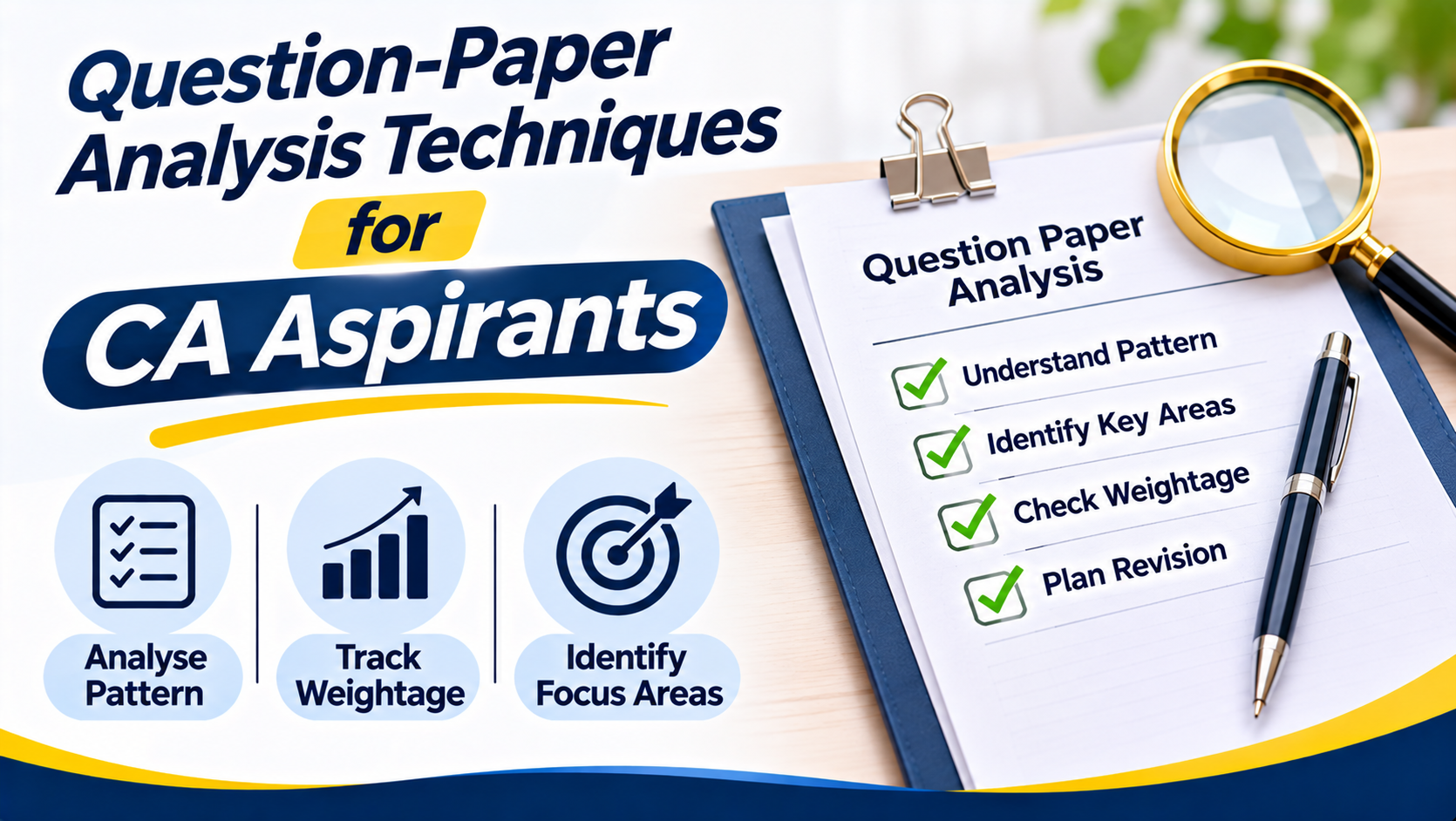
Solving a CA question paper is only the first part of practice. The real learning begins when you examine what the paper tested, how you responded and why marks were lost. A thoughtful analysis turns one attempt into a practical revision plan.
Instead of checking only the score, review topic coverage, question requirements, difficulty, time spent, accuracy and answer presentation. This helps identify patterns that a marks total alone cannot show.
Start with the paper structure
Record the subject, test date, syllabus portion, total marks and time allowed. Note the number of questions, internal choices and broad question types. This gives context to your result and makes comparisons between tests more meaningful.
Map questions to syllabus topics
Create a topic-wise record of questions. Note marks attached to each topic and whether a question combines chapters. This can show which areas need more practice and whether you are overlooking topics in your revision schedule.
Classify question types
Separate questions into conceptual, application-based, calculation-heavy, case-based, descriptive and interpretation-based categories where relevant. You may perform well in direct questions but struggle when a concept appears in a case. This classification helps select the right practice method.
Assess difficulty realistically
Mark each question as comfortable, moderate or challenging. Do not label a question difficult merely because you answered incorrectly. Check whether the issue was unfamiliar content, lengthy calculation, confusing wording or poor time management.
Compare marks earned with marks available
For every question, record marks available and awarded. Identify whether marks were lost because of an incorrect concept, missing step, incomplete explanation, wrong interpretation, calculation error or unanswered sub-part. This makes analysis specific enough to guide improvement.
Review time spent on each question
Compare time used with marks and complexity. Look for questions where you spent too long for a limited return. Also identify questions you left despite knowing the topic. These patterns may point to slow calculations, repeated reading or weak question selection.
Check the quality of your answer
Compare your response with the suggested answer or evaluation comments. Check whether you addressed every part, used relevant terms, showed workings and reached a conclusion. Do not copy a model answer blindly; understand which points were essential.
Build an error log
Maintain a short record with four columns: question or topic, type of error, reason and corrective action. If you repeatedly miss adjustments in a practical question, revise the concept and solve fresh questions of the same type. Review the log before each mock.
Turn analysis into a revision plan
Prioritise errors that are repeated, high-impact or easy to correct. Assign a specific action and date: revise a topic, practise similar questions, rewrite a theory answer or attempt a timed section. Recheck the same skill in the next paper.
Use CA Exams Test Series feedback constructively
Evaluation and analysis through CA Exams Test Series can complement your own review. Combine marks and evaluator observations with your time log and error record. The goal is to understand the reason behind the result and make the next attempt more effective.
Quick Reference Table
| Analysis area | Question to ask | Action |
|---|---|---|
| Topic coverage | Which chapters were tested and which remain weak? | Revise gaps and practise mixed questions |
| Question type | Which formats caused difficulty? | Practise that format under time |
| Marks lost | Why did I lose marks? | Correct the concept or method |
| Time use | Where did I spend too long? | Set question-wise limits |
| Presentation | Were steps and explanations clear? | Improve structure and workings |
| Repeat errors | Which mistakes appeared again? | Track and reattempt questions |
Frequently Asked Questions
How many mock tests should a CA student attempt?
There is no fixed number for every student. Choose a frequency that matches syllabus coverage and leaves enough time to analyse each paper and revise the weaknesses it reveals.
Should I attempt a full-length mock test before completing the syllabus?
Short or sectional tests are useful while learning. Full-length papers become more meaningful when you have covered enough of the syllabus to make the attempt representative.
Why is analysing a mock test important?
Analysis explains why marks were lost. It can reveal conceptual gaps, calculation errors, incomplete answers and time-management problems that a score alone does not identify.
How should I handle repeated mistakes?
Record each repeated error, revisit the underlying concept or method and practise fresh questions of the same type. Recheck the skill after a gap to confirm that the correction has lasted.
Are previous question papers enough for CA preparation?
Previous papers help you understand question styles and practise application, but combine them with the current syllabus, study material, revision and suitable mock tests.
How can I improve answer-writing skills?
Practise within a time limit, address every part of the requirement, show relevant workings and organise theory answers with clear explanations and conclusions where needed.
Should I compare my mock-test score with other students?
Use comparison carefully. Your most useful measure is progress across comparable tests, including accuracy, completion and reduction of repeated errors.
What should I do if my mock-test marks do not improve?
Check whether your practice addresses the actual cause of lost marks. Change the method if necessary, clarify difficult concepts and retest with a fresh paper.
How should I use evaluator comments?
Look for repeated comments about relevance, structure, missing steps or incomplete explanations. Choose one or two points and apply them deliberately in your next answer.
How can CA Exams Test Series help with mock-test preparation?
CA Exams Test Series can provide a structured way to practise papers and review performance. Combine available feedback with your own error log and a realistic revision plan.