Table of contentsShowHide
- 1.Why Track Mock Test Performance?
- 2.Record More Than the Total Score
- 3.Measure Accuracy and Attempt Rate
- 4.Analyse Topic-Wise Performance
- 5.Track Time Spent on Questions
- 6.Maintain an Error Log
- 7.Compare Results Across Tests
- 8.Set Actionable Improvement Targets
- 9.Use a Simple Performance Dashboard
- 10.Common Tracking Mistakes
- 11.Conclusion
Mock test scores provide useful information about CA exam preparation, but a score on its own does not explain what a student should do next. A higher or lower mark may reflect concept clarity, time management, paper difficulty or incomplete coverage.
Performance tracking turns individual results into a clearer picture of progress. By recording accuracy, topic-wise marks, time spent and recurring errors, students can identify patterns and make informed revision decisions.
Why Track Mock Test Performance?
Tracking helps students understand whether preparation is improving and where effort should be directed. Without records, it is easy to remember only the final score or the questions that felt difficult. A performance history can reveal repeated losses in one topic, slow practical attempts or incomplete theory answers.
The purpose is to support better decisions. A repeated concept gap may require focused revision. Strong concepts but poor timing may call for timed question practice. Different problems need different solutions.
Record More Than the Total Score
After each mock test, record the date, subject, test name, maximum marks, marks obtained and duration. Add questions attempted and marks by question or topic where possible. Note whether the test was full-length, cumulative or chapter-wise so results can be compared fairly.
Also record the conditions of the attempt. A test completed with interruptions or access to notes should not be compared directly with a timed, closed-book attempt. Brief notes about difficulty and syllabus coverage provide useful context.
Measure Accuracy and Attempt Rate
The total score combines several factors. Where the marking scheme allows it, accuracy can be calculated as correct responses divided by attempted responses, multiplied by 100. Attempt rate can be calculated as attempted questions or marks divided by the total available questions or marks, multiplied by 100.
For papers with partial or step-wise marking, a simple correct-versus-incorrect count may not fully represent performance. Record marks earned against marks attempted and review the working. Use the same method across comparable tests.
Analyse Topic-Wise Performance
Break the score down by chapter or topic wherever possible. A subject-level score can hide differences: a student may perform well in familiar chapters but lose marks in an area that has not received enough revision.
Use topic-wise records to identify areas that are secure, need more practice or require conceptual rebuilding. Do not label a topic permanently on the basis of one question. Look for repeated evidence and review why marks were lost.
Track Time Spent on Questions
Record approximate time spent on major questions or sections. This can reveal whether you over-invest in a difficult question or take too long to write answers. Compare time spent with the marks and complexity of the requirement.
If a question takes longer than expected, identify the cause: slow recall, difficulty interpreting facts or unnecessary explanation. Set a specific pacing adjustment for the next test and check whether it improves the result without reducing accuracy.
Maintain an Error Log
For each important mistake, record the question, topic, error type, reason and corrective action. Categories may include concept gap, memory lapse, wrong formula, calculation error, misreading, incomplete answer and presentation issue.
Keep entries short and actionable. For example: “Forgot adjustment in final working — revise concept and solve two similar questions.” Review the log before revision sessions and the next mock. Close an entry only after reattempting the question or demonstrating that the issue is corrected.
Compare Results Across Tests
Compare tests that are reasonably similar in format, syllabus coverage and difficulty. A chapter test should not be compared directly with a full-length paper as if both measure the same thing. Look at performance across several attempts rather than reacting to one result.
A score may rise while accuracy falls if more questions were attempted. It may also fall because the paper covered less familiar topics. Use question-level analysis to understand the movement.
Set Actionable Improvement Targets
A useful target describes an action that can be completed and checked. Instead of “improve audit”, set a target such as “revise the selected topic and attempt 15 application questions by Friday”. Instead of “increase speed”, set a timed practice target and record both time and accuracy.
Limit targets to the two or three issues with the greatest effect. Too many targets can make the plan difficult to follow. Once the main issues improve, move to the next priorities.
Use a Simple Performance Dashboard
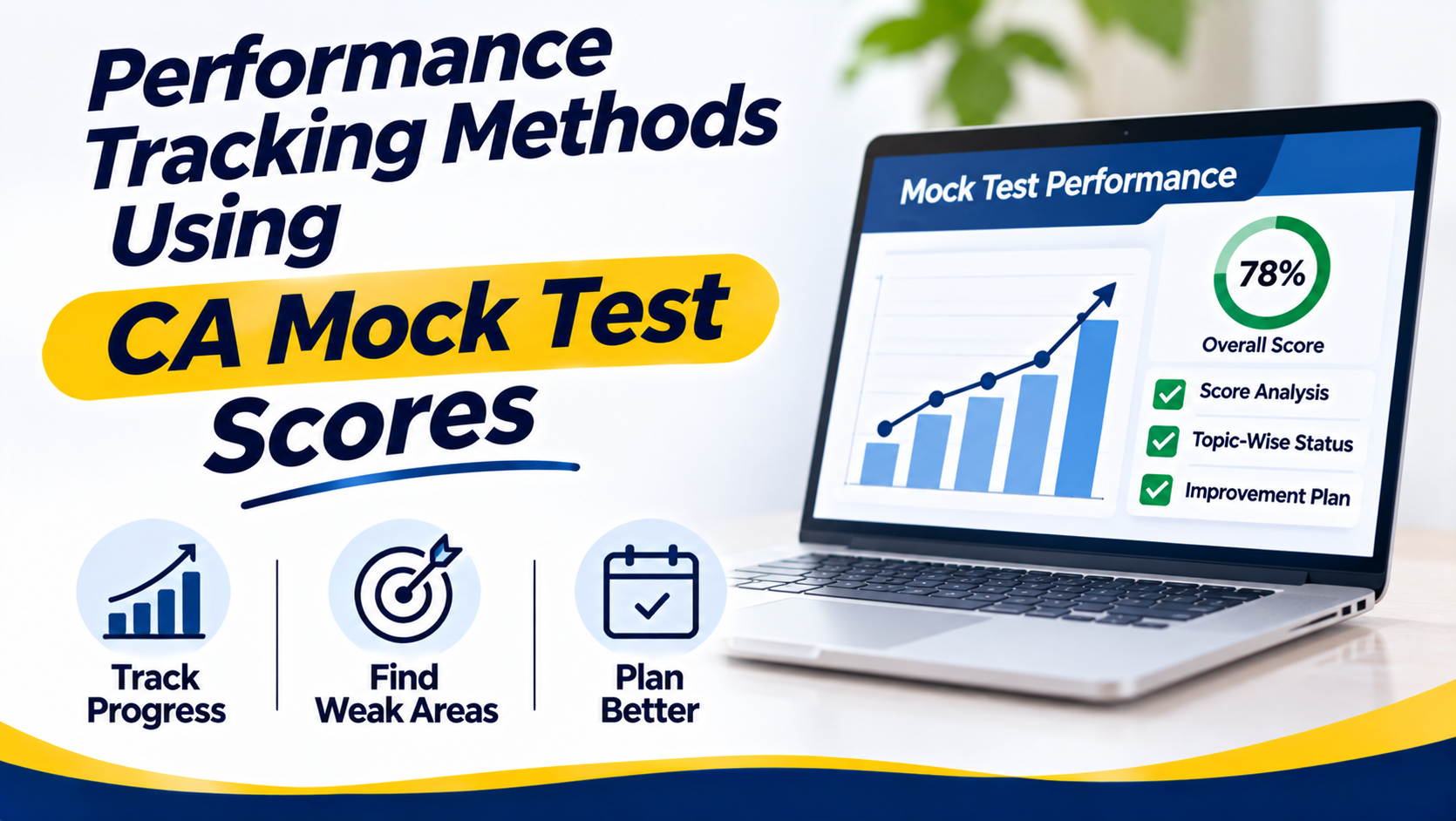
A spreadsheet or notebook can summarise test date, paper, test type, score, accuracy, attempt rate, time observation, strongest topics, weak topics and next action. A line chart of comparable scores may show broad progress, while a topic table can guide revision.
Keep the dashboard easy to update. A complicated system that takes longer to maintain than to review is unlikely to last. Update it soon after each test while the details are fresh.
Common Tracking Mistakes
Do not compare every score without considering paper type and difficulty. Avoid treating one low result as proof that you cannot handle a subject. Do not record numbers without noting what they mean or what action follows. A tracker should lead to a revision decision.
Another mistake is focusing only on the total score. Review accuracy, topic coverage, time and answer quality as well. Look for patterns across multiple attempts and make measured adjustments.
Conclusion
CA mock test scores become more useful when supported by topic-wise analysis, accuracy records, time tracking and an error log. Keep the system simple, compare similar tests and turn findings into specific practice targets. Consistent tracking helps you understand not just how you performed, but what to do differently.
Frequently Asked Questions
Why should CA students track mock test scores?
Tracking shows how performance changes and helps identify recurring weaknesses. It provides evidence for deciding whether to revise concepts, practise more questions, improve pacing or work on answer presentation.
What details should I record after every CA mock test?
Record the date, subject, test type, maximum marks, score, topic-wise marks where available, attempted questions, time observations and key errors. Add one or two next actions so analysis leads to practice.
Is the total mock test score enough to measure progress?
No. The total score does not explain why marks were gained or lost. Topic-wise performance, accuracy, attempt rate, time use and answer quality provide a more useful picture.
How do I calculate accuracy in a mock test?
Where the marking scheme supports it, divide correct responses by attempted responses and multiply by 100. For partial marking, also review marks earned against marks attempted and inspect the working.
How often should I review my CA mock test performance?
Review each test soon after completing it, then look for broader patterns during a weekly or fortnightly planning session. This converts fresh feedback into corrections without overreacting to one result.
What is an error log in CA exam preparation?
An error log is a short record of mistakes, their causes and the action needed to correct them. It may include concept gaps, memory lapses, calculation errors, misreading and presentation issues.
Should I compare scores from different CA mock tests?
Compare tests with similar formats, syllabus coverage and difficulty. Use detailed question analysis when tests differ significantly. Trends across comparable attempts are more meaningful than unrelated scores.
How can I use topic-wise mock test scores?
Use topic-wise marks to identify areas that are secure, need more practice or require conceptual revision. Confirm the pattern across multiple questions and tests before changing study priorities.
What should I do if my mock test score does not improve?
Check the error pattern rather than repeating the same routine. Identify whether the issue is knowledge, application, time or presentation, then set a focused practice target and review its effect in the next test.
Can CA Exams Test Series help with performance tracking?
A CA test series with evaluation and performance reports can organise feedback on scores and answer quality. Combine those insights with a personal tracker and use each report to plan targeted revision.