Table of contentsShowHide
- 1.Start with the Official Exam Plan and Your Available Time
- 2.Use Three Types of Tests in Your Schedule
- 3.Plan Tests During the Learning Stage
- 4.Move to Mixed Practice as Syllabus Coverage Improves
- 5.Schedule Full-Length Mocks with Enough Review Time
- 6.CA Foundation: Build Familiarity Across All Papers
- 7.CA Intermediate: Balance Papers and Groups
- 8.CA Final: Focus on Integration and Exam Execution
- 9.Create a Weekly Mock Test Calendar
- 10.Analyse Every Test and Update the Next Schedule
- 11.Quick Reference Table
- 12.Conclusion
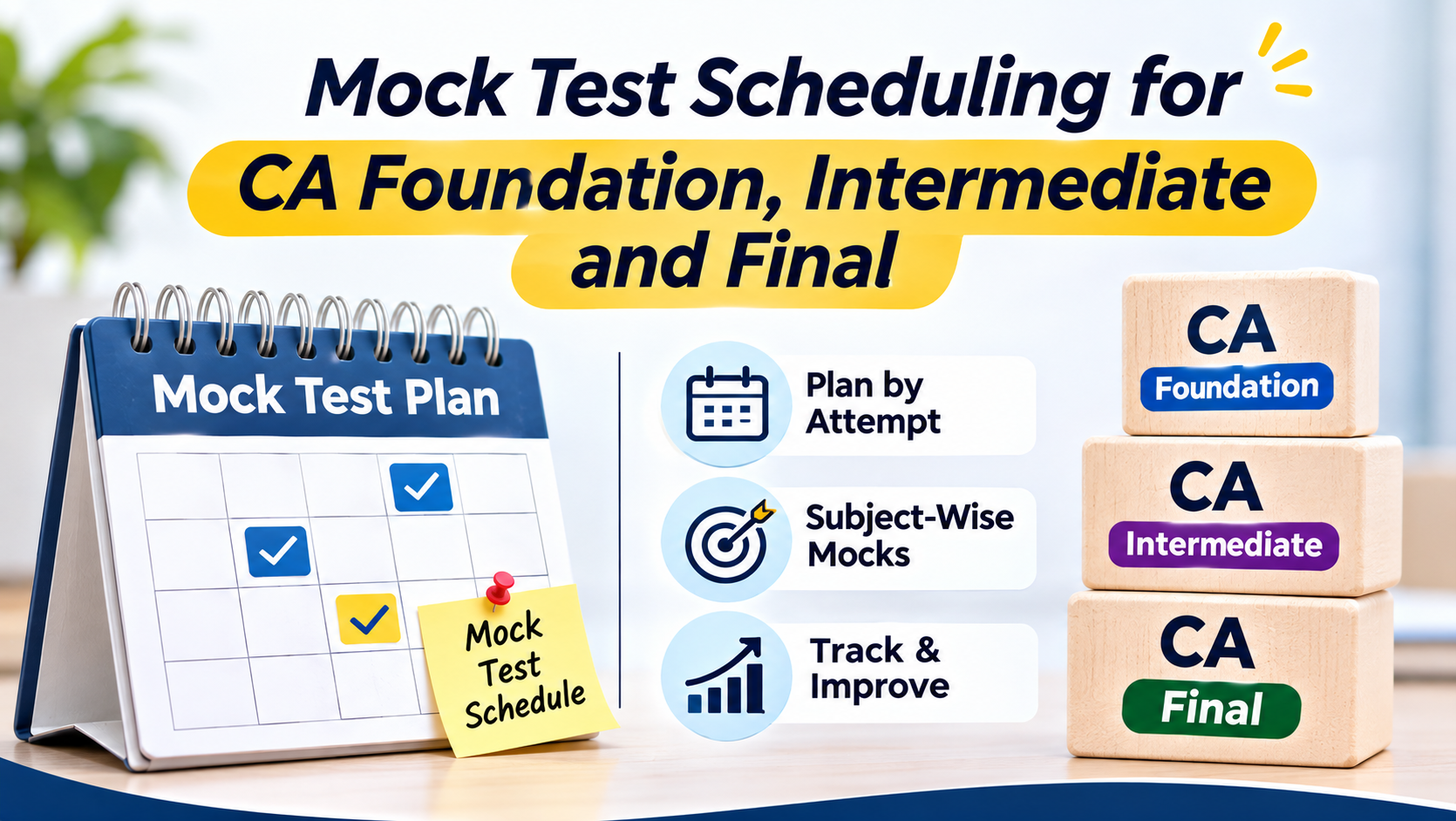
CA Foundation, Intermediate and Final students need a schedule that reflects their course level and preparation stage. The plan should move from topic-wise practice to mixed questions and full-length papers, with enough time after every test to understand lost marks and improve.
Start with the Official Exam Plan and Your Available Time
Confirm the examination attempt, applicable syllabus, paper structure and official timetable through ICAI. Work backwards from the first paper and mark the dates for syllabus completion, revision, full mocks and final review. A sample schedule should never replace official examination information.
Count the realistic study days available after accounting for classes, work, travel and personal commitments. Keep buffer days for topics that take longer than expected or for a test that needs to be rescheduled.
Use Three Types of Tests in Your Schedule
Chapter tests help check understanding soon after learning a topic. Mixed or unit tests check whether you can retrieve concepts without being told which chapter they belong to. Full-length mock tests help practise time management, question selection and answer presentation.
Use each type for a different purpose. Do not treat a chapter test as a replacement for a full paper, or a full mock as the only way to identify basic concept gaps.
Plan Tests During the Learning Stage
Start with short tests after completing meaningful sections of a chapter. The aim is to discover misunderstandings early, while you still have time to revisit the explanation and correct your notes.
Keep the test manageable. A short set of well-selected questions followed by careful review can be more useful than attempting a large paper before you have studied the underlying concepts.
Move to Mixed Practice as Syllabus Coverage Improves
When several chapters are complete, combine questions from those topics. Mixed practice helps you decide which concept applies to a question, rather than relying on chapter headings as clues.
Use the results to identify topics that are forgotten or confused with similar provisions and methods. Add these areas to the next revision block and retest them after a suitable interval.
Schedule Full-Length Mocks with Enough Review Time
Full papers should be placed when you have covered enough syllabus to make the attempt meaningful. Follow the applicable exam duration and conditions as closely as possible. Keep your phone and unrelated material away during the test.
Do not schedule full mocks so close together that you cannot analyse them. The review is where you identify repeated errors, incomplete answers, weak time allocation and topics that require another round of practice.
CA Foundation: Build Familiarity Across All Papers
Foundation students should distribute practice across the papers rather than focusing only on the subject they enjoy most. Use chapter tests during learning, mixed practice after completing units and full-paper mocks as the examination approaches.
Give attention to both conceptual understanding and the ability to complete questions within the available time. Review mistakes carefully, especially where a small misunderstanding affects several questions.
CA Intermediate: Balance Papers and Groups
Intermediate students need a schedule that reflects whether they are preparing one group or both. Allocate tests across every paper in the selected group or groups. Do not allow a difficult subject to take all the practice time while another paper receives no timed work.
Use topic tests to strengthen technical areas, then move to mixed and full-paper attempts. Review the balance each week so that the schedule remains realistic and covers the complete applicable syllabus.
CA Final: Focus on Integration and Exam Execution
Final-level preparation often requires students to connect concepts across chapters and apply them to detailed case-based or practical questions. Include tests that develop both technical accuracy and the ability to organise a complete answer under time pressure.
Full-paper mocks can help refine question selection, time allocation and presentation. After each attempt, distinguish between a knowledge gap and an execution issue; the corrective action will be different.
Create a Weekly Mock Test Calendar
Assign test days in advance and reserve separate review blocks. A weekly plan might include chapter practice early in the week, a mixed test later, and a longer mock when the syllabus and available time allow. Adjust the pattern to your course level and attempt.
Keep at least one flexible slot for revision or backlog. If a test is missed, reschedule it thoughtfully instead of placing several tests together and removing the time needed to learn from them.
Analyse Every Test and Update the Next Schedule
After a test, record marks, questions left unanswered, time spent, concept errors, calculation mistakes and presentation issues. Select a small number of priority improvements rather than trying to fix everything at once.
CA Exams Test Series can be used as part of a planned testing routine across Foundation, Intermediate and Final preparation. Use the feedback to guide revision, practise similar questions and check whether the same errors reduce in later attempts.
Quick Reference Table
| Preparation stage | Test type |
|---|---|
| Learning a chapter | Short chapter test |
| Several chapters completed | Mixed or unit test |
| Syllabus substantially covered | Timed paper sections |
| Revision stage | Full-length mock |
| After every test | Error review and retest |
Conclusion
A useful preparation routine depends on consistency, honest review and practical adjustments. Keep your plan aligned with the applicable ICAI syllabus and official instructions, and use CA Exams Test Series as one part of a wider routine of learning, revision and question practice. The goal is to make every class, study session and test contribute to better understanding and more confident exam performance.
Frequently Asked Questions
When should CA students start attempting mock tests?
Begin chapter-wise tests after learning a meaningful portion of a topic. You do not need to wait until the entire syllabus is complete. Full-length mocks become more useful when you have covered enough material to attempt a paper meaningfully.
How many mock tests should CA Foundation students attempt?
There is no fixed number for every student. Plan a manageable mix of chapter tests, mixed practice and full papers based on syllabus coverage and available time. Leave enough time to review each attempt and correct mistakes.
How should CA Intermediate students schedule mock tests?
Distribute tests across every paper in the group or groups you are preparing for. Combine chapter tests with mixed practice and full-paper mocks. Review the schedule weekly so that no subject is consistently neglected.
How should CA Final students use full-length mock tests?
Use full papers to practise integrated questions, time management, answer selection and presentation. Analyse whether marks were lost because of technical gaps or exam execution, then target the relevant weakness before the next attempt.
Is it better to attempt mock tests before completing the syllabus?
Chapter tests can begin while you are learning. Full-length tests are generally more useful after substantial syllabus coverage, although a diagnostic paper may help identify broad weaknesses. Match the test type to your preparation stage.
How much time should I leave between two mock tests?
Leave enough time to review the first paper, revise weak topics and practise corrections before attempting another. The interval depends on paper length, your preparation stage and the number of subjects you are managing.
Should I analyse a mock test even if I score well?
Yes. A good score may still hide slow question selection, incomplete workings or repeated small errors. Review correct answers as well as mistakes to identify which methods are reliable and which need improvement.
What should I record after every CA mock test?
Record marks, time taken, unanswered questions, topic-wise errors, calculation or presentation issues and the next corrective action. Tracking these details over several tests gives a clearer picture than comparing marks alone.
Should I attempt mock tests under exam conditions?
Full-length mocks should follow the applicable exam duration and a quiet, uninterrupted setting as closely as possible. This helps you practise concentration, time allocation and answer completion. Use shorter chapter tests more flexibly during learning.
Can CA Exams Test Series help with mock test scheduling?
A structured test series can provide planned practice and feedback across subjects. Use its tests alongside your own revision calendar, and confirm that the papers match the applicable syllabus and examination requirements for your attempt.