Table of contentsShowHide
- 1.What Is a Full-Length Mock Test?
- 2.Understand the Actual Exam Experience
- 3.Improve Time Allocation
- 4.Develop Better Question Selection
- 5.Build Writing Stamina and Focus
- 6.Identify Gaps Across the Syllabus
- 7.Improve Answer Presentation
- 8.Use Mock Tests at the Right Stage
- 9.Review Results Beyond the Score
- 10.Mistakes to Avoid During Mock Tests
- 11.Conclusion
Knowing the syllabus is essential, but it does not automatically mean that a student is ready to attempt the actual paper. An examination also tests time management, question selection, writing stamina and the ability to apply knowledge across a complete paper.
A full-length mock test is most useful when attempted under realistic conditions and followed by careful review. The score matters, but the habits and insights developed through the process are often more valuable.
What Is a Full-Length Mock Test?
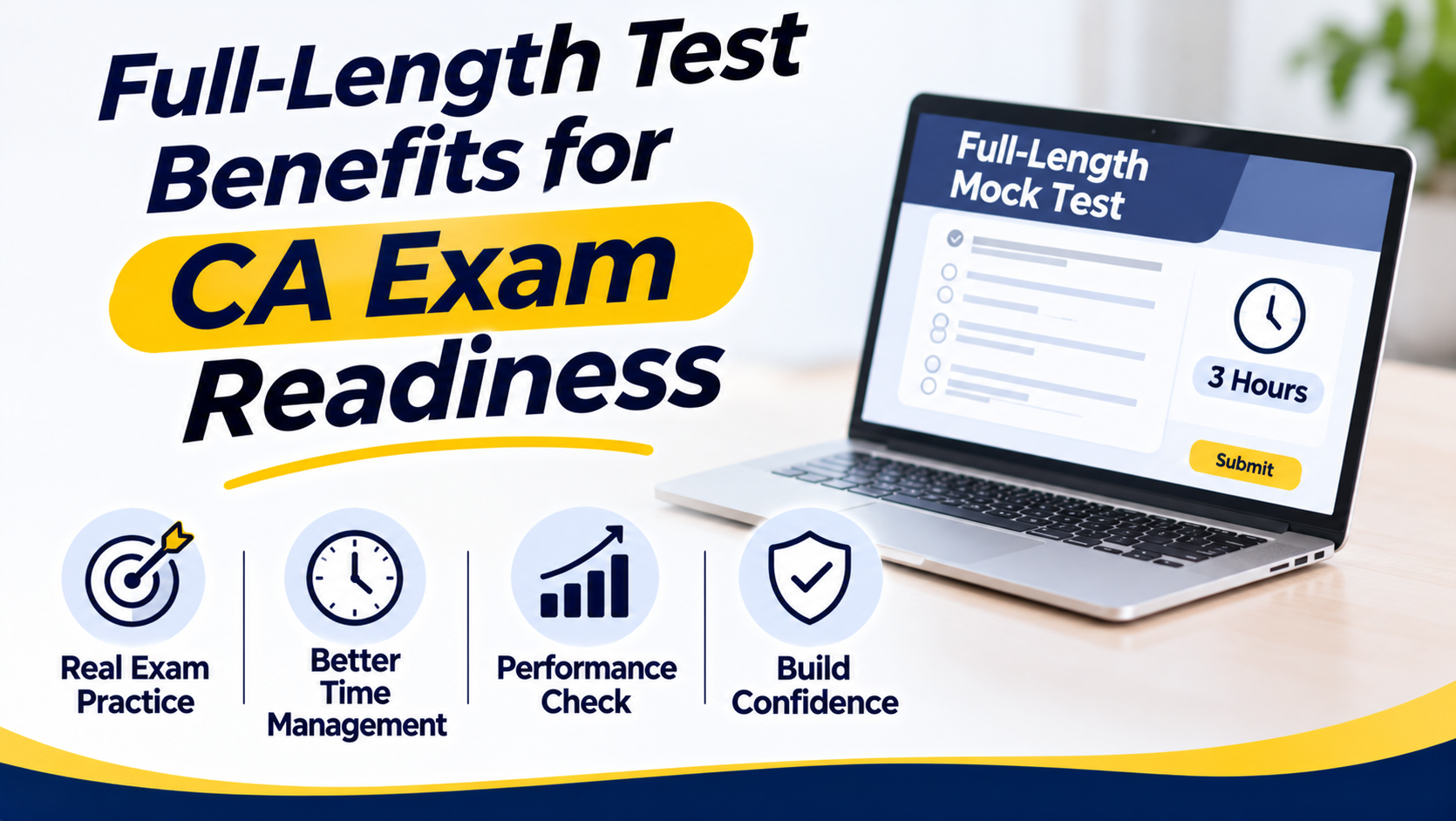
A full-length mock test is a practice examination designed around the duration, structure and broad requirements of the relevant CA paper. Unlike a chapter test, it requires you to retrieve and apply knowledge across the subject in one sitting. It also reveals whether your pacing and concentration can be sustained for the complete examination.
Use a paper aligned with the current pattern and instructions. A mock that differs significantly from the actual format may still offer practice, but it is less useful for judging exam readiness.
Understand the Actual Exam Experience
Students often study in flexible conditions, pausing to check notes or taking breaks whenever they wish. The examination does not offer the same flexibility. A full-length test creates a realistic practice environment by requiring independent decisions and continuous concentration.
Follow the time limit, use permitted stationery and keep study material away. Avoid pausing the clock for convenience. This makes the result a more dependable reflection of current preparation.
Improve Time Allocation
Time management is not simply writing faster. It involves deciding how much time a question deserves according to its marks, complexity and your familiarity with the topic. Before starting, make a broad plan and reserve a few minutes for checking. Do not allow one difficult question to consume time needed for several questions you can answer well.
After the test, compare planned time with actual time. If a question took too long, identify whether the cause was weak knowledge, excessive working, poor selection or an inefficient answer structure. Test a revised pacing strategy in the next mock.
Develop Better Question Selection
A paper may contain questions of different difficulty and familiarity. Where the instructions allow options, students need to read requirements carefully and choose questions they can answer accurately. Do not select a question only because its topic looks familiar; check every part of the requirement first.
For practical questions, identify the data and required output. For theory questions, consider whether you can explain the relevant points with enough clarity. If you become stuck, move forward where permitted and return later if time remains.
Build Writing Stamina and Focus
A complete paper requires sustained effort. Students who solve individual questions well may still struggle to maintain accuracy for the entire duration. Regular full-length practice gradually builds the ability to concentrate, write clearly and manage fatigue.
Review the quality of answers towards the end of the test. If calculations become careless or explanations lose structure, examine whether fatigue, poor pacing or inadequate preparation is responsible. Build up to full-length sessions and leave time for recovery and review.
Identify Gaps Across the Syllabus
A full-length test can reveal gaps that chapter-wise practice may not show. When topics appear together, you must identify the relevant concept without a chapter heading. This tests recall and application in a more integrated way.
Analyse incorrect, incomplete and unattempted questions. Separate knowledge gaps from execution problems. A question left blank because the concept was unknown needs a different response from one left blank because too much time was spent elsewhere.
Improve Answer Presentation
A well-organised answer allows the evaluator to follow the method. Full-length practice helps maintain readable handwriting, clear workings, appropriate headings and logical sequencing throughout the paper. In practical subjects, show essential steps; in theory papers, address the requirement directly and use headings where they improve clarity.
Check whether you labelled workings, used relevant formats and kept answers proportionate to marks. Avoid unnecessary introductions and repeated explanations.
Use Mock Tests at the Right Stage
Do not wait until the final few days to attempt your first full-length paper. Begin with chapter tests while learning, then introduce cumulative tests as more of the syllabus is covered. Full-length tests become more useful once you can attempt a meaningful portion of the paper.
The number of mocks should depend on available time and the quality of review you can complete. Many attempts without analysis can create activity without improvement. Leave time between tests to revise weak areas and apply feedback.
Review Results Beyond the Score
The score is one measure, but it does not explain why the result occurred. Review marks by question, time spent, accuracy, completeness and presentation. Identify questions where you knew the concept but lost marks through missing steps or unclear explanations.
Maintain an error log with a correction and follow-up action. If you forgot a provision, schedule recall practice. If you misread a requirement, practise identifying action words. If time ran out, revise pacing and test the new approach.
Mistakes to Avoid During Mock Tests
Do not pause a mock to check a formula or search for a solution. That changes the conditions and hides gaps. Avoid using a time limit or paper pattern that differs from the current examination. Do not focus only on the final score while ignoring answer-level feedback.
Also avoid attempting full-length tests too close together. Without time to review and correct errors, the same weaknesses may appear repeatedly. Treat each test as a cycle: attempt, evaluate, revise and reattempt selected questions.
Conclusion
Full-length mock tests translate subject knowledge into examination performance. They develop time awareness, question selection, writing stamina and the ability to work across the syllabus. Attempt papers under realistic conditions, review every answer and turn the findings into a practical revision plan.
Frequently Asked Questions
When should CA students start attempting full-length mock tests?
Start with chapter tests while learning and introduce cumulative tests as syllabus coverage increases. Attempt full-length papers once you can meaningfully address a substantial part of the subject, leaving enough time to review mistakes.
How many full-length mock tests should I attempt?
The right number depends on your preparation stage and available time. Prioritise tests attempted under realistic conditions and reviewed properly. A smaller number of well-analysed papers can be more useful than repeated attempts without correction.
Do full-length mock tests improve time management?
Yes. They show how long different questions take and whether your planned allocation is realistic. Reviewing actual time spent helps you adjust pacing, avoid getting stuck and reserve time for checking.
Should I attempt a mock test before completing the syllabus?
You can attempt one before finishing every chapter to understand the paper format and identify gaps. Interpret the score in light of incomplete coverage and use the result to guide further study.
Are full-length tests better than chapter-wise tests?
They serve different purposes. Chapter tests check understanding of specific topics, while full-length tests assess application, stamina and time management across a paper. A balanced plan should include both.
How should I simulate the CA examination at home?
Choose a paper aligned with the current pattern, follow the prescribed duration and instructions, use permitted stationery and keep study material away. Attempt it in one sitting without avoidable interruptions.
What should I analyse after a full-length CA mock test?
Review marks by question, time spent, accuracy, incomplete answers, unattempted questions and presentation. Classify mistakes by cause and write a specific action for each recurring weakness.
What if my mock test score is low?
A low score is feedback, not a final prediction. Check whether the cause was incomplete coverage, weak concepts, poor pacing or answer presentation. Address the main causes and measure progress in later tests.
Should I check solutions while attempting a mock test?
No. Checking solutions during the timed attempt removes the assessment value. Complete the paper independently first, then compare your answers with the suggested solution or evaluation feedback.
Can a CA test series help improve exam readiness?
A structured CA test series can provide timed papers, evaluation and performance insights. Use these alongside ICAI study resources and personal revision, and follow every test with a review and correction plan.