Table of contentsShowHide
- 1.Why Evaluation Criteria Matter
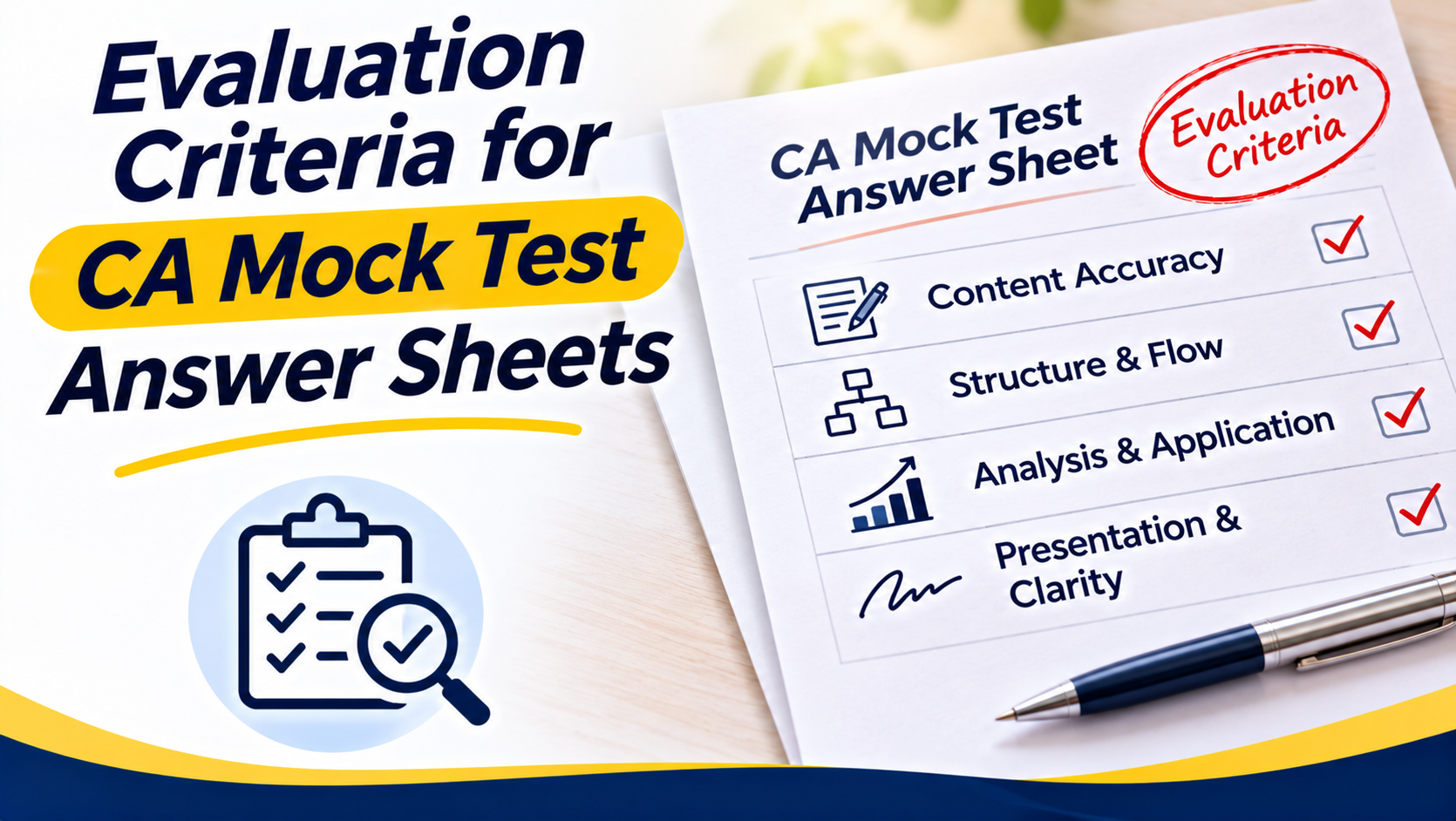
- 2.Accuracy and Conceptual Understanding
- 3.Relevance to the Question
- 4.Step-Wise Working and Reasoning
- 5.Use of Provisions, Standards and Formats
- 6.Completeness and Coverage
- 7.Presentation and Readability
- 8.Time Management and Attempt Strategy
- 9.How to Read Evaluation Feedback
- 10.Use Evaluation to Improve
- 11.Conclusion
Attempting a CA mock test is only one part of effective exam practice. The real learning often begins when the answer sheet is evaluated and the student understands where marks were gained or lost. Useful evaluation considers the method, reasoning, completeness and presentation, not just the final answer.
Knowing the broad criteria helps students write answers that address the question, show relevant working and make reasoning easy to follow. These habits improve practice and make feedback easier to apply.
Why Evaluation Criteria Matter
A score tells you how an answer performed, but evaluation criteria explain the quality behind it. Two answers may reach the same figure, yet one may contain clear working while the other relies on unsupported calculations. A theory answer may contain correct facts but still miss the requirement.
Understanding broad evaluation criteria helps you practise with purpose. It also distinguishes a knowledge problem from an answer-writing problem, which require different improvement strategies.
Accuracy and Conceptual Understanding
Accuracy is central to practical and theory answers. In a practical question, it includes selecting the correct treatment, applying the appropriate formula and checking calculations. In a theory question, it means explaining the relevant concept correctly and avoiding statements that conflict with the applicable syllabus material.
A correct final answer matters, but the underlying method matters too. If the result is incorrect, clear working helps identify where the mistake occurred. Show the necessary steps instead of jumping directly to a conclusion.
Relevance to the Question
An answer should respond to the requirement actually asked. Students sometimes write everything they remember about a topic even when only one issue is relevant. This uses time and can make the answer harder to assess. Identify action words such as state, explain, calculate, discuss or advise.
For case-based questions, connect the facts to the applicable concept. A generic explanation without application may not fully answer the requirement. Relevance demonstrates that you have understood both the subject and the task.
Step-Wise Working and Reasoning
In practical papers, show important calculation stages. Label working notes, state assumptions where needed and make the link between data and result clear. Write the formula before substituting figures when that helps explain the method.
In theory papers, organise reasoning so the evaluator can follow the point. A useful structure may include the issue, applicable principle, application and conclusion. Adapt the structure to the question rather than using a mechanical template.
Use of Provisions, Standards and Formats
Where a question requires a legal provision, accounting standard, auditing standard or prescribed format, use the relevant reference accurately and in line with the syllabus for your attempt. Do not add section numbers or technical references unless you are confident they are correct.
Use appropriate formats and labels in practical answers. In theory answers, explain the rule clearly and apply it to the facts. The purpose is to demonstrate understanding, not simply to fill the page with technical terms.
Completeness and Coverage
Check whether every part of the requirement has been answered. A question may ask for a calculation and explanation, or contain several independent sub-parts. Missing one component can reduce completeness even when the other part is correct.
Use marks and wording as a guide to the depth required. A short requirement does not need a lengthy essay, while a multi-part question needs a response covering each requested element.
Presentation and Readability
A readable answer sheet helps the evaluator locate the response and follow the method. Use clear question numbers, suitable headings, separate working notes and enough spacing between answers. Underline key terms selectively, but avoid excessive decoration.
For calculations, align figures and identify totals. For descriptive answers, use paragraphs or numbered points where they improve clarity. Presentation cannot replace correct knowledge, but poor presentation can make correct work difficult to follow.
Time Management and Attempt Strategy
Evaluation can reveal whether time was used effectively. An incomplete answer, an unattempted section or excessive detail in a low-mark question may indicate a pacing issue. Compare the time spent with the marks and complexity of each requirement.
During practice, learn to move forward when a question takes too long, where instructions permit. Return to unfinished parts if time remains. Aim for a balanced paper rather than spending the entire examination perfecting one answer.
How to Read Evaluation Feedback
Read feedback question by question. Note marks awarded, missing elements and comments about method or presentation. Convert general remarks into specific actions: add a conclusion, label working, state the relevant principle or answer each sub-part separately.
Compare your answer with the suggested solution, but remember that it is one valid presentation, not necessarily the only acceptable wording. Focus on technical correctness, relevance and sufficient coverage.
Use Evaluation to Improve
Maintain an error log with the question reference, error type, reason and corrective action. If you omit working notes repeatedly, make them a checklist item. If you confuse similar provisions, prepare a comparison sheet and practise recalling the differences. If answers are too long, practise writing to the marks and requirement.
End the evaluation cycle by reattempting selected questions. Rewriting an answer after reading feedback checks whether you can apply the correction. Without this step, comments may be understood but not translated into better performance.
Conclusion
Effective CA mock test evaluation considers accuracy, relevance, reasoning, completeness and readability. Use the criteria to understand answer quality rather than simply chase a higher score. Review feedback, record recurring errors and reattempt selected questions to turn each mock test into a practical learning step.
Frequently Asked Questions
What are the main criteria for evaluating a CA mock test answer sheet?
Common criteria include technical accuracy, relevance to the requirement, correct working, completeness, appropriate use of concepts and readable presentation. The exact marking approach depends on the paper, question and applicable evaluation scheme.
Is the final answer more important than working notes in CA practical papers?
The final answer matters, but clear working notes show how you reached it and may demonstrate the method. Present essential steps, label calculations and avoid unsupported figures without an explanation.
Do CA mock test evaluators award step-wise marks?
Marking may recognise correct steps or components depending on the question and evaluation scheme. Do not assume a fixed rule for every paper, but show a logical method that can be followed.
How important is answer relevance in CA examinations?
Relevance is essential because an answer must address the specific requirement. Unrelated information wastes time and can obscure the correct point. Identify action words and connect your response to the facts or task.
Should I mention section numbers and accounting standards in every answer?
Mention technical references when relevant and when you can state them accurately. Avoid adding uncertain section numbers or standards merely to make an answer look technical. Explain the principle clearly and apply it.
Can good presentation compensate for an incorrect answer?
Presentation cannot replace technical correctness. Clear structure, labelled workings and readable answers help evaluators follow the method and identify correct components. Aim for both accuracy and clarity.
How should I analyse marks lost in a mock test?
Compare each answer with the requirement and evaluation feedback. Classify lost marks as concept errors, incomplete coverage, calculation mistakes, irrelevant content or presentation issues, then assign a corrective action.
What is the best way to improve CA answer writing?
Practise within a time limit, address the requirement directly, show essential working and review feedback. Reattempt questions where marks were lost to check whether the correction has become part of your method.
Should I compare my mock test answer with the suggested solution word for word?
No. Compare concepts, logic, calculations and coverage rather than copying exact wording. Different expressions may communicate the same correct point if the answer remains accurate and relevant.
How can CA Exams Test Series evaluation help students?
A structured evaluation process can show where answers need stronger concepts, clearer working or better presentation. Use feedback with an error log and reattempt plan so every test leads to measurable improvement.