Table of contentsShowHide
- 1.There is no single ideal number of mock tests
- 2.During the learning stage
- 3.During syllabus completion
- 4.During the first revision
- 5.In the final preparation phase
- 6.Use performance to decide the next test
- 7.Do not confuse test count with preparation quality
- 8.Balance tests with revision and rest
- 9.Use a frequency guide, not a rigid rule
- 10.How CA Exams Test Series fits into a practice routine
- 11.Quick Reference Table
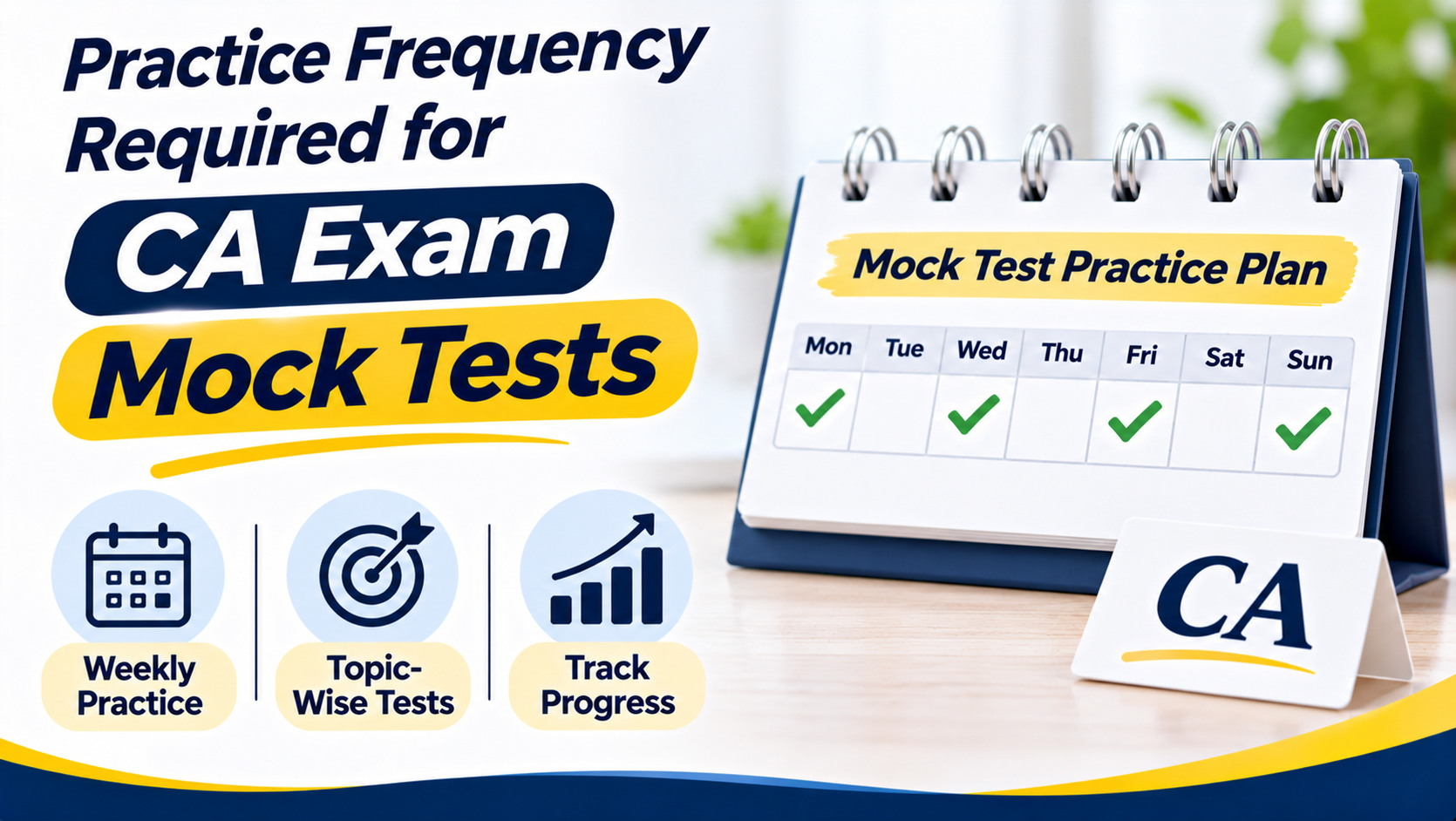
One common question during CA preparation is how often a student should attempt mock tests. Taking too few tests may leave exam timing and answer presentation untested. Taking too many without reviewing them can reduce time for learning and revision.
The right frequency depends on syllabus coverage, time left before the examination and performance in earlier tests. A useful schedule balances concept study, question practice, full-length papers and correction of mistakes.
There is no single ideal number of mock tests
A student who has just started a subject needs a different schedule from someone revising the complete syllabus. Use short tests while learning chapters, mixed-topic tests after covering a reasonable portion and full-length papers when you can attempt a broad range of topics.
During the learning stage
After completing a chapter or connected topic group, attempt a short timed test. This checks whether you can apply the concept without relying on notes. A weekly test or one after a few study sessions may work, depending on topic size. Review it before moving on.
During syllabus completion
As more chapters become familiar, combine topics in one test. Mixed practice matters because the actual paper does not follow your study order. A weekly or fortnightly mixed test can reveal whether older chapters are being forgotten while you focus on new material.
During the first revision
Increase timed sectional and group-wise papers. These tests help connect concepts across chapters and improve question selection. Keep enough time after each test to check solutions, understand mistakes and revise weak areas. A test without review is only a score from one day.
In the final preparation phase
When the syllabus is substantially covered, schedule full-length mock papers at regular intervals. One or two full papers per subject in a week may be manageable for some students, but this is not a fixed rule. Adjust for available days, subject demands and review time.
Use performance to decide the next test
If your score is low because of conceptual gaps, revise before another full paper. If you know the material but leave questions incomplete, practise timed sections. If calculation errors are frequent, add focused numerical drills. The next test should address the reason behind the previous result.
Do not confuse test count with preparation quality
Completing many papers without checking errors may be less useful than completing fewer papers with careful analysis. Record the question, the reason for losing marks and the correction. Reattempt selected questions after a gap to check whether the learning has lasted.
Balance tests with revision and rest
Mock tests should not replace revision, study material or adequate breaks. Keep a realistic weekly plan with time for concepts, practice, review and rest. If accuracy falls because you are tired, adding more tests is unlikely to solve the problem.
Use a frequency guide, not a rigid rule
During chapter learning, test after a chapter or topic block. During syllabus completion, use a mixed test weekly or fortnightly. During revision, schedule sectional tests. In the final phase, add full papers only when you can analyse them properly.
How CA Exams Test Series fits into a practice routine
CA Exams Test Series can help organise chapter-wise, sectional and full-length practice around your preparation stage. Choose papers that match the relevant syllabus and pattern, then use evaluation to decide what to revise before the next attempt.
Quick Reference Table
| Preparation stage | Suggested frequency | Main purpose |
|---|---|---|
| Chapter learning | Short test after a chapter or topic block | Check understanding and application |
| Syllabus completion | One mixed-topic test weekly or fortnightly | Retain earlier topics |
| First revision | Regular sectional or group-wise tests | Improve recall and selection |
| Final phase | One or two full papers per subject weekly, if manageable | Build exam stamina |
| Last few days | Selective practice and error-based revision | Consolidate without overloading |
Frequently Asked Questions
How many mock tests should a CA student attempt?
There is no fixed number for every student. Choose a frequency that matches syllabus coverage and leaves enough time to analyse each paper and revise the weaknesses it reveals.
Should I attempt a full-length mock test before completing the syllabus?
Short or sectional tests are useful while learning. Full-length papers become more meaningful when you have covered enough of the syllabus to make the attempt representative.
Why is analysing a mock test important?
Analysis explains why marks were lost. It can reveal conceptual gaps, calculation errors, incomplete answers and time-management problems that a score alone does not identify.
How should I handle repeated mistakes?
Record each repeated error, revisit the underlying concept or method and practise fresh questions of the same type. Recheck the skill after a gap to confirm that the correction has lasted.
Are previous question papers enough for CA preparation?
Previous papers help you understand question styles and practise application, but combine them with the current syllabus, study material, revision and suitable mock tests.
How can I improve answer-writing skills?
Practise within a time limit, address every part of the requirement, show relevant workings and organise theory answers with clear explanations and conclusions where needed.
Should I compare my mock-test score with other students?
Use comparison carefully. Your most useful measure is progress across comparable tests, including accuracy, completion and reduction of repeated errors.
What should I do if my mock-test marks do not improve?
Check whether your practice addresses the actual cause of lost marks. Change the method if necessary, clarify difficult concepts and retest with a fresh paper.
How should I use evaluator comments?
Look for repeated comments about relevance, structure, missing steps or incomplete explanations. Choose one or two points and apply them deliberately in your next answer.
How can CA Exams Test Series help with mock-test preparation?
CA Exams Test Series can provide a structured way to practise papers and review performance. Combine available feedback with your own error log and a realistic revision plan.