Table of contentsShowHide
- 1.Why an attempt strategy matters
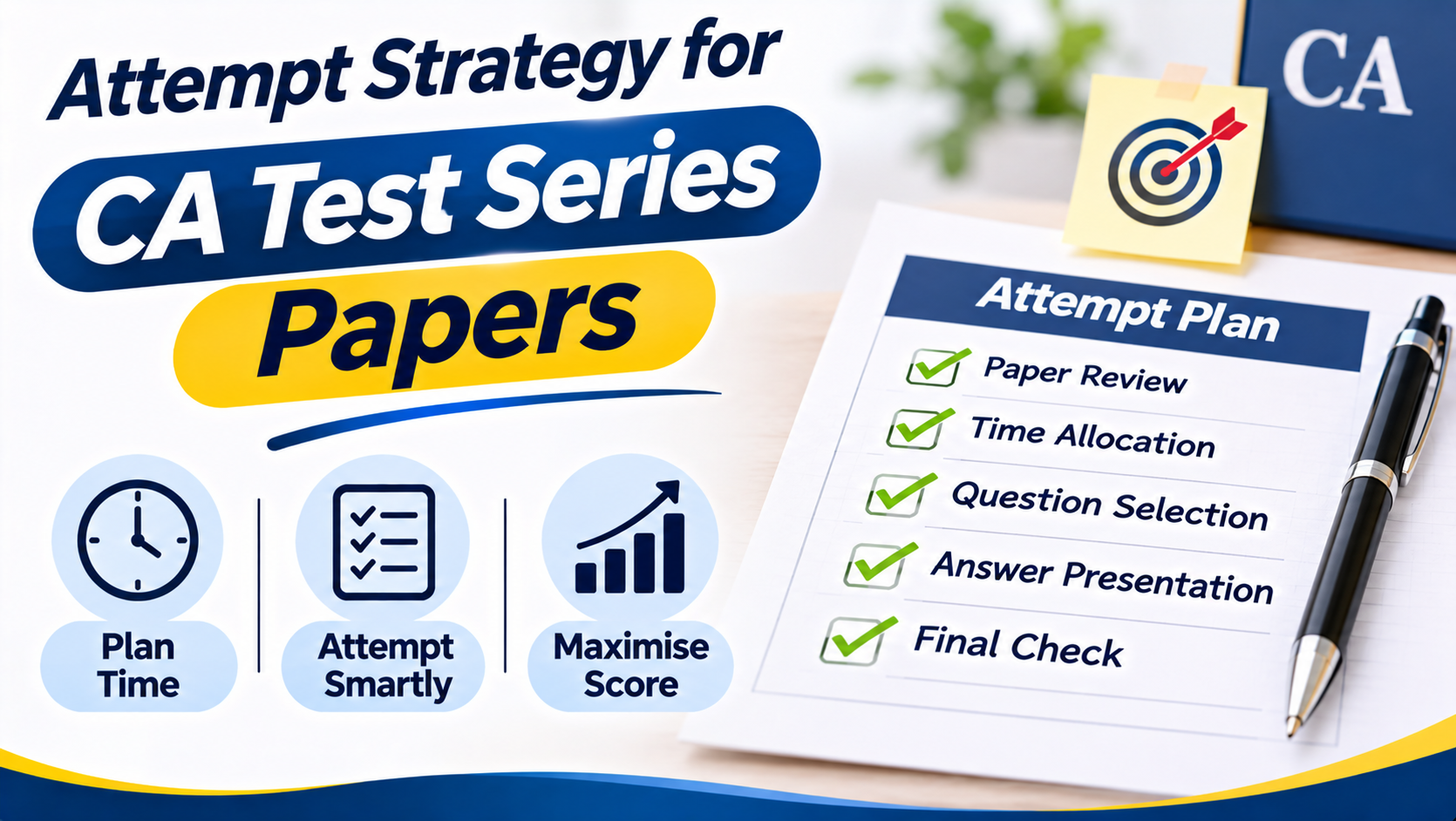
- 2.Read the paper before writing
- 3.Choose a question order that suits you
- 4.Allocate time according to marks
- 5.Handle practical and theory questions differently
- 6.Make answer presentation easy to evaluate
- 7.Keep a buffer for review
- 8.Use CA mock tests to refine the strategy
- 9.A practical attempt sequence
- 10.How CA Exams Test Series can support improvement
- 11.Quick Reference Table
A mock test becomes useful when you treat it like the actual CA examination. Knowing the syllabus is important, but your ability to read questions carefully, select the right order, manage time and present answers clearly also affects your score.
A planned attempt strategy helps you avoid spending too long on one question or leaving easy marks untouched. The aim is not to rush; it is to make sensible decisions from the first reading to the final review.
Why an attempt strategy matters
A paper may contain familiar topics, lengthy practical questions and short theory requirements together. Without a plan, students often begin with the first question and continue even when it takes too long. This can leave limited time for questions they could have answered confidently. A strategy gives every part of the paper a fair chance.
Read the paper before writing
Use the reading time, where provided, to understand requirements and identify questions you can attempt confidently. Notice verbs such as calculate, explain, discuss, advise, distinguish or comment. These words indicate the expected answer. Check marks and internal choices before deciding your sequence.
Choose a question order that suits you
Subject to examination instructions, you do not always have to attempt questions in printed order. Start with a question you understand well and can complete accurately. Avoid choosing a lengthy question only because its topic looks familiar; assess its adjustments, sub-parts and explanations first.
Allocate time according to marks
Set a working time limit for each question based on its marks and the total examination duration. Include a small buffer for reading, calculations and checking. If a question crosses its planned limit, move forward after completing the essential requirements. Do not let one answer consume time needed for several others.
Handle practical and theory questions differently
For practical questions, write relevant working notes, show key steps and label the final answer. For theory questions, use short paragraphs, clear headings and relevant provisions or concepts. Keep the answer focused on the requirement rather than reproducing everything you remember about the chapter.
Make answer presentation easy to evaluate
Use a logical sequence: identify the issue, state the principle, apply it to the facts and give a conclusion where required. In numerical answers, show workings in order and mention units where relevant. Number sub-parts correctly and leave readable spacing. Presentation cannot replace correct knowledge, but it can make your reasoning easier to follow.
Keep a buffer for review
Reserve the final few minutes to check question numbers, totals, signs, units, omitted sub-parts and whether each answer addresses the actual requirement. In theory answers, check that the conclusion follows from the explanation. Avoid hurried changes unless you have identified a definite error.
Use CA mock tests to refine the strategy
Attempt each mock under realistic time conditions. After evaluation, compare planned time with the time actually spent. Note where minutes were lost: repeated reading, unclear workings, overlong introductions or difficulty selecting questions. Test one or two specific improvements in the next paper.
A practical attempt sequence
Scan the paper and mark familiar, moderate and demanding questions. Begin with a strong question, follow the time plan and move on when a question exceeds its limit. Complete selected requirements, then use the buffer to review. Adapt the sequence to the paper pattern and official instructions.
How CA Exams Test Series can support improvement
A structured routine through CA Exams Test Series can help you practise timed papers, review answer quality and identify recurring time-management issues. Use feedback as evidence: select a clear action for the next attempt, practise it and check whether it improves completion and accuracy.
Quick Reference Table
| Stage | What to do | What to avoid |
|---|---|---|
| Initial scan | Identify requirements, choices and familiar questions | Starting without checking the whole paper |
| Question selection | Choose a confident, manageable question first | Selecting only by topic familiarity |
| Time control | Set limits based on marks and keep a buffer | Spending too long on one answer |
| Answer writing | Show steps, structure theory and answer the verb | Writing everything remembered |
| Final review | Check totals, sub-parts, signs and omissions | Changing answers without a clear reason |
Frequently Asked Questions
How many mock tests should a CA student attempt?
There is no fixed number for every student. Choose a frequency that matches syllabus coverage and leaves enough time to analyse each paper and revise the weaknesses it reveals.
Should I attempt a full-length mock test before completing the syllabus?
Short or sectional tests are useful while learning. Full-length papers become more meaningful when you have covered enough of the syllabus to make the attempt representative.
Why is analysing a mock test important?
Analysis explains why marks were lost. It can reveal conceptual gaps, calculation errors, incomplete answers and time-management problems that a score alone does not identify.
How should I handle repeated mistakes?
Record each repeated error, revisit the underlying concept or method and practise fresh questions of the same type. Recheck the skill after a gap to confirm that the correction has lasted.
Are previous question papers enough for CA preparation?
Previous papers help you understand question styles and practise application, but combine them with the current syllabus, study material, revision and suitable mock tests.
How can I improve answer-writing skills?
Practise within a time limit, address every part of the requirement, show relevant workings and organise theory answers with clear explanations and conclusions where needed.
Should I compare my mock-test score with other students?
Use comparison carefully. Your most useful measure is progress across comparable tests, including accuracy, completion and reduction of repeated errors.
What should I do if my mock-test marks do not improve?
Check whether your practice addresses the actual cause of lost marks. Change the method if necessary, clarify difficult concepts and retest with a fresh paper.
How should I use evaluator comments?
Look for repeated comments about relevance, structure, missing steps or incomplete explanations. Choose one or two points and apply them deliberately in your next answer.
How can CA Exams Test Series help with mock-test preparation?
CA Exams Test Series can provide a structured way to practise papers and review performance. Combine available feedback with your own error log and a realistic revision plan.