Table of contentsShowHide
- 1.Why simulation matters
- 2.Recreate a focused examination environment
- 3.Choose a realistic paper and schedule
- 4.Plan time according to marks
- 5.Practise question selection
- 6.Maintain answer presentation under pressure
- 7.Analyse more than the score
- 8.Build a repeatable mock-test routine
- 9.Using CA Exams Test Series effectively
- 10.Quick Reference Table
- 11.Conclusion
Preparing for a CA examination involves more than completing the syllabus and remembering concepts. Students also need to become comfortable with the pressure, timing and discipline of the actual examination hall. A topic may feel familiar during revision, yet applying it within a fixed time can be a different experience.
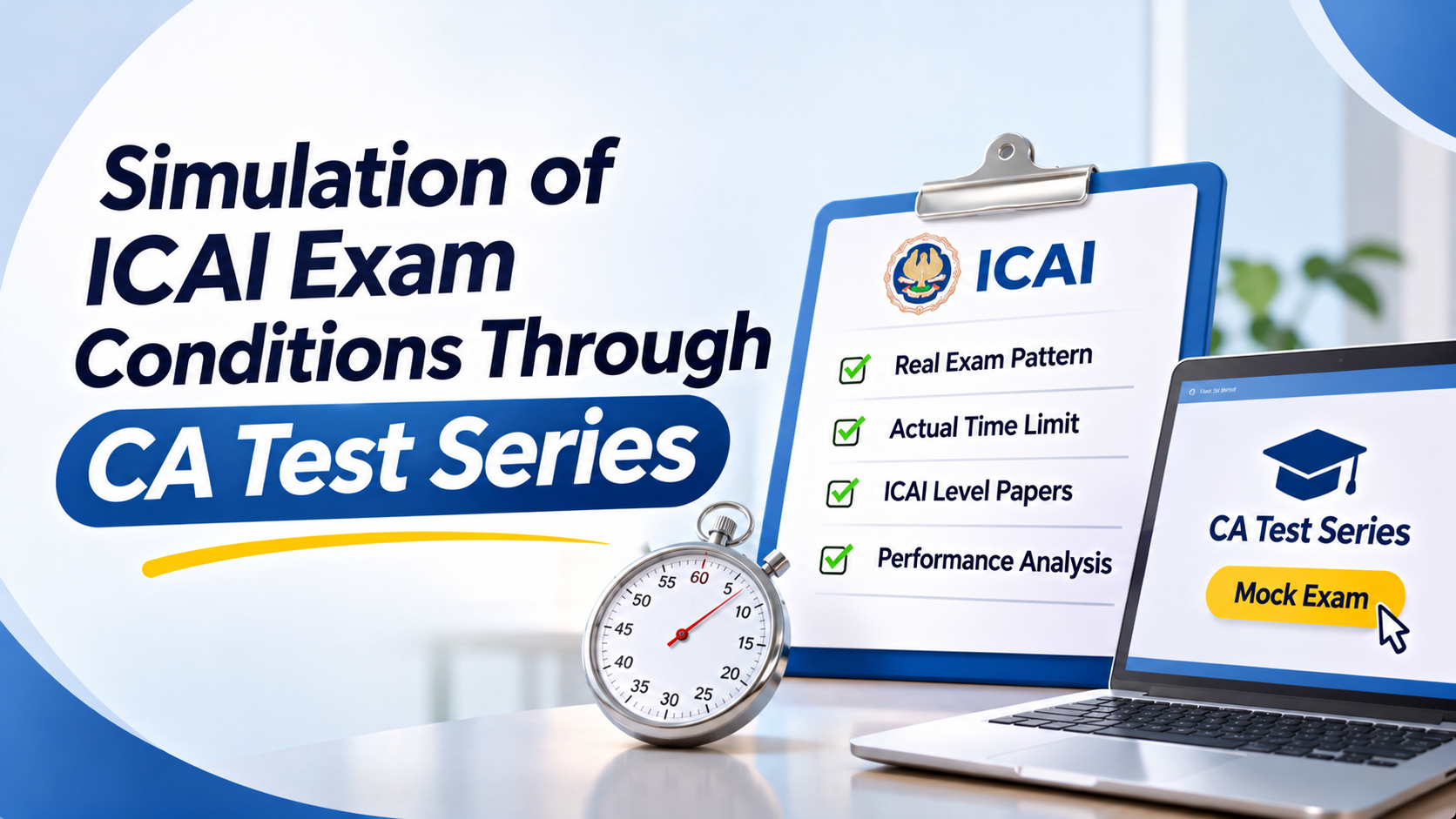
A well-planned CA test series gives students an opportunity to practise in conditions similar to the ICAI examination. It helps them understand how to read a paper, select questions, manage time and present answers without depending on last-minute guesswork.
Why simulation matters
Studying at home is often flexible. Students pause lectures, check notes or spend extra time on a difficult question. The actual examination has a fixed duration and requires independent decision-making. Practising in similar conditions helps reduce the gap between preparation and performance.
A simulated paper also reveals habits that ordinary revision may hide. You may discover that the first question takes too long, calculations become untidy under pressure or the final answers are rushed. Identifying these patterns during practice gives you time to improve.
Recreate a focused examination environment
Choose a quiet place, keep permitted stationery ready and sit for the complete duration. Keep your phone away, avoid checking notes and follow the paper instructions. Use the permitted calculator and do not pause the timer for unrelated tasks.
The room does not need to look exactly like an examination centre. What matters is practising continuous, independent work. Follow the same routine each time so that discipline becomes familiar.
Choose a realistic paper and schedule
Use a paper that reflects the applicable syllabus, subject coverage and question style. Chapter tests are useful for checking one area, but a full-length paper is needed to practise the complete examination experience. Schedule it when you can remain undisturbed.
A useful paper contains a mix of direct, application-based and challenging questions. Do not practise only familiar questions; the purpose is to learn how to respond when the paper is less predictable.
Plan time according to marks
Before writing, review the marks and requirements of the questions. Decide how much time each deserves and keep a small buffer for reading instructions and checking important workings. Avoid spending a disproportionate amount of time on one difficult part.
Record when you complete each question. If a question repeatedly takes too long, practise a more focused answer or a clearer calculation method. Your time plan should be based on actual practice rather than an ideal timetable.
Practise question selection
Some students lose time by starting with a difficult question and refusing to move on. Use mock tests to practise a sensible sequence, while following the examination instructions. Secure marks in areas you understand and return to demanding questions when time permits.
Question selection is not an excuse to ignore weak chapters. It is a way to use the available time responsibly. Review after each test whether your sequence helped you attempt the paper more completely.
Maintain answer presentation under pressure
Presentation often suffers when students rush. Working notes become unclear, headings are missed and explanations lose structure. Practise writing legibly, showing relevant calculations and arranging answers logically even when the timer is running.
For practical subjects, label workings and make calculations easy to follow. For theory papers, use relevant headings and concise explanations. Match the format to the requirement instead of using one fixed style for every answer.
Analyse more than the score
A score does not explain why marks were lost. Classify errors as concept gaps, incorrect application, calculation mistakes, incomplete answers, misreading or poor time allocation. This makes the next revision session specific.
Review attempted and unattempted questions. If a question was left because of time, practise pacing. If it was left because the concept was unfamiliar, return to the relevant study material. Also examine answers that were partly correct but poorly explained.
Build a repeatable mock-test routine
Use a planned sequence rather than taking tests randomly. Early in preparation, topic tests can identify gaps. As coverage improves, add subject-wise and full-length papers. Leave enough time between attempts to review mistakes and revise the connected concepts.
Maintain a simple record of the paper, score, attempted questions, time observations and next actions. The record helps you see whether the same mistakes are reducing and whether your examination technique is becoming more consistent.
Using CA Exams Test Series effectively
A structured CA Exams Test Series can provide planned practice papers and a framework for reviewing performance. Look for syllabus relevance, clear instructions, realistic timing and useful feedback. The value of a test lies not only in the marks but also in the improvement that follows.
Use mock tests alongside ICAI study material, RTPs, MTPs and other applicable official resources. No test series can guarantee a result, but disciplined practice can make you more familiar with the demands of the examination.
Quick Reference Table
| Preparation stage | Suitable practice | Purpose |
|---|---|---|
| Learning stage | Topic tests | Check understanding |
| After a subject | Subject-wise timed paper | Practise linking chapters |
| Revision phase | Full-length mock | Build stamina and test strategy |
| After every test | Mistake analysis | Set targeted revision tasks |
Conclusion
Effective CA preparation comes from combining clear concepts with regular practice and honest review. Use prescribed ICAI resources as your foundation, set realistic targets and turn every assessment into a plan for improvement. A consistent approach with CA Exams Test Series can help you practise with greater discipline and understand where your next revision effort should go.
Frequently Asked Questions
How does a CA test series simulate ICAI exam conditions?
It provides timed papers, examination-style instructions and structured attempts. Students practise completing answers independently and managing the pressure of a fixed-duration paper.
Should I attempt full-length mocks before completing the syllabus?
Topic tests are more useful during early learning. Attempt full-length mocks once you have reasonable syllabus coverage so that the result gives a meaningful picture of your preparation.
How many mock tests should CA students take?
The number depends on available time, syllabus coverage and how carefully each paper is reviewed. A smaller number of well-analysed tests can be more useful than frequent attempts without correction.
Should I use notes during a mock test?
Avoid notes when the purpose is to simulate the actual examination. Keep open-book practice separate and use it only when you are deliberately testing reference skills.
What should I do after a mock test?
Review incorrect, incomplete and unattempted questions. Identify whether the cause was a concept gap, application error, calculation mistake, presentation issue or time pressure.
Does a mock score predict my ICAI result?
A mock score indicates current preparation but cannot guarantee an examination result. Use it mainly to identify areas that need attention and track improvement across attempts.
How can I improve time management?
Allocate time according to marks and question requirements. Track completion time during mocks, avoid getting stuck and reserve a short buffer for checking important workings.
Are chapter tests enough?
Chapter tests build topic-level understanding, but subject-wise and full-length papers are also needed to practise combining concepts and completing a complete paper.
Should I practise at the same time as my actual exam?
When practical, practising at a similar time can help you understand your concentration pattern. Consistency and uninterrupted practice matter more than matching the exact hour.
Can CA Exams Test Series replace ICAI material?
No. ICAI study material and applicable official resources remain essential. A test series complements them through structured practice and performance review.