Table of contentsShowHide
- 1.What Is Usually Included in a Free CA Final Test Series?
- 2.What You Should Check Before Using a Free Test
- 3.What a Free Test Can Help You Achieve
- 4.Common Limitations of Free CA Final Test Series
- 5.Free vs Paid CA Final Test Series: What Is the Difference?
- 6.Comparison Table: Free and Paid Options
- 7.When Should You Upgrade from a Free Test Series?
- 8.When a Free Option May Be Enough
- 9.How to Evaluate a Paid Plan Before You Buy
- 10.How to Make the Most of Any CA Final Mock Test
- 11.A Practical Decision Checklist
- 12.Conclusion
A free CA Final test series can be a useful way to begin practising exam-style questions without committing to a paid plan. It may help you understand the format of a test, check your current preparation, and discover which subjects or topics need more attention. For students managing coaching fees, study material, and other exam expenses, free practice can be a sensible starting point.
However, free access does not always include every feature a student needs. The number of papers, evaluation method, feedback, solutions, and access period can vary by provider. Before deciding whether to continue with a free option or upgrade, look at what you actually receive and whether it supports your current stage of preparation.
What Is Usually Included in a Free CA Final Test Series?
Free plans differ between providers, so check the specific offer rather than assuming every platform provides the same features. Common possibilities include a sample mock paper, a limited set of subject-wise questions, a short trial period, a downloadable practice paper, or access to selected solutions.
A free test can be particularly helpful when you are exploring a platform. You can assess whether the question layout is easy to use, the instructions are clear, and the content appears relevant to your syllabus and preparation needs. If the provider offers a sample evaluation, you can also see whether the feedback is practical and understandable.
Treat the features as possibilities, not promises. Read the offer details carefully and check whether access is limited by time, number of attempts, subjects, or evaluation credits.
What You Should Check Before Using a Free Test
First, confirm that the test is relevant to the syllabus and exam pattern applicable to your attempt. A practice paper that does not match your current course requirements may not be the best use of limited study time. Check the paper's subject, coverage, date or version, and any instructions provided by the publisher.
Next, look at the answer key or solution quality. A score is useful, but an explanation of the correct approach helps you learn from mistakes. For numerical or practical questions, the working steps can be as important as the final answer. For theory-based questions, look for clear reasoning and a structured answer format.
Finally, check the conditions of access. Find out whether you need to create an account, whether the test expires, what personal information is requested, and whether any feature becomes paid after the trial. Avoid assuming that an advertised free test includes evaluation or detailed feedback unless the provider states that clearly.
What a Free Test Can Help You Achieve
A free mock can provide a low-pressure way to try timed practice. Instead of reading a chapter and assuming you know it, attempt questions without notes and see what you can recall independently. This can reveal gaps in understanding, forgotten provisions or formulas, and topics that need another revision session.
It can also help you establish a baseline. Record which questions you attempted, how much time you used, and the types of errors you made. Even if the test is not evaluated by a teacher, you can compare your responses with a reliable solution and identify recurring mistakes.
Free tests can also help you decide whether a particular provider's format suits you. If the sample is relevant, well organised, and supported by clear solutions, you have better information for deciding whether to use more of that provider's material.
Common Limitations of Free CA Final Test Series
A free plan may include only a small selection of papers. That may be enough to sample the platform or test a few topics, but it may not provide a complete practice schedule across all your papers. Check the actual number of tests available before building your revision plan around them.
Evaluation can also be limited. Some free resources provide an answer key only, while others may offer a score or automated result without detailed comments on presentation, reasoning, or time management. This is not necessarily a problem if you can analyse your own work, but students who need structured feedback should understand the difference.
Another limitation may be access to solutions, updates, or support. A free paper could be available for a limited period, or some features may require an upgrade. Review these conditions in advance so you are not surprised when you need the resource later in your preparation.
Free vs Paid CA Final Test Series: What Is the Difference?
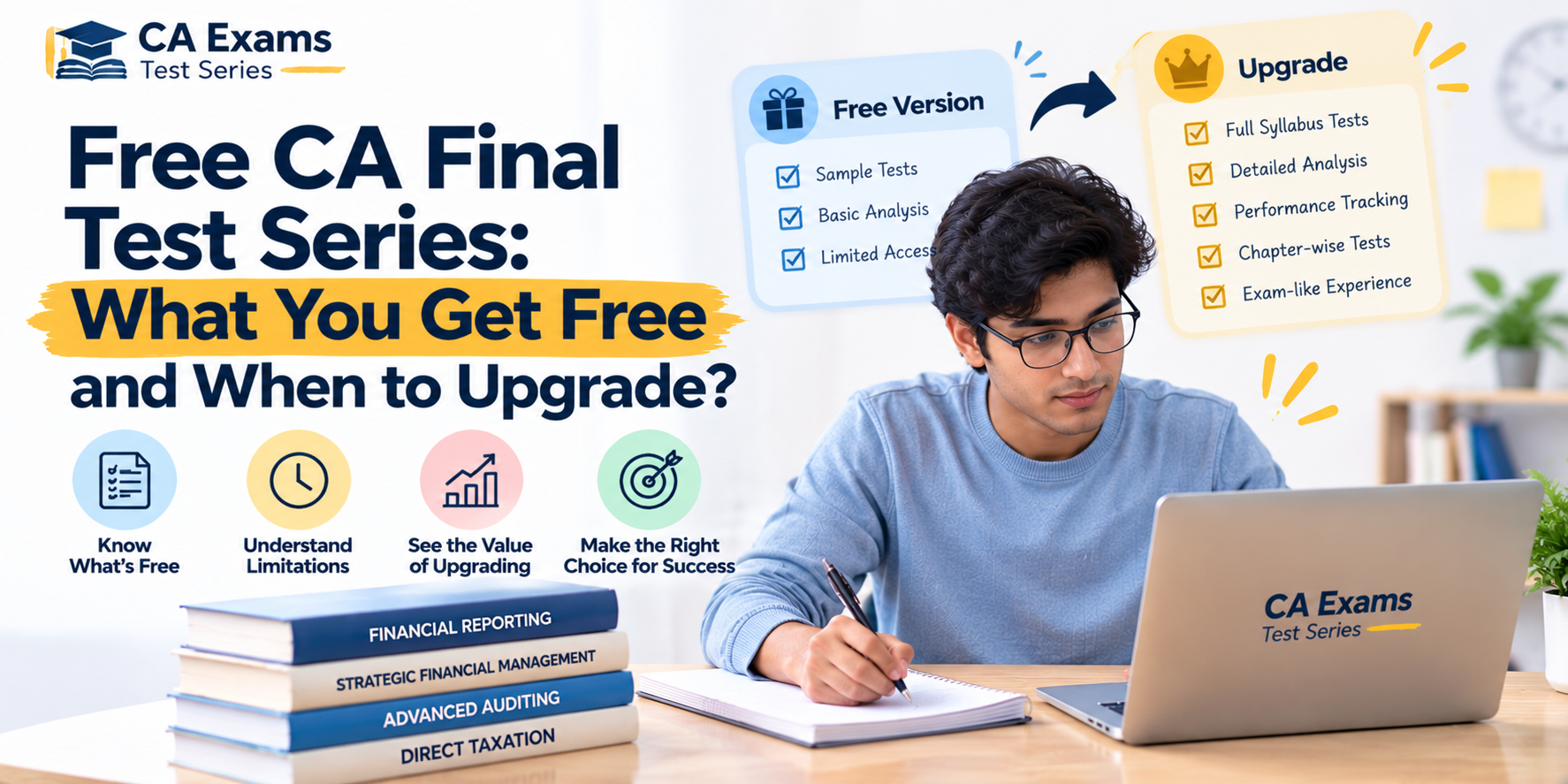
The difference is not simply that one option costs money and the other does not. A paid plan may offer more papers, a planned test calendar, evaluated answer sheets, detailed feedback, or additional practice resources. These features vary by provider and should be checked before purchasing.
A free resource can be enough for students who mainly need extra questions and are comfortable checking their own answers. A paid plan may be worth considering when you need a more structured routine, multiple full-length papers, external evaluation, or a consistent way to track progress. The right decision depends on the gap you are trying to solve.
Comparison Table: Free and Paid Options
Use the following table as a checklist when comparing a free option with a paid one. It describes common differences, not guaranteed features of every provider.
| Feature | Free option | Paid option |
|---|---|---|
| Number of tests | Often limited or sample-based | May include a wider set of papers; verify plan details |
| Solutions | May provide an answer key or selected solutions | May include more detailed solutions, depending on provider |
| Evaluation | May be unavailable or limited | May offer evaluated answers or feedback; confirm before buying |
| Study schedule | Usually self-managed | May include a planned calendar or test milestones |
| Best fit | Trying a platform or adding a few practice questions | Students who need structure or additional feedback |
When Should You Upgrade from a Free Test Series?
Consider upgrading when the free resource no longer meets a clear preparation need. For example, you may have used the available sample papers and now need more full-length practice, or you may be unsure how to improve your answer presentation and want evaluator feedback.
An upgrade may also make sense if you struggle to keep practice consistent. A planned test calendar can create useful checkpoints, provided it leaves enough time for revision and review. If you already follow a schedule independently and can evaluate your own answers accurately, you may not need every paid feature.
Do not upgrade just because other students are doing so or because a platform promotes a limited-time offer. Identify the feature you need, check the syllabus relevance and evaluation process, compare the total price and access period, and read the terms before paying.
When a Free Option May Be Enough
Free practice may be enough when you are at an early stage of preparation, want to test a platform before choosing it, or need a small number of additional questions for a topic. It can also work well for students who have strong self-evaluation habits and can compare their answers carefully with reliable solutions.
If you use free papers, make them part of a repeatable process: attempt the test under suitable conditions, check every answer, record mistakes, revise the weak topic, and reattempt the question later. The value comes from this cycle rather than from the price of the resource.
How to Evaluate a Paid Plan Before You Buy
Before purchasing, check the syllabus and exam-pattern alignment for your attempt, the number and type of tests included, the access period, and whether the schedule matches your preparation timeline. Look at sample questions and solutions where available instead of relying only on promotional claims.
Ask how evaluation works. Will you receive a score only, or written feedback on the answers? How long does evaluation take? Are there clear marking guidelines? Is there a way to review mistakes and track performance across attempts? These details matter more than a long feature list if your main goal is to improve exam performance.
Also compare the total cost with the features you will realistically use. A plan is poor value if it contains resources you do not need or if its schedule leaves no time for revision. Choose a service that complements your study material and fits your available hours.
How to Make the Most of Any CA Final Mock Test
Set aside a fixed time for the test and attempt it without checking notes or solutions. Follow the instructions and time limit as closely as practical. This makes the result more useful for understanding recall, accuracy, and time management.
After the test, classify errors into concept gaps, forgotten information, calculation mistakes, misreading the requirement, incomplete answers, presentation issues, and time-management problems. Choose the most important corrections and schedule them into your next revision session. Do not move on simply because you have seen the answer key.
Keep a simple record of each attempt: date, paper or topic, score if available, completion status, main errors, and next actions. Over time, this gives you a clearer picture of progress than relying on memory or comparing scores from unrelated papers.
A Practical Decision Checklist
Before deciding to upgrade, ask yourself a few questions. Have you used all the useful free resources available? Do you need more papers, evaluator feedback, a planned schedule, or progress tracking? Can you explain the mistakes in your current answers? Will the paid features solve a real problem in your preparation?
If the answer points to a specific gap and the provider offers a suitable feature at a reasonable price, an upgrade may be worthwhile. If you only need more practice questions and can review them independently, continue using reliable free resources while keeping your revision plan consistent.
Conclusion
A free CA Final test series can be a practical starting point for timed practice, checking topic-level understanding, and exploring a provider's format. Before upgrading, compare the actual number of tests, syllabus relevance, solutions, evaluation, access period, and price. Pay only when the additional features address a real need. Whatever option you choose, attempt tests honestly and use each result to guide your next revision session.
FAQs
What is included in a free CA Final test series?
It may include a sample mock paper, selected subject-wise questions, downloadable papers, solutions, or limited trial access. Features differ by provider, so check the offer details before relying on any specific inclusion.
Are free CA Final mock tests useful?
Yes. They can help you practise under time limits, identify weak topics, and explore a provider's question format. Their usefulness depends on syllabus relevance and whether you review your answers carefully.
Is a free CA Final test series enough for exam preparation?
It may be enough for additional practice if you can evaluate your answers and already have a revision plan. Students needing more full-length papers, structured scheduling, or evaluator feedback may need extra resources.
When should I upgrade to a paid CA Final test series?
Consider upgrading when you need more papers, detailed evaluation, a planned schedule, or progress tracking that your free option does not provide. Compare features and terms before paying.
Do free CA Final tests include answer evaluation?
Not always. Some resources provide only question papers or answer keys, while others may offer limited evaluation. Confirm whether evaluation is included and what type of feedback you will receive.
How can I check the quality of a free mock test?
Check whether it matches the applicable syllabus and exam pattern, whether questions are clearly worded, and whether solutions explain the method. Attempt the paper under timed conditions to judge its usefulness.
Should I buy a test series early in my CA Final preparation?
Not automatically. First identify your needs and preparation stage. A paid series may help with structure, but it is most useful when you can attempt tests and leave enough time to analyse them.
Can I use free and paid mock tests together?
Yes. You can use free papers for extra topic practice and a paid plan for structured full-length tests or evaluation. Keep all practice aligned with your syllabus and avoid overloading your schedule.
What matters more: the number of mock tests or their analysis?
Analysis is essential. A large number of tests offers limited benefit if you repeat the same mistakes. Review errors, revise weak topics, and reattempt difficult questions before moving to another paper.
How do I choose the right CA Final test series?
Compare syllabus relevance, paper quality, number of tests, solution clarity, evaluation details, access period, price, and feedback. Choose features that address your own preparation gaps rather than buying based on promotion alone.