Table of contentsShowHide
- 1.Why ICAI Syllabus Changes Matter
- 2.How Online CA Classes Track Official Updates
- 3.What Course Resources May Be Updated?
- 4.Study Material and Notes
- 5.Recorded and Live Lectures
- 6.Question Banks and Practice Material
- 7.How Online Classes Communicate Updates
- 8.What Happens to Recorded Courses and Older Study Material?
- 9.How Mock Tests and Test Series Should Be Updated
- 10.How to Check Whether an Online CA Course Handles Updates Properly
- 11.Questions Worth Asking Before Enrolling
- 12.A Quick Checklist for Students
- 13.Practical Checklist
- 14.What Students Should Do When ICAI Announces a Change
- 15.Balancing Updates With Your Existing Study Plan
- 16.Common Mistakes to Avoid
- 17.Conclusion
Preparing for a CA examination requires more than watching lectures and completing chapters. Students also need to make sure that the material they study matches the syllabus and exam requirements applicable to their attempt. When the Institute of Chartered Accountants of India (ICAI) announces a change, students may wonder whether their recorded classes, notes, question banks, and mock tests are still relevant.
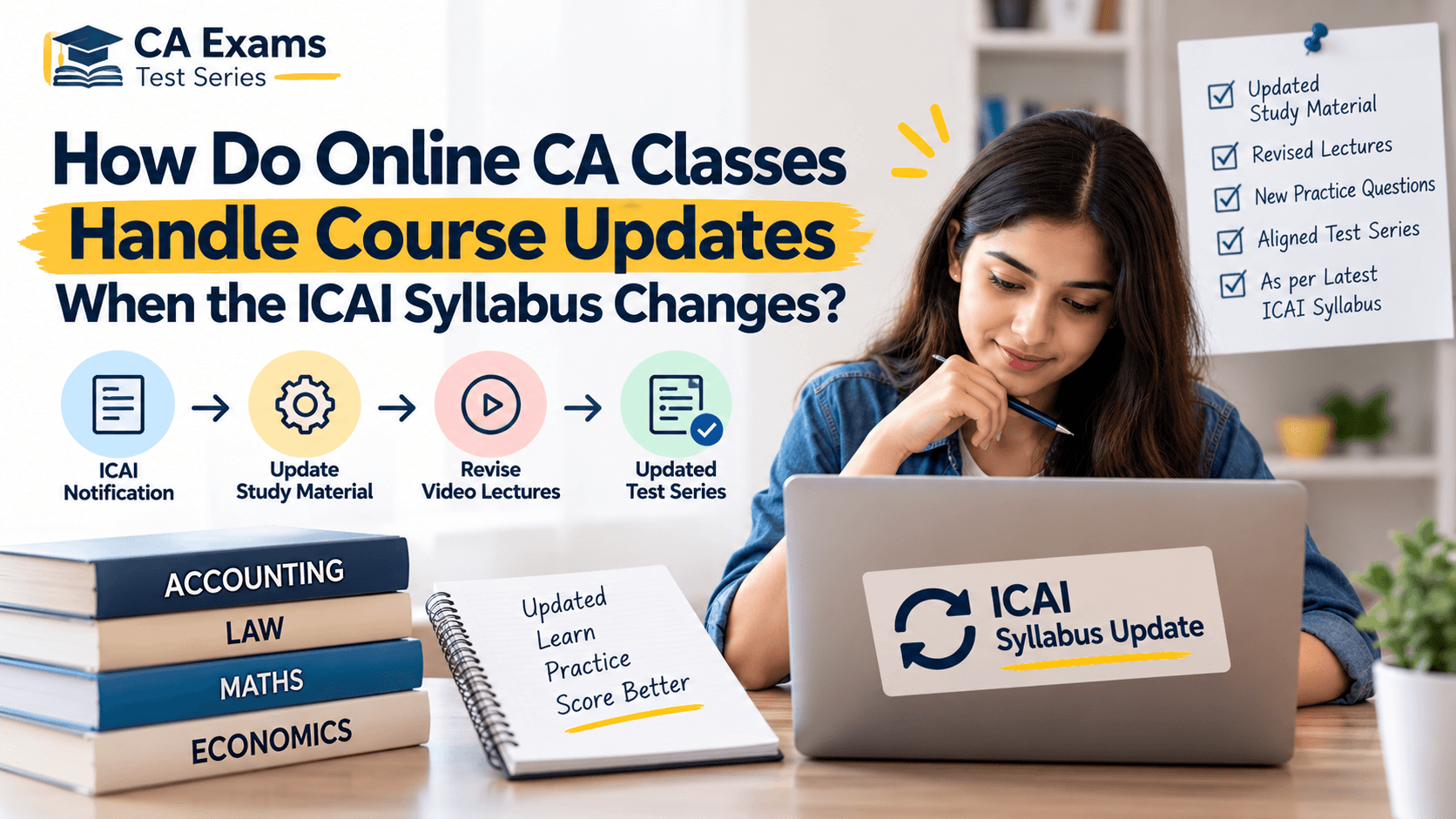
Good online CA classes have a clear process for handling such changes. They review official announcements, identify the affected topics, update learning resources, and explain what students should study or set aside. The exact process differs between providers, so students should check how a course handles updates before enrolling. This guide explains what a reliable update system looks like and how you can protect your preparation.
Why ICAI Syllabus Changes Matter
CA course content can be affected by changes to the syllabus, study material, examination scheme, applicable laws, accounting or auditing requirements, and attempt-specific instructions. Not every announcement changes the entire course. Sometimes an update applies only to a particular topic, paper, examination cycle, or set of students.
Studying outdated content can waste valuable time or leave gaps in preparation. The opposite problem is also possible: students may discard useful notes simply because they hear that a syllabus has changed. The right response is to confirm the official announcement, understand its scope, and then adjust the study plan based on the applicable attempt.
Students should therefore distinguish between an official ICAI update and a coaching provider’s interpretation of it. A class provider can explain and organise the information, but ICAI’s official announcements and applicable study resources should remain the primary reference.
How Online CA Classes Track Official Updates
A responsible online learning provider should monitor official ICAI sources, including announcements, examination notifications, syllabus pages, and study-material releases. The provider’s academic team can then compare the new information with the course already available to students.
The review should identify what has changed, which CA Foundation, Intermediate, or Final papers are affected, when the change applies, and whether it is relevant to the student’s examination attempt. This avoids broad, confusing messages that suggest every student must replace all their notes.
Students should be able to see the source and date of an update. If a class provider announces a change without explaining its basis, check the official ICAI website before making major changes to your preparation. A clear source trail makes it easier to separate confirmed requirements from assumptions or informal discussion.
What Course Resources May Be Updated?
Updates may affect several parts of an online CA course. The extent of the revision depends on the official change; a small amendment may require only a note or supplementary explanation, while a major syllabus revision may require broader changes.
Study Material and Notes
Faculty teams may revise chapter notes, summaries, examples, illustrations, and references so that students are not relying on superseded information. Updated files should have clear labels, such as a revision date or version number. Where only a few pages change, a concise amendment sheet can be more useful than asking students to download an entirely new set of notes.
Students should avoid mixing old and new versions without checking the differences. Keep one clearly identified current set and retain older copies only when they are useful for comparison.
Recorded and Live Lectures
Some updates can be explained through a short supplementary video or live session. Others may require a revised lecture or a new explanation of the affected concept. Providers may not need to re-record every lecture when only a small part of a chapter has changed, but they should make the relevant correction easy to find.
For recorded courses, check whether the provider adds update videos to the course dashboard and tells enrolled students where to find them. For live batches, ask how missed update sessions are shared with students who cannot attend.
Question Banks and Practice Material
Practice questions, chapter tests, revision sheets, and case-based questions may need revision if the change affects what students are expected to know or apply. A well-maintained course labels new questions clearly and indicates the relevant paper or topic.
Old questions are not automatically useless. They may still help students practise foundational concepts or answer-writing skills. The important point is to know which questions remain aligned with the current requirements and which should be used only for general practice.
How Online Classes Communicate Updates
Publishing revised material is only one part of the process. Students need to know that an update exists, whether it affects them, and what action they should take. Providers may use dashboard notifications, email, course announcements, app messages, live sessions, or student support channels.
A useful update notice should answer four questions: What changed? Which paper or topic is affected? Which examination attempt does it apply to? What should the student do next? For example, a notice might direct students to download a revised chapter note, watch a short explanation, and attempt a replacement quiz.
Look for a central place where updates are listed in chronological order. Scattered messages can be difficult to track, especially when students are revising several papers at once. If an update is important, save the notice or add its action to your study planner.
What Happens to Recorded Courses and Older Study Material?
Recorded lectures are convenient because students can study at their own pace, but they can also create uncertainty when a syllabus or rule changes after a video was recorded. A provider should explain whether the original lecture remains valid, needs a supplementary explanation, or should no longer be used for the affected part.
Do not assume that every older lecture is obsolete. Concepts that have not changed may still be useful, while a particular law, threshold, syllabus inclusion, or examination instruction may need correction. Follow the provider’s topic-specific guidance and compare it with official ICAI resources.
If the platform does not clearly label updated content, ask support for written clarification. A short confirmation can prevent you from spending hours revising material that is no longer applicable to your attempt.
How Mock Tests and Test Series Should Be Updated
Mock tests are most useful when their syllabus coverage, question style, and instructions reflect the requirements applicable to the student’s attempt. If an official change affects a paper, a test provider should review the relevant questions, answer keys, marking guidance, and solutions.
An updated test series should make it clear which tests have been revised and which version students should attempt. If the update is significant, the provider may replace a test, issue an additional practice set, or explain which questions should be skipped. Students should not have to guess whether a mock test includes an outdated topic.
After attempting a revised test, review both the score and the reason behind any errors. Use the feedback to identify concept gaps, presentation issues, and areas where you misunderstood the new requirement. CA Exams Test Series can be considered as part of a structured practice routine, but students should verify that any test series they choose is aligned with the official syllabus for their attempt.
How to Check Whether an Online CA Course Handles Updates Properly
Before purchasing a course, ask specific questions rather than relying only on a general promise of ‘updated content’. A provider’s answers can reveal whether it has a repeatable academic process or updates resources only when students complain.
Questions Worth Asking Before Enrolling
Ask how the provider monitors ICAI announcements and how students are notified when a change affects their batch. Find out whether supplementary videos, revised notes, and replacement tests are included in the course fee or require an additional purchase.
Also check whether access to updates continues for the period you need, how long it takes the academic team to review a new announcement, and whether students can contact faculty when an update is unclear. No provider can responsibly promise that every resource will be revised instantly, but it should be able to explain its process and communication standards.
A Quick Checklist for Students
Use this checklist when evaluating a course or reviewing your current resources:
Practical Checklist
Confirm that the course identifies the examination attempt and applicable syllabus.
Check for dated or version-labelled notes and practice materials.
Look for a dedicated announcement area or update log.
Verify that relevant lectures and question banks are reviewed after a change.
Ask how revised mock tests, solutions, and answer keys are provided.
Compare important changes with official ICAI notifications and study material.
Keep a record of what you have downloaded and what still needs to be reviewed.
What Students Should Do When ICAI Announces a Change
First, avoid panic. Read the official notice carefully and confirm the attempt, paper, and effective date. A headline or social media post may leave out important conditions. If the announcement is difficult to interpret, consult the official explanatory material or ask a qualified faculty member for help.
Next, identify the affected parts of your study plan. Mark the relevant chapters, notes, videos, and tests. Replace or annotate material only where necessary instead of restarting the entire subject. If the update affects a topic you have already studied, schedule a focused revision session and practise a few questions to confirm your understanding.
Finally, record the change in your planner. Include the date, source, affected topic, and action required. This small habit helps you avoid repeatedly searching for the same information and gives you a clear record when you begin final revision.
Balancing Updates With Your Existing Study Plan
One syllabus update should not automatically derail your weekly timetable. Estimate how much work the change actually creates and fit it into your plan. A minor clarification may need a short review, while a major change could require several sessions and additional practice.
Keep your core study routine intact wherever possible: learn concepts, revise them, solve questions, and review mistakes. Set aside a small weekly slot to check course announcements and update your materials. This is more manageable than checking messages constantly throughout the day.
If you are close to the examination, prioritise confirmed, attempt-relevant changes and follow official instructions. Avoid spending time on rumours, unverified predictions, or resources that do not apply to your attempt.
Common Mistakes to Avoid
One common mistake is relying entirely on a coaching notification without checking its source. Another is assuming that a course is fully updated simply because it is advertised as current. Students should look for dated resources and clear instructions, especially when a change affects exam eligibility, syllabus coverage, or the applicable scheme.
Do not keep several conflicting versions of the same notes without labels. Do not delete every older file automatically, either; some material may remain relevant. Most importantly, do not delay preparation while waiting for a provider to explain every detail. Use official information to understand the change and contact the provider about the specific course resources that need clarification.
Conclusion
Online CA classes handle ICAI syllabus changes best when they combine official monitoring, academic review, updated resources, clear communication, and revised practice material. The quality of the process matters more than a broad claim that a course is always current.
As a student, verify updates against official ICAI information, keep your materials organised, and adjust your plan only where the change applies. Choosing a provider that explains its update process can help you study with greater confidence and use your preparation time effectively.
Frequently Asked Questions
How do online CA classes know when the ICAI syllabus changes?
They should monitor official ICAI announcements, examination notifications, and study-material releases. Academic teams then review the changes and identify which papers, topics, batches, and examination attempts are affected.
Do online CA classes update recorded lectures after a syllabus change?
It depends on the provider and the size of the change. Some add supplementary videos or notes, while major changes may require revised lectures. Students should check the course update policy and follow topic-specific instructions.
Will I need to buy a new CA course if the syllabus changes?
Not necessarily. Many providers supply relevant updates to enrolled students, but policies differ. Before enrolling, ask whether revised notes, update lectures, and replacement tests are included in the course fee.
How can I check whether my CA study material is updated?
Look for a revision date or version label, check the provider’s update announcements, and compare important details with the official ICAI study material and notifications applicable to your examination attempt.
Are old CA lecture videos useless after an ICAI update?
No. Unchanged concepts may still be useful. However, a topic affected by a new syllabus, rule, or examination instruction may need a supplementary explanation or replacement resource. Confirm which sections remain applicable.
Do CA test series providers revise mock tests when the syllabus changes?
A reliable provider should review affected tests, questions, answer keys, and solutions. Ask how revised tests are identified and whether you will receive replacement questions or clear instructions about outdated content.
How quickly should an online CA course be updated?
There is no single turnaround time for every type of announcement. The provider should review official information promptly, communicate what is affected, and explain when revised resources will be available rather than promising instant updates for every change.
Should I stop studying while waiting for syllabus updates?
Usually, no. Continue with topics that are confirmed as relevant to your attempt. Verify the announcement, identify affected chapters, and adjust only the necessary parts of your study plan.
Where should students verify ICAI syllabus changes?
Use official ICAI websites, notifications, examination announcements, and applicable study-material releases as the primary sources. Coaching explanations can help clarify the impact, but should not replace official information.
What should I ask before choosing online CA classes?
Ask how updates are tracked, how students are notified, whether revised notes and lectures are included, how mock tests are aligned, and how you can get clarification from faculty or student support.