Table of contentsShowHide
- 1.Why Language Subtitles Can Help CA Students
- 2.How Subtitles Support Complex Concepts
- 3.Connecting Spoken Explanations With Technical Terms
- 4.Following Multi-Step Numerical Problems
- 5.Understanding Law, Taxation, and Audit Explanations
- 6.Are Subtitles Better in English or a Familiar Language?
- 7.When Subtitles May Not Be Enough
- 8.How to Use Subtitles Without Slowing Down Preparation
- 9.A Practical Subject-Wise Approach
- 10.Accounting and Costing
- 11.Business and Corporate Law
- 12.Taxation
- 13.Auditing and Theory-Based Papers
- 14.What to Look for in Online CA Classes With Subtitles
- 15.Subtitle Quality and Controls
- 16.Updated Course Material and Student Support
- 17.How to Decide Whether Subtitles Work for You
- 18.Common Mistakes to Avoid
- 19.Conclusion
Subtitles are not a replacement for good teaching or regular practice, but they can make lessons easier to follow when used thoughtfully. They allow students to read key terms while listening, revisit difficult explanations, and connect spoken ideas with written language. This guide explains when subtitles are useful, where they can fall short, and how CA students can use them without becoming dependent on them.
Why Language Subtitles Can Help CA Students
CA subjects often combine technical English with concepts that require careful interpretation. In Accounting, a small difference between terms can affect how a transaction is recorded. In Law, the meaning of a provision may depend on precise wording. Taxation and Audit also use specialised expressions that students need to recognise in questions and answers.
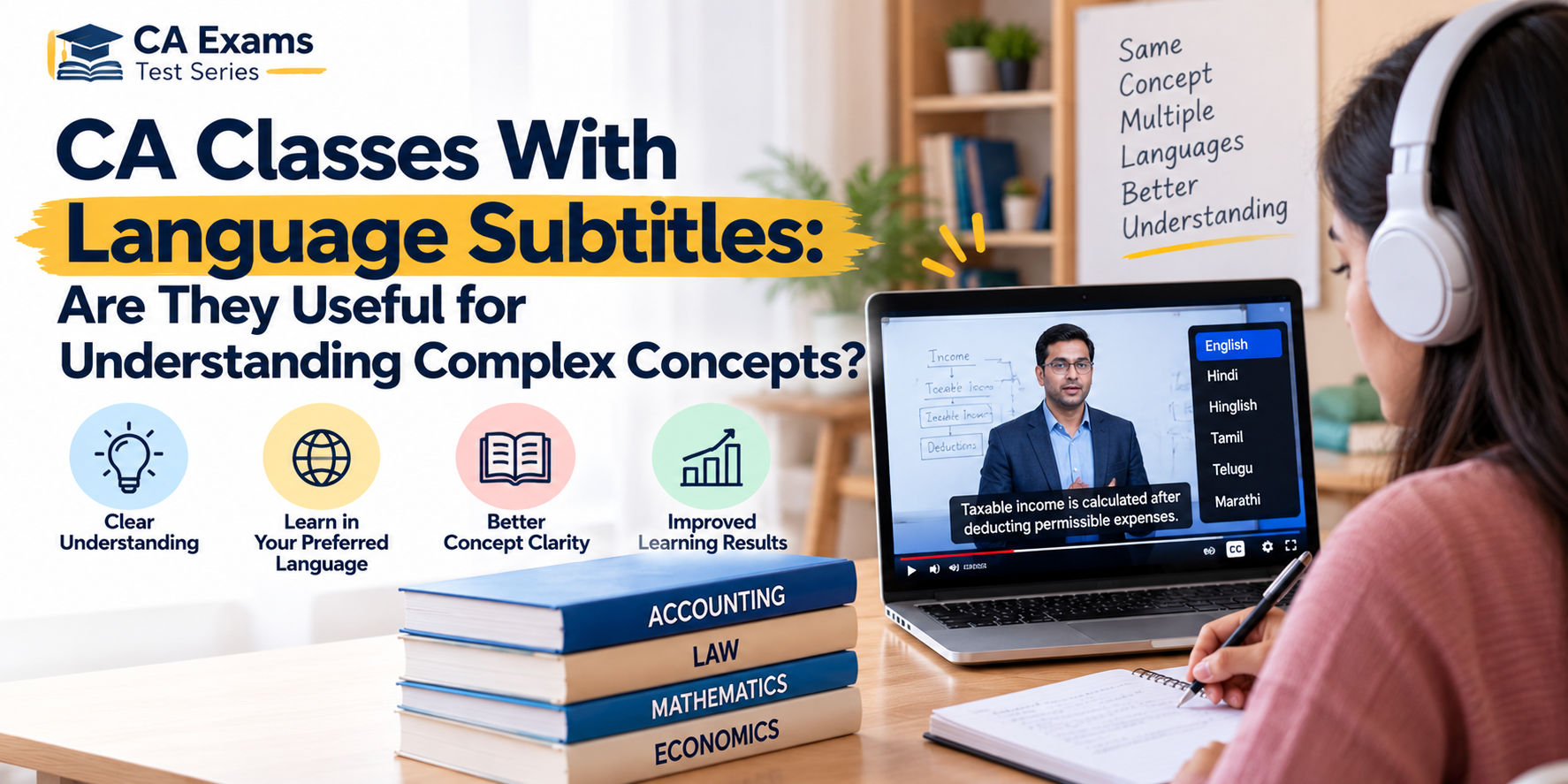
Subtitles make spoken explanations visible. When a teacher defines a term, lists steps, or compares two similar concepts, students can hear the explanation and read the words at the same time. This can be particularly helpful for students who are comfortable with the subject but still building confidence in academic English.
Subtitles can also help when students study in a noisy environment, have difficulty following a fast explanation, or want to review a particular point without replaying an entire lecture. Their usefulness depends on accuracy, readability, and how actively the student engages with the lesson.
How Subtitles Support Complex Concepts
Complex concepts rarely become clear from reading a definition once. Students usually need an explanation, an example, and a chance to apply the idea. Subtitles can strengthen the first two steps by making the teacher’s explanation easier to follow and giving the student a written reference to check after the lesson.
Connecting Spoken Explanations With Technical Terms
When a lecturer introduces terms such as recognition, measurement, materiality, assessment, or audit evidence, students may understand the general idea but struggle to remember the exact word. Accurate subtitles help connect the sound of a term with its spelling. This makes it easier to recognise the same term later in study material, questions, and suggested answers.
Students should still note the formal definition from reliable course material. Subtitles may simplify or shorten a sentence, and automatic captions can misrecognise technical vocabulary. Treat them as a learning aid rather than the final authority on a term’s meaning.
Following Multi-Step Numerical Problems
In practical subjects, a teacher may move from one calculation to another while explaining why each figure is included. Subtitles can help students follow the sequence and identify the reason behind a step. This can be useful when a calculation involves several adjustments or when a student wants to pause and copy a formula accurately.
However, subtitles cannot replace working through the problem independently. After watching the example, close the video and attempt a similar question on your own. If you can reproduce the method and explain why each step is required, you are more likely to have understood the concept rather than merely followed the demonstration.
Understanding Law, Taxation, and Audit Explanations
Law lessons often rely on exact wording and distinctions between related provisions. Subtitles can help students catch a section number, condition, exception, or key phrase that might otherwise pass too quickly. They can also make it easier to replay the portion where the teacher explains how a provision applies to a situation.
In Taxation, students may benefit when the lecturer explains a sequence of conditions, calculations, or exceptions. In Audit, subtitles can help learners notice the difference between similar terms and understand how a standard applies in a practical situation. In all cases, students should verify technical details against the current study material and the syllabus applicable to their examination attempt.
Are Subtitles Better in English or a Familiar Language?
The best subtitle language depends on the student’s learning goals. English subtitles can support familiarity with the terminology used in study material, examination questions, and professional communication. Subtitles in a familiar language may help a student understand a difficult idea before learning how to express it in formal English.
Some students benefit from a combination: listen to the lecture in English with English subtitles, then use a trusted explanation in a familiar language if the concept remains unclear. Others may prefer a lecture in a familiar language with English technical terms retained on screen. There is no single option that works equally well for everyone.
Choose subtitles that clarify meaning without changing important technical terms. If a translation makes a legal or accounting term sound different from the wording used in the syllabus, record the formal English term alongside the explanation.
When Subtitles May Not Be Enough
Subtitles can display words accurately and still leave a concept unclear. A student may read the sentence without understanding the underlying rule, assumption, or calculation. Subtitles also do not show whether the student can solve a question independently or present an answer in an examination-ready format.
Automatic captions may contain errors, especially with abbreviations, section numbers, names, technical terms, or speakers with a strong accent. Captions can also lag behind the audio, cover part of a diagram, or move too quickly to read comfortably. If a sentence appears incorrect, pause the video and check the teacher’s notes or another reliable source.
Students should avoid watching lectures passively with their eyes fixed on the subtitles. Pause when necessary, write a short summary in their own words, and use questions to test understanding. The goal is to learn the concept, not to finish the video as quickly as possible.
How to Use Subtitles Without Slowing Down Preparation
A simple routine can make subtitle-supported classes more effective. Before the lecture, review the topic name and any key terms listed in the study material. This gives you a framework for the explanation and helps you notice unfamiliar language.
During the lecture, keep subtitles enabled when they improve comprehension. Pause at definitions, complex calculations, and important comparisons. Write down only the essential points rather than copying every caption. If a term appears unclear, mark it for checking after the class instead of interrupting your concentration repeatedly.
After the lecture, close the video and explain the main idea in your own words. Attempt a few related questions without looking at the solution. Return to the relevant video section only when you identify a specific gap. This approach turns subtitles into a support tool within active learning rather than a passive reading exercise.
A Practical Subject-Wise Approach
Different CA subjects may require different subtitle habits. The purpose is not to turn every class into a transcription exercise, but to use on-screen text where it offers a clear benefit.
Accounting and Costing
Use subtitles to catch assumptions, formula names, adjustments, and the order of calculation steps. After the explanation, solve the question independently and compare your workings with the model answer. Focus on why each figure is included, not only on the final total.
Business and Corporate Law
Use subtitles to identify key terms, conditions, exceptions, and the structure of an explanation. Then refer to the prescribed study material for the exact legal wording and practise writing a concise answer. Avoid relying on captions alone for section numbers or statutory language.
Taxation
Subtitles can help you follow the sequence of a tax computation and note terms that sound similar. Make a separate list of important conditions and verify amendments or applicability from the official material relevant to your attempt. For a numerical problem, practise the full computation after watching.
Auditing and Theory-Based Papers
Use subtitles to capture definitions, distinctions, and the reasoning behind a procedure. After class, create short revision prompts rather than copying full paragraphs. Try answering each prompt from memory and check whether your wording preserves the meaning of the concept.
What to Look for in Online CA Classes With Subtitles
If subtitles are important to your learning, check the platform before enrolling. Do not assume that every recorded course includes accurate captions or that captions are available in several languages.
Subtitle Quality and Controls
Look for readable text, sensible timing, adjustable playback speed, and the ability to pause or replay a short section. Captions should not hide formulas, charts, or the teacher’s annotations. If the platform offers both manually prepared and automatic captions, ask whether technical lessons have been reviewed for accuracy.
Check which languages are available and whether you can turn subtitles on or off. The ability to choose is valuable because some lessons may be easier to follow with captions, while others may require full attention to a diagram or worked example.
Updated Course Material and Student Support
Subtitles are only one part of a learning experience. Students also need clear notes, relevant practice questions, doubt support, and course material aligned with the syllabus for their examination attempt. If a subtitle conflicts with the teacher’s notes or an official source, seek clarification rather than guessing.
CA Exams Test Series can complement video learning with structured practice and review. Before choosing any course or test series, check what it includes, how feedback is provided, and whether the material is suitable for your level and attempt.
How to Decide Whether Subtitles Work for You
Test the feature instead of relying on a general claim that subtitles improve learning. Watch a short lesson on a topic you find difficult, first with subtitles and then review your understanding without them. Can you explain the main concept? Can you solve a related question? Can you recall the important terms?
If subtitles help you understand the lesson and remember technical vocabulary, keep using them where useful. If you find yourself reading without listening, pause frequently, or becoming distracted by caption errors, try a different subtitle language, a slower playback speed, or a shorter study session.
Students should also consider their exam goal. Subtitles may help comprehension during learning, but examination performance depends on recall, application, writing practice, and time management. Make sure your study routine includes all of these elements.
Common Mistakes to Avoid
One mistake is treating every caption as accurate. Technical words, figures, and statutory references should be checked whenever they seem doubtful. Another is copying subtitles word for word, which can leave little time for problem-solving and revision.
Some students keep subtitles on even when they no longer need them, while others avoid them because they believe captions are only for beginners. Neither approach is necessary. Use subtitles strategically for difficult explanations, unfamiliar terms, and revision, then practise without assistance to test your understanding.
Finally, do not choose a course based on subtitles alone. Teaching quality, syllabus alignment, practice material, doubt resolution, and the ability to review lessons are also important factors in a complete CA preparation plan.
Conclusion
Language subtitles can be useful in online CA classes because they help students follow explanations, recognise technical vocabulary, and revisit complex steps. They are especially valuable when the captions are accurate and the student uses them actively.
Use subtitles as a bridge to independent understanding, not as a substitute for study material or question practice. The best learning routine combines clear explanations, careful revision, and regular attempts at questions without assistance.
Frequently Asked Questions
Are subtitles useful for CA online classes?
Yes. Accurate subtitles can help students follow fast explanations, recognise technical terms, and revisit difficult concepts. They work best when combined with notes, revision, and independent question practice rather than passive video watching.
Which subtitle language is best for CA preparation?
It depends on your comfort and goals. English subtitles help build familiarity with examination terminology, while a familiar language may clarify difficult ideas. Keep formal technical terms aligned with the prescribed study material.
Can subtitles help with CA Accounting and Costing?
They can help students follow formulas, assumptions, and calculation steps. However, students should pause the lecture, practise the problem independently, and understand why each adjustment is made instead of memorising the displayed steps.
Are automatic subtitles always accurate in CA lectures?
No. Automatic captions can misread technical vocabulary, figures, abbreviations, and section numbers. Verify doubtful details against faculty notes and official study material, especially when the information affects a calculation or legal provision.
Do subtitles help students understand CA Law?
Subtitles can make key terms and explanations easier to follow, but they should not replace the prescribed legal wording. Check relevant provisions in the current study material and practise writing answers in your own words.
Should I watch every CA lecture with subtitles turned on?
Not necessarily. Use them when they improve comprehension or help with technical terms. Turn them off when they distract you, and regularly test your understanding by recalling concepts and solving questions without assistance.
Can subtitles improve my CA exam marks?
Subtitles may support understanding, but they do not guarantee higher marks. Results also depend on conceptual clarity, revision, answer presentation, problem-solving practice, and managing time under examination conditions.
What should I do if subtitles show an incorrect technical term?
Pause the video and check the term in the teacher’s notes or official study material. If the difference remains unclear, ask the course faculty or support team before using it in your revision notes.
Are subtitles helpful for students who understand English but struggle with fast lectures?
Yes. English captions can make it easier to catch key phrases and technical terms while listening. Adjustable playback speed and short replays can also help without requiring the student to translate every sentence.
What should I check before buying online CA classes with subtitles?
Confirm which languages are available, whether captions are reviewed for accuracy, how easily lessons can be paused, and whether the course includes updated notes, practice questions, doubt support, and material aligned with your exam attempt.