Table of contentsShowHide
- 1.What Happens After the Examination?
- 2.How Examiners Evaluate Answers
- 3.Why Step-Wise Marking Matters
- 4.Checking and Quality-Control Steps
- 5.From Evaluated Scripts to Result Processing
- 6.What If You Think Your Marks Are Incorrect?
- 7.Verification, Inspection and Certified Copies: Know the Difference
- 8.How Students Can Prepare for Evaluation
- 9.Common Myths About CA Evaluation
- 10.Quick Reference Table
- 11.How CA Exams Test Series Can Support Your Preparation
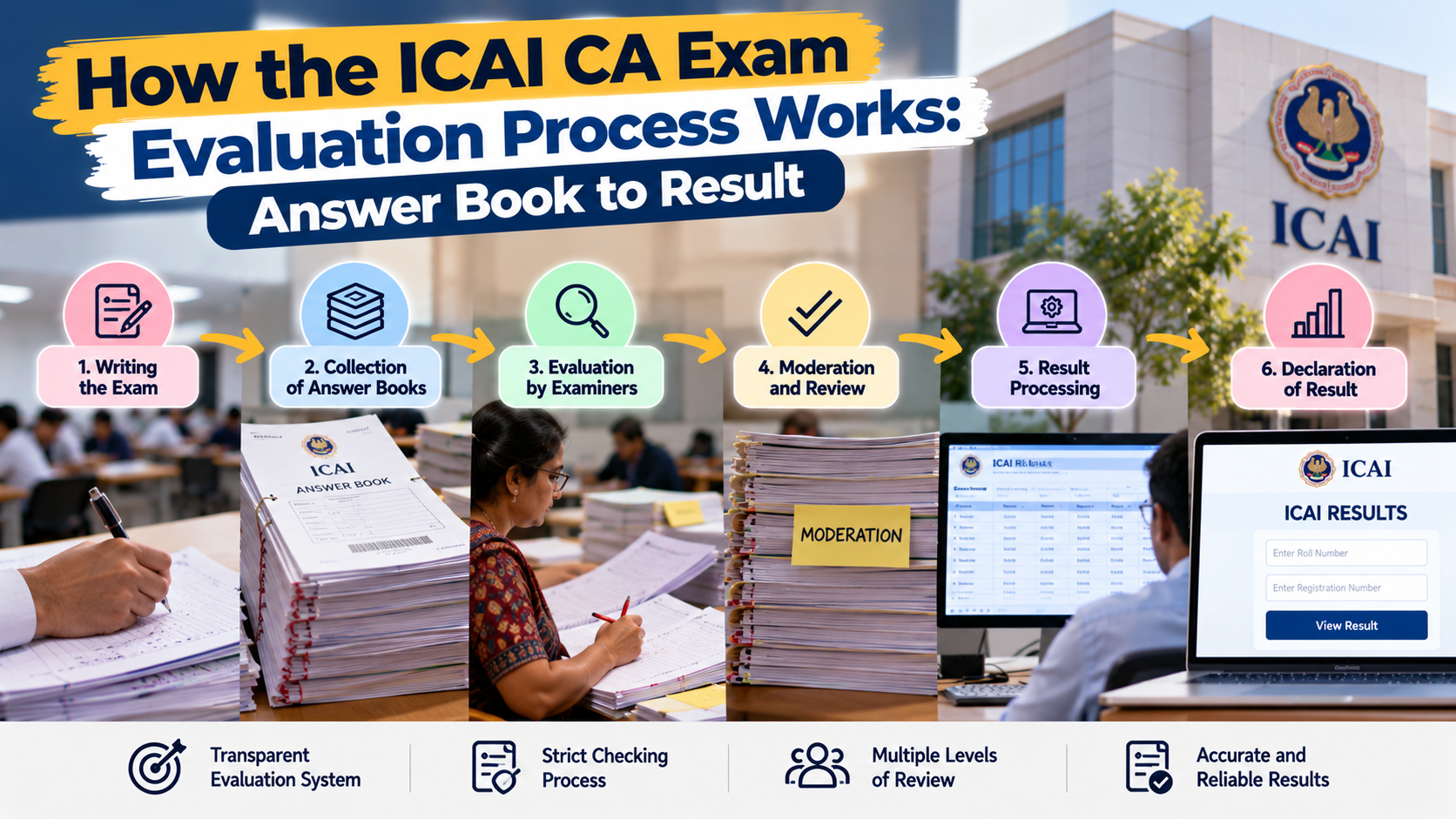
After a CA examination, students often wonder what happens to an answer book before the result is announced. The process involves more than assigning marks: answer books are evaluated under instructions, checks are carried out and results are processed before publication.
This article explains the broad stages using information published by ICAI. Exact operational arrangements can change by course, paper or session, so the guide does not claim to reveal every internal step. For official procedures after the result, use the ICAI examination portal and the guidance issued for your attempt.
What Happens After the Examination?
Once the examination is completed, answer books are collected and processed according to the examination administration system. The handling process is designed to connect each script to the correct candidate and paper while maintaining examination controls. The exact technology and workflow can vary, so students should avoid assuming that every paper follows an identical physical process.
ICAI has introduced digital evaluation in a phased manner for examination answer books. This means evaluation may take place through online systems for applicable papers or sessions. Whether a student writes in a physical answer book or the script is later processed digitally, the marks must be recorded and handled under the applicable evaluation instructions.
How Examiners Evaluate Answers
Examiners assess responses against the applicable question requirements and marking guidance. In practical papers, marks may be awarded for relevant working steps, methods, calculations and conclusions, as applicable. In theory papers, marks depend on the relevant content and how directly the answer addresses what the question asks. The precise allocation depends on the paper and its marking scheme.
ICAI has described step-wise marking as an integral part of evaluation. Students should therefore show logical workings and relevant steps rather than writing only a final figure where the question requires a process. Clear presentation does not guarantee marks, but it helps make the reasoning visible to the evaluator and reduces the chance that correct work is overlooked.
Why Step-Wise Marking Matters
Step-wise marking recognises the parts of a solution that demonstrate the required method, subject to the marking instructions. For example, a practical answer may include a formula, working notes, an adjustment and a final result. If the final number is wrong but some steps are correct, the applicable marking scheme may award marks for those steps.
ICAI has stated that step-wise marking is supported by review and quality checks. Students should not interpret this as a promise that every partial answer will receive a fixed number of marks. The result depends on the actual answer, the question requirements and the examiner’s instructions. Practising complete, logically ordered solutions is the safest approach.
Checking and Quality-Control Steps
ICAI has published information describing checks after evaluation, including ensuring that answers have been evaluated, marks are carried forward correctly and totals are accurate. Such checking is intended to catch administrative or recording errors; it is not the same as a second examiner simply awarding marks based on a different opinion about the quality of an answer.
ICAI has also explained that where step-wise marks have not been awarded in accordance with instructions, the issue may be addressed during review or through the applicable verification process. These checks support accuracy, but they do not mean that a candidate can expect a fresh subjective re-evaluation on request.
From Evaluated Scripts to Result Processing
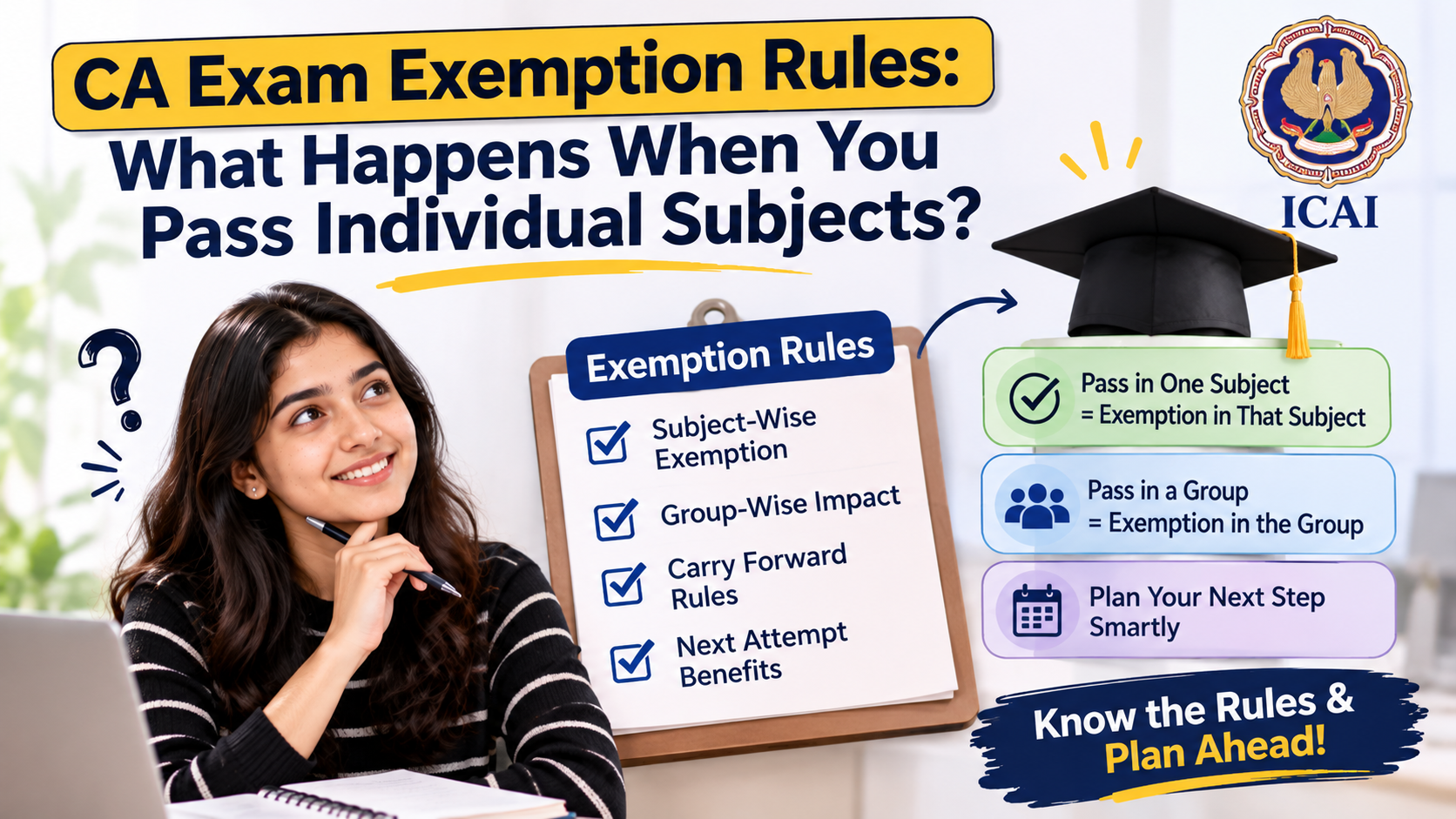
After evaluation and applicable checks, marks are processed under the examination rules for the relevant course and session. The result reflects paper-wise performance and the criteria for passing a paper or group. The overall result may also include exemptions or other status information where relevant under the applicable rules.
Students should use the official result portal and notices to understand their outcome. Avoid relying on unverified screenshots or unofficial claims about result dates. Once the result is published, check the marks and status carefully and save the official details for your records.
What If You Think Your Marks Are Incorrect?
ICAI provides procedures for verification of answer books and for requesting certified copies or inspection, subject to the current rules and deadlines. Verification is focused on specified checks, such as whether the answer book compilation is complete, whether a question or part remains unvalued, whether totals are correct and whether marks have been transferred accurately.
Verification is not the same as re-evaluation. ICAI’s published guidance states that there is no general provision for re-evaluation of answer books. If you believe an answer deserved more marks because of a difference in academic judgement, that is not automatically a correctable verification error. Read the official procedure to understand what can be checked.
Verification, Inspection and Certified Copies: Know the Difference
Verification asks the examination authority to check the specified aspects of the marks and answer-book process. Inspection or certified copies allow a candidate to review the evaluated answer book under the procedure applicable to that session. These are distinct services, and applying for one should not be assumed to complete the process for another unless the current official instructions say so.
Deadlines, fees and online steps may change. ICAI’s examination FAQ and session-specific notices should be treated as the source of truth. Keep a copy of your application confirmation and choose the correct papers carefully, because the process may have restrictions on changing a submitted request.
How Students Can Prepare for Evaluation
Students cannot control the evaluation workflow, but they can make their answers easier to assess. Read the requirement carefully, show workings, label assumptions, organise sub-parts, use relevant headings for theory answers and leave enough time to complete the paper. Follow the instructions for MCQs, answer books and permitted materials for the particular examination.
After mock tests, review not only the marks but also whether your reasoning is visible. If you lost marks in a practical answer, identify whether the problem was knowledge, method, calculation or presentation. For theory papers, check relevance, coverage and clarity. These habits improve exam performance without relying on assumptions about how a particular examiner might award marks.
Common Myths About CA Evaluation
A common myth is that requesting verification automatically leads to rechecking every answer for academic merit. Another is that a student’s marks must increase if they submit a request. Verification checks defined issues; the outcome may be unchanged unless a discrepancy is found.
Another misconception is that neat handwriting alone determines the result. Readability can help, but marks depend on answering the question and meeting the relevant marking requirements. Students should focus on accurate knowledge, complete working and a clear response rather than trying to guess the examiner’s personal preferences.
Quick Reference Table
| Stage | Broad purpose | What students should understand |
|---|---|---|
| Answer-book processing | Associate and process scripts under exam controls | Exact handling may vary by session |
| Evaluation | Assess answers using paper instructions | Show relevant steps and answer the requirement |
| Checking and review | Check evaluation coverage and mark recording | Quality checks are not general re-evaluation |
| Result processing | Apply passing and result rules | Read official result and status carefully |
| Post-result services | Verification, inspection or certified copies | Follow current deadlines and procedures |
How CA Exams Test Series Can Support Your Preparation
Alongside official information and a realistic study routine, structured practice can help you identify gaps before the examination. CA Exams Test Series can be part of a preparation plan that includes timed papers, answer review and regular revision. Use practice results to decide what to improve next, and rely on ICAI for official eligibility, examination and result rules.
Frequently Asked Questions
Does ICAI evaluate CA answer books digitally?
ICAI has introduced online evaluation in a phased manner. The arrangement may depend on the paper and examination session. Check official ICAI notices for the relevant attempt rather than assuming that every answer book follows the same technical workflow.
What is step-wise marking in CA exams?
Step-wise marking means relevant steps in a solution may receive marks under the applicable marking guidance, rather than judging only the final answer. Students should show logical working and intermediate steps where the question requires them.
Are CA answer books checked after evaluation?
ICAI has published information about checking procedures that include confirming answers have been evaluated, marks are carried forward correctly and totals are accurate. The exact operational arrangements may vary, but these checks are intended to help identify processing errors.
Can I request re-evaluation of my CA answer sheet?
ICAI’s published guidance states that there is no general provision for re-evaluation of answer books. Candidates can use the prescribed verification or inspection/certified-copy procedures, which have specific purposes and deadlines.
What errors can verification identify?
The published verification procedure includes checks for incomplete answer-book compilation, unvalued questions or parts, totaling errors and discrepancies in marks carried to the cover page or system. Consult the current instructions for the precise scope and application process.
Is verification the same as getting certified copies?
No. Verification and obtaining inspection or certified copies are distinct services. Each has its own purpose and procedure. Read the current ICAI examination FAQ to choose the correct service and follow the applicable online steps.
How long does CA exam evaluation take?
The time required depends on the examination schedule and the processes for that session. Use official ICAI announcements for result timing. Avoid relying on unofficial estimates or assuming that a previous session’s timeline will repeat.
Can my marks change after verification?
Marks can change if a discrepancy within the verification process is identified and corrected. A change is not guaranteed. Verification is not an opportunity for a general re-assessment of the academic quality of every answer.
Should I apply for the next attempt while waiting for verification?
Check the current ICAI guidance and deadlines for the next exam form. Earlier ICAI instructions have advised candidates not to miss a forthcoming exam application while waiting for verification, but confirm the rule for your current session.