
Table of contentsShowHide
- 1.Why Your First CA Mentorship Session Matters
- 2.Questions About Your Current Preparation
- 3.Questions About a Realistic Study Plan
- 4.Questions About Subject Priorities and Difficult Chapters
- 5.Questions About Revision and Retention
- 6.Questions About Mock Tests and Answer Writing
- 7.Questions About Exam-Day Strategy
- 8.Questions About Accountability and Follow-Up
- 9.What You Should Prepare Before Meeting Your Mentor
- 10.How to Judge Whether the Guidance Is Useful
- 11.Quick Reference Table
- 12.How CA Exams Test Series Can Support Your Preparation
Your first meeting with a CA mentor can help you turn a vague preparation plan into a practical one. Instead of asking only how to pass the exam, use the session to understand your current position, identify gaps and agree on actions you can follow every week.
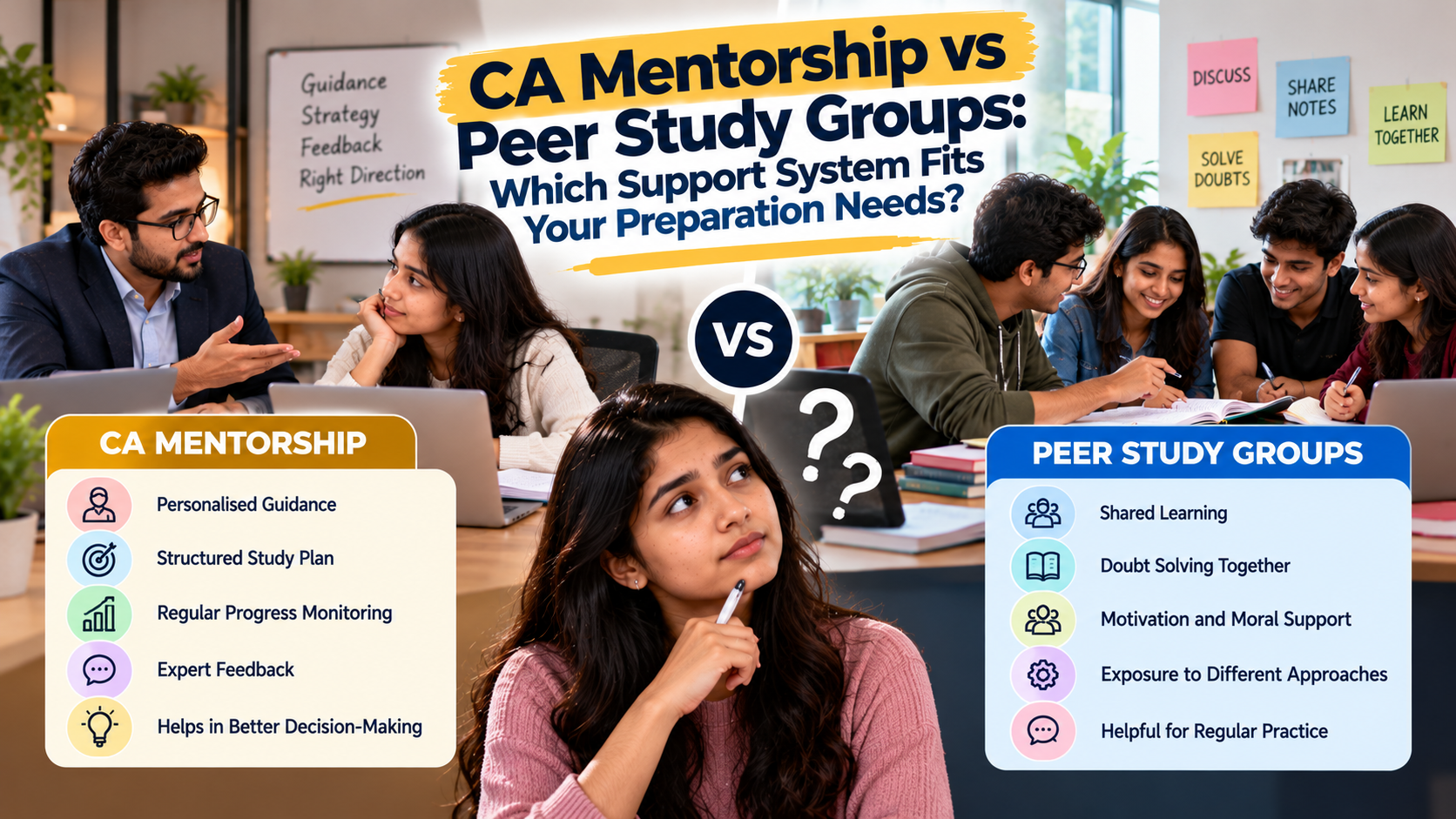
A useful mentor session is a two-way conversation. Your mentor needs an honest picture of your preparation, while you need clear guidance that fits your attempt, available study hours, subject confidence and personal responsibilities. The questions below can help you leave the meeting with a plan rather than a list of general tips.
Why Your First CA Mentorship Session Matters
CA preparation involves a large syllabus, technical concepts, regular revision and the ability to present answers within a fixed time. Students can work hard for weeks and still feel unsure about whether their method is effective. A mentor can help you assess the process, but the quality of the conversation depends partly on the information and questions you bring.
Treat the first session as a diagnostic meeting, not a promise of a particular result. A responsible mentor should understand your current level, explain the reasoning behind recommendations and help you build a routine that can be reviewed and adjusted. Be cautious of anyone who guarantees a rank or a pass without assessing your preparation.
Questions About Your Current Preparation
Begin by asking your mentor to help you evaluate your current position. Share the subjects completed, chapters pending, marks from recent tests and the amount of time you can realistically study. Avoid describing your preparation as simply good or bad; specific details make the discussion more useful.
Ask which topics appear to be your strongest and weakest, how to distinguish a genuine conceptual gap from a revision problem, and what evidence should be used to judge progress. If you have not taken a mock test, ask how to establish a baseline through a chapter test or timed paper.
Questions About a Realistic Study Plan
Ask how your remaining syllabus should be divided across the weeks before the attempt. The answer should account for subject weight, chapter dependencies, your existing progress and the time needed for practice. A plan that assumes ten focused hours every day may look impressive but will not help if you can consistently manage five.
Discuss weekly targets, daily study blocks, buffer days and a method for recovering after an unproductive day. Ask what to do when one subject begins taking more time than planned. A useful schedule includes review points, not just chapter completion dates, and leaves room for illness, college or work commitments.
Questions About Subject Priorities and Difficult Chapters
Ask which subjects need more frequent contact and which chapters should be studied before others. In practical subjects, you may need a cycle of concept learning, solved examples and independent questions. In theory-heavy subjects, you may need repeated recall, answer-writing practice and revision of key provisions or concepts.
Ask how to allocate time without abandoning a difficult paper. Your mentor should explain how to maintain a minimum level of practice in every subject while giving extra attention to weak areas. Request a method for deciding whether to move on from a chapter or spend another session on it.
Questions About Revision and Retention
Ask how many revision cycles are realistic before your exam and what each cycle should achieve. The first revision may focus on understanding and filling gaps; later revisions should rely increasingly on active recall, short notes, question practice and timed writing instead of rereading entire chapters.
Find out how to revise topics that you forget repeatedly. A mentor may suggest a mistake notebook, spaced revision dates, flashcards, summary sheets or short tests. Ask how to measure whether revision is working: being able to explain a concept or solve a new question is stronger evidence than recognising a highlighted paragraph.
Questions About Mock Tests and Answer Writing
Mock tests reveal whether you can use your knowledge under exam conditions. Ask when to start full-length papers, how often to attempt them and how to analyse the result. Clarify whether you should complete a paper first and review it afterwards, rather than interrupting the attempt to check solutions.
Ask your mentor to show you how to analyse an answer beyond the total marks. Was the issue a concept error, incomplete working, poor presentation, misreading the requirement, calculation accuracy or time management? For theory answers, discuss structure, relevant points and direct responses to the question. For practical answers, discuss working notes, assumptions and logical steps.
Questions About Exam-Day Strategy
Ask how to divide time among questions, how to handle a question that seems unfamiliar and when to move on from a calculation that is taking too long. The strategy should be consistent with the paper pattern and current ICAI instructions for your level and attempt.
Discuss the materials and documents you should check before the exam, how to plan travel and reporting time, and what to do if you feel anxious. Your mentor can help you create a routine, but official instructions and admit-card directions should always take priority.
Questions About Accountability and Follow-Up
Ask what progress indicators you should report at the next meeting. Useful indicators include chapters completed, revision sessions, test scores, accuracy, unanswered questions and time spent per question. Agree on a simple format so that tracking does not become another large task.
Clarify how often you should meet, what kind of questions can be sent between sessions and how advice will change if your test results do not improve. Ask for a short written action list after the session. You remain responsible for doing the work; mentoring is most effective when feedback leads to specific changes.
What You Should Prepare Before Meeting Your Mentor
Bring your attempt date, subject-wise syllabus status, recent test scores, daily availability and a list of the three problems that worry you most. If you have answer sheets or mock-test reports, share them. Evidence helps the mentor give tailored guidance rather than generic motivation.
Be honest about distractions, unfinished lectures and inconsistent revision. Hiding these details may lead to an unrealistic plan. You do not need to present yourself as perfectly organised; the point of the session is to identify the next useful step and build a system you can maintain.
How to Judge Whether the Guidance Is Useful
Good guidance is specific, explainable and open to review. You should understand what to do, why it matters and how to tell whether it worked. A mentor should be willing to adjust the plan when evidence shows that the workload or method is unsuitable.
Be cautious if the session relies only on pressure, comparison with other students or claims of guaranteed success. A good mentor supports independent learning and helps you make better decisions. The goal is not to depend on someone for every small choice; it is to develop a preparation process you can manage confidently.
Quick Reference Table
| Area | Question to ask | What a useful answer should provide |
|---|---|---|
| Study plan | How should I divide the remaining syllabus? | Weekly targets, buffer time and review dates |
| Weak subjects | Which gaps should I address first? | Priorities based on tests and chapter status |
| Revision | How can I retain topics for longer? | A repeatable recall and practice routine |
| Mock tests | How should I analyse my score? | Error categories and corrective actions |
| Accountability | What should I report next time? | Simple progress measures and follow-up actions |
How CA Exams Test Series Can Support Your Preparation
Alongside official information and a realistic study routine, structured practice can help you identify gaps before the examination. CA Exams Test Series can be part of a preparation plan that includes timed papers, answer review and regular revision. Use practice results to decide what to improve next, and rely on ICAI for official eligibility, examination and result rules.
Frequently Asked Questions
What should I ask a CA mentor in the first meeting?
Ask about your current preparation level, subject priorities, realistic study hours, revision cycles, mock-test analysis and the next steps before your attempt. Share your test scores and syllabus status so the advice can reflect your actual position.
Should I tell my CA mentor about unfinished syllabus?
Yes. Honest information helps your mentor create a workable plan. Hiding pending chapters can lead to unrealistic targets and unnecessary pressure. Explain what remains, why it is pending and how much time you can consistently study each day.
How long should the first CA mentorship session be?
The duration depends on your needs and the mentor’s process. It should be long enough to review your attempt, current preparation, key difficulties and action plan. A short follow-up can then check whether the agreed changes are working.
Can a CA mentor guarantee that I will pass?
No mentor can responsibly guarantee an exam result. Performance depends on preparation, application, consistency and exam-day factors. Look for clear feedback, realistic planning and measurable progress rather than promises of guaranteed marks, ranks or exemptions.
Should I ask my mentor to make my complete timetable?
You can request a timetable framework, but it should be built around your availability and revised with your input. A plan you understand and can maintain is more useful than a detailed schedule that ignores your real routine.
What if I disagree with my mentor’s study advice?
Explain your concern and ask for the reasoning behind the recommendation. Discuss your test results and available time. Good mentoring allows questions and adjustments; you should understand the plan rather than follow it blindly.
How often should I meet a CA mentor?
There is no single ideal frequency. Some students benefit from weekly reviews, while others need a meeting after each major test or milestone. Choose a cadence that supports accountability without taking too much time away from actual study.
Should I share mock-test marks with my mentor?
Yes. Share marks along with the paper, time taken, unanswered questions and mistakes. A score alone does not explain the cause of a problem. Reviewing the answer sheet helps identify whether the issue is knowledge, accuracy, presentation or time management.
What should I do after the first guidance session?
Turn the discussion into a short action list with weekly targets, revision dates and a mock-test plan. Start with the first few actions, track what you complete and bring evidence of progress to the next session.