
Table of contentsShowHide
- 1.Define What the Mentorship Program Is Trying to Improve
- 2.Measure Consistency and Follow-Through
- 3.Track Concept Clarity and Recall
- 4.Measure Independent Problem-Solving
- 5.Evaluate Answer-Writing and Presentation
- 6.Monitor Time Management
- 7.Use an Error Log to Measure Learning
- 8.Measure Confidence Through Observable Behaviour
- 9.Assess Planning and Self-Correction Skills
- 10.Use a Balanced Progress Dashboard
- 11.How CA Exams Test Series Can Support Progress Reviews
- 12.Avoid Turning Tracking Into Pressure
- 13.Conclusion
A test score is a snapshot of performance on one paper at one point in preparation. It can reveal weaknesses, but it does not always explain their cause. One student may know the concepts but run out of time; another may finish the paper but lose marks because answers lack structure. Both need different next steps.
Measure outcomes such as marks alongside leading indicators such as regular practice, recall, and correction of errors. Leading indicators help you see whether the study process is improving before scores consistently reflect it.
Define What the Mentorship Program Is Trying to Improve
At the start, identify the student’s main needs. One student may need help following a timetable; another may need stronger concepts, written presentation, or confidence attempting unfamiliar questions. A mentorship program should define a few goals instead of measuring every possible behaviour.
Write each goal in observable terms. “Improve confidence” is difficult to assess alone; “attempt a new question without repeatedly checking notes” is more concrete. “Get better at Audit” is broad; “write structured answers and review missing points” is actionable.
Measure Consistency and Follow-Through
Consistency means carrying out important study actions regularly, not studying the same number of hours every day. Track planned versus completed learning blocks, revision sessions, question practice, and weekly reviews. Look at trends over several weeks rather than judging the student by one disrupted day.
A simple completion rate is priority tasks completed divided by priority tasks planned. Use it as a discussion prompt, not a grade. If the rate is low, investigate unrealistic targets, vague tasks, or competing responsibilities.
Track Concept Clarity and Recall
Concept clarity is visible when a student explains an idea in their own words, identifies when it applies, and distinguishes it from similar concepts. Recall can be checked by closing the notes and reproducing key rules, formulas, steps, or arguments. These checks are often more revealing than rereading a chapter and feeling familiar with it.
Use short recall checks at spaced intervals. Record which concepts are recalled correctly, which need prompting, and which remain confusing. A mentor can then recommend targeted revision rather than repeating the entire course.
Measure Independent Problem-Solving
A key sign of progress is the ability to begin a question without immediately looking at the solution. Track whether the student identifies what is asked, selects a suitable method, shows the steps, and checks the result. For theory papers, observe whether the student identifies the issue, organises the answer, and applies the relevant principle to the facts.
Use fresh questions where possible. Repeating a familiar example may show memory of the solution rather than transferable understanding. Gradually increase question variety and complexity.
Evaluate Answer-Writing and Presentation
Exam answers need to be clear, relevant, and complete within the available time. Review whether the student addresses the requirement, uses a logical structure, shows workings where needed, and avoids unrelated details. For numerical answers, look at workings and presentation as well as the final figure.
Use a consistent checklist. If an answer is conceptually correct but poorly organised, practise structure. If important parts are missing, plan the answer before writing. This makes feedback specific enough to use.
Monitor Time Management
Record time used for selected questions and whether the student completed the required parts. Early in learning, slower work may be expected; over time, the student should become more efficient without sacrificing accuracy. Compare similar tasks rather than treating all questions as equally demanding.
If time is a recurring problem, identify the cause: spending too long on one question, excessive background, weak recall, or repeatedly checking answers. Each cause requires a different practice strategy.
Use an Error Log to Measure Learning
An error log records the mistake, likely cause, correction, and next action. Categories can include concept gap, forgotten detail, calculation error, misreading, incomplete answer, weak presentation, and time pressure. Review whether the same errors recur and whether targeted practice reduces them.
The aim is not to eliminate every error immediately. It is to make mistakes useful and less repetitive. A student who explains why an answer went wrong and applies the correction to a new question is showing meaningful progress.
Measure Confidence Through Observable Behaviour
Confidence is not simply saying “I feel prepared.” It may appear as willingness to attempt unfamiliar questions, a calmer response to a difficult paper, and the ability to decide which question to answer first. Ask the student to rate confidence in specific tasks and compare the rating with observed performance.
Keep this measure supportive. A student can be confident in one paper and uncertain in another. The purpose is to identify where more guided practice or clearer feedback would help.
Assess Planning and Self-Correction Skills
Over time, students should become more capable of setting realistic goals, noticing when a plan is failing, and making adjustments based on evidence. Track whether the student can explain priorities, estimate task duration more accurately, and decide what to revise after a test.
This is a valuable mentorship outcome because it builds independence. The mentor should gradually help the student make more decisions rather than becoming the only person who can organise preparation.
Use a Balanced Progress Dashboard
A concise dashboard can combine indicators without turning mentorship into paperwork. Review a small number every week or fortnight.
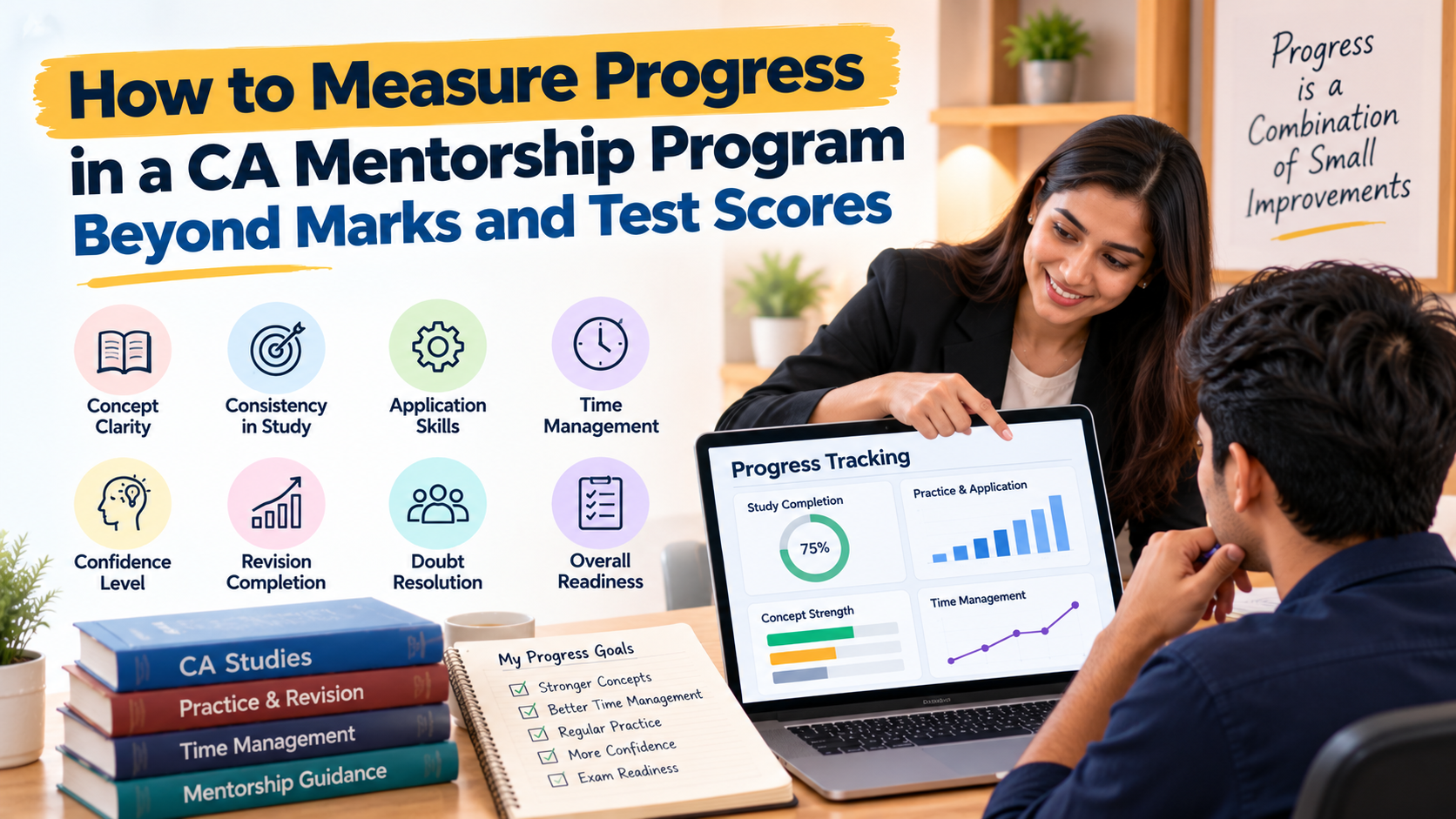
Suggested measures: consistency—planned versus completed tasks; concept clarity—closed-book explanations; application—fresh questions attempted independently; answer writing—structure and completeness; time management—time per task; error correction—repeat mistakes; independence—student-led planning and review. Ask a clear question for each area and record one next action.
Use trends, examples, and discussion together. A dashboard should make a conversation clearer, not reduce development to a single number.
How CA Exams Test Series Can Support Progress Reviews
Structured tests provide evidence about application, answer writing, accuracy, and timing. Choose chapter tests when relevant material has been studied and broader mocks when the student has sufficient coverage. After each test, review the script and record next actions rather than focusing only on the score.
CA Exams Test Series may serve as one practice resource within a wider mentorship plan. The most useful assessment matches the student’s stage and leaves time for feedback and follow-up. A later attempt can show whether advice has translated into better performance.
Avoid Turning Tracking Into Pressure
Too many metrics can overwhelm students and encourage them to optimise the tracker rather than learn. Choose only indicators linked to current goals. Keep reviews respectful, acknowledge improvements, and discuss setbacks as information about the plan.
Avoid comparing students with each other when their starting points differ. Compare current work with the student’s earlier work and the standard required by the exam. Tracking should make progress visible and guide useful action.
Conclusion
A CA mentorship program should measure more than marks. Consistency, recall, independent application, answer writing, time management, error correction, and planning skills help explain whether preparation is becoming stronger. Use a simple dashboard, review trends rather than isolated results, and connect each finding to a practical next step.
Frequently Asked Questions
How can CA mentorship progress be measured beyond marks?
Track consistency, concept recall, independent question attempts, answer presentation, time management, recurring mistakes, and the student’s ability to plan next steps. Review these indicators over time and connect each finding to a practical action.
Are mock test scores still important in mentorship?
Yes. Scores provide useful evidence of exam performance, but interpret them alongside question completion, accuracy, topic coverage, and error patterns. One score alone rarely explains the full picture.
What should a CA mentor review every week?
Review priority tasks completed, difficult concepts, practice attempts, recurring errors, and one or two actions for the next week. Keep the review focused on decisions rather than collecting excessive data.
How do I measure concept clarity?
Ask the student to explain concepts without notes, solve fresh questions, and distinguish between similar rules or methods. Record which ideas are clear and which still require prompting or targeted revision.
How can answer-writing progress be tracked?
Use a consistent checklist for relevance, structure, completeness, workings, and time. Compare answers to similar tasks and identify one specific skill to practise next.
What is an error log in CA preparation?
An error log records mistakes, likely causes, corrections, and follow-up actions. Reviewing it helps students identify repeated problems and check whether targeted practice prevents the same errors from recurring.
Can confidence be measured objectively?
Explore confidence through task-specific self-ratings and observable behaviours, such as attempting unfamiliar questions under time limits. Treat the measure as a discussion aid, not a judgement of the student.
How often should a mentorship progress dashboard be updated?
A weekly or fortnightly review is often enough, depending on the student’s needs and workload. Track only a small set of relevant indicators so measurement supports study rather than taking time away.
How can a test series support mentorship?
Tests offer evidence about application, accuracy, answer writing, and timing. Use results to identify the next learning action, then check in a later attempt whether the correction helped.
What shows that a student is becoming more independent?
The student can set realistic goals, recognise weak areas, analyse mistakes, adjust the study plan sensibly, and explain next steps without waiting for the mentor to make every decision.