Table of contentsShowHide
- 1.Confirm the official route first
- 2.Milestone one: understand your starting point
- 3.Milestone two: create a subject-wise map
- 4.Milestone three: learn concepts and practise early
- 5.Milestone four: introduce regular revision
- 6.Milestone five: measure progress with tests
- 7.Milestone six: set a syllabus completion checkpoint
- 8.Milestone seven: practise full papers
- 9.Milestone eight: plan the final revision window
- 10.Keep milestones accountable
- 11.Conclusion
Preparing for CA exams takes more than covering the syllabus. Students need to make practical decisions, test their understanding, and review progress throughout the preparation cycle. The right support system can help make that process clearer and more consistent.
CA Exams Test Series supports exam-focused practice as part of a wider study routine. The guidance below explains practical steps students can adapt to their course level, timetable, and current preparation stage. Always verify deadlines and syllabus requirements using official ICAI information.
Confirm the official route first
Confirm eligibility, registration requirements, applicable syllabus, examination schedule, and deadlines through official ICAI information. Requirements and dates can change, so do not rely only on social media posts or old timetables.
A mentor can help you organise administrative tasks and understand the sequence of preparation. Keep confirmations and official notices in one place. Academic planning should be built around verified information.
Estimate the study time available before your intended attempt, including classes, self-study, revision, test practice, and flexibility for delays.
Milestone one: understand your starting point
Review your current knowledge, available hours, learning preferences, and responsibilities before building a detailed timetable. Students have different starting points and need different pacing.
Attempt a diagnostic quiz or a small set of representative questions where appropriate. This is not a prediction of your final score; it helps identify concepts that need explanation and habits that need attention.
Agree on a realistic weekly routine. Identify time for demanding subjects, classes, self-study, and regular review. Start with a routine you can maintain before increasing the workload.
Milestone two: create a subject-wise map
Break each paper into chapters and estimate the time required for learning, practice, and revision. Do not assume every chapter needs the same number of sessions.
Use a tracker with separate columns for learning, question practice, revision, and testing. Mark a topic complete only when you can explain the concept and solve suitable questions independently.
Monthly checkpoints help prevent one subject from absorbing all available time. A subject map also shows when a paper is falling behind.
Milestone three: learn concepts and practise early
Focus on understanding concepts and practising soon after studying them. Do not postpone every question until the entire syllabus is finished; early practice reveals misunderstandings while the topic is fresh.
Use official study material and a limited number of reliable supporting resources. Collecting too many lectures and notes can slow progress. Ask your mentor to help choose a primary source and use extra resources only to solve specific gaps.
Set a chapter checkpoint that includes a closed-book summary, selected questions, and unresolved doubts. This provides better evidence than counting lectures watched.
Milestone four: introduce regular revision
Revision should begin before the first pass through the syllabus is complete. Schedule short reviews of older topics while continuing with new chapters, especially during a long preparation cycle.
Use active recall: close the book and write key points, explain a rule, or solve a question from memory. Then check gaps. Rereading can create familiarity without showing whether you can retrieve the material independently.
Keep concise revision notes containing formulas, difficult concepts, distinctions, and personal mistakes. Ask your mentor whether the notes are useful for quick review or have become too long.
Milestone five: measure progress with tests
Use timed chapter tests and subject-level practice once enough material has been covered. These tests show whether knowledge transfers to questions and whether you can work within a time limit.
Classify errors after each test. Knowledge gaps need revision; careless errors need a checking method; slow performance needs timed practice; weak written answers need structure and presentation work.
Discuss patterns with your mentor. Avoid changing the entire timetable after every mark fluctuation. Prioritise recurring weaknesses that affect several chapters or papers.
Milestone six: set a syllabus completion checkpoint
Set a target for completing first-round learning that leaves enough time for revision and full-paper practice. Work backwards from the official exam schedule instead of choosing an arbitrary cut-off.
If a chapter takes longer than expected, review the trade-off. You may need a different explanation, focused doubt-clearing, or a revised time estimate. Do not let one topic consume the time reserved for all other papers.
Keep a list of remaining gaps and decide which need immediate attention. The aim is to enter revision with a clear map rather than extending first study indefinitely.
Milestone seven: practise full papers
Full-paper practice tests recall across topics, time allocation, question selection, sustained concentration, and presentation. It differs from solving isolated questions with a textbook open.
Follow the duration and instructions applicable to your exam. Attempt the paper in exam-like conditions and record where time was spent. Analyse unanswered questions, incomplete answers, and preventable mistakes afterwards.
CA Exams Test Series can support structured practice. Select papers suited to your course and attempt, then use feedback to choose what to revise. The number of papers attempted is not the only measure of readiness.
Milestone eight: plan the final revision window
During final revision, focus on recall, important gaps, exam technique, and error correction. Avoid starting multiple new resources or rebuilding notes from scratch without a clear reason.
Use a subject rotation plan so every paper stays active. For example, combine a demanding subject, another subject for practice, and a short revision block. Adapt the sequence to your strengths and exam schedule.
Keep the plan realistic and protect time for rest. Extreme hours are not proof of commitment; consistent recall and calm execution matter more.
Keep milestones accountable
A mentor can review evidence, help make decisions, and keep the plan connected to actual progress. Bring the tracker, test results, and doubts to each checkpoint and agree on a small number of actions.
Adjust milestones when circumstances change, but do so deliberately. If targets repeatedly slip, investigate whether the workload, learning method, resources, or personal constraints need attention.
First-attempt preparation does not mean every week will be perfect. It means building a system that identifies problems early and helps you return to the plan.
Conclusion
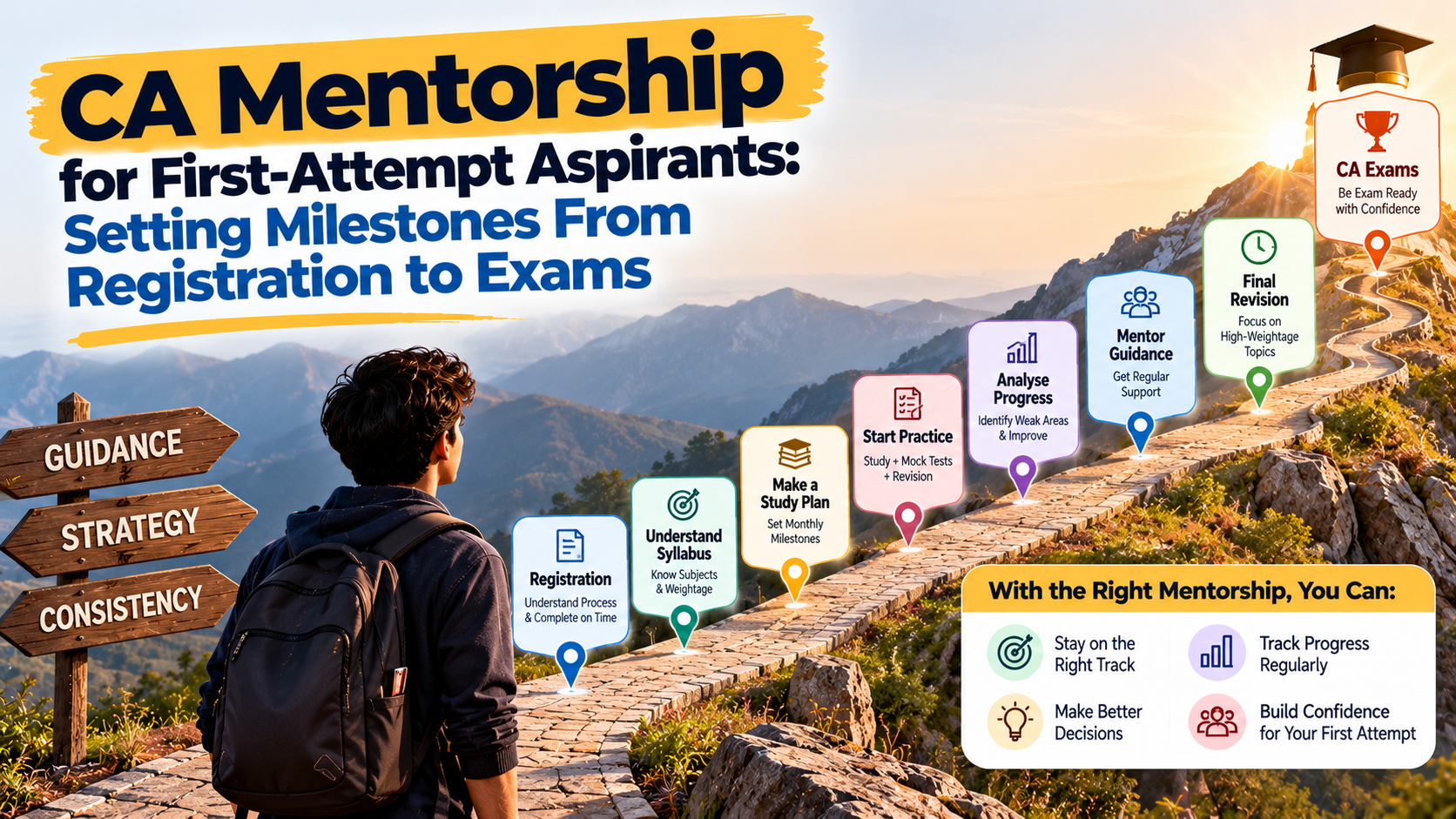
First-attempt preparation is easier to manage when divided into milestones: official registration, starting-point review, subject mapping, learning, revision, tests, and final practice. A mentor can help set realistic checkpoints and make adjustments based on evidence. Verify official requirements, practise throughout the journey, and use every test to improve the next stage.
Frequently Asked Questions
When should I start mentorship for my first CA attempt?
You can begin while planning registration and your study routine. Early guidance helps you understand requirements, map the syllabus, and set checkpoints.
What milestones should I set?
Useful milestones include confirming official requirements, mapping subjects, completing first learning, starting revision, attempting tests, finishing syllabus coverage, practising full papers, and final revision.
Should I wait until the syllabus is complete before testing?
No. Start chapter practice while learning and add subject-level and full-paper tests as preparation develops. Early testing helps reveal gaps.
How often should I review milestones?
A brief weekly check and a deeper monthly review can work well. Review often enough to identify delays early.
Can a mentor guarantee a first-attempt pass?
No ethical mentor can guarantee an exam result. Mentorship supports planning and feedback, but results depend on preparation and exam performance.
How do I choose study material?
Start with official material for your applicable course and attempt. Add limited supporting resources only when they address a specific learning need.
What should I track?
Track chapter learning, practice, revision dates, test accuracy, recurring mistakes, and completed targets rather than study hours alone.
When should I begin full-length papers?
Begin when suitable for your course level and enough material has been covered. Follow the relevant format and analyse each attempt.
What if I miss a milestone?
Identify why it was missed, assess the impact on later stages, and adjust deliberately instead of adding all missed work to the next week.
How can CA Exams Test Series help?
Structured tests provide timed practice and performance evidence. Use results to assess readiness, identify errors, and set revision targets.