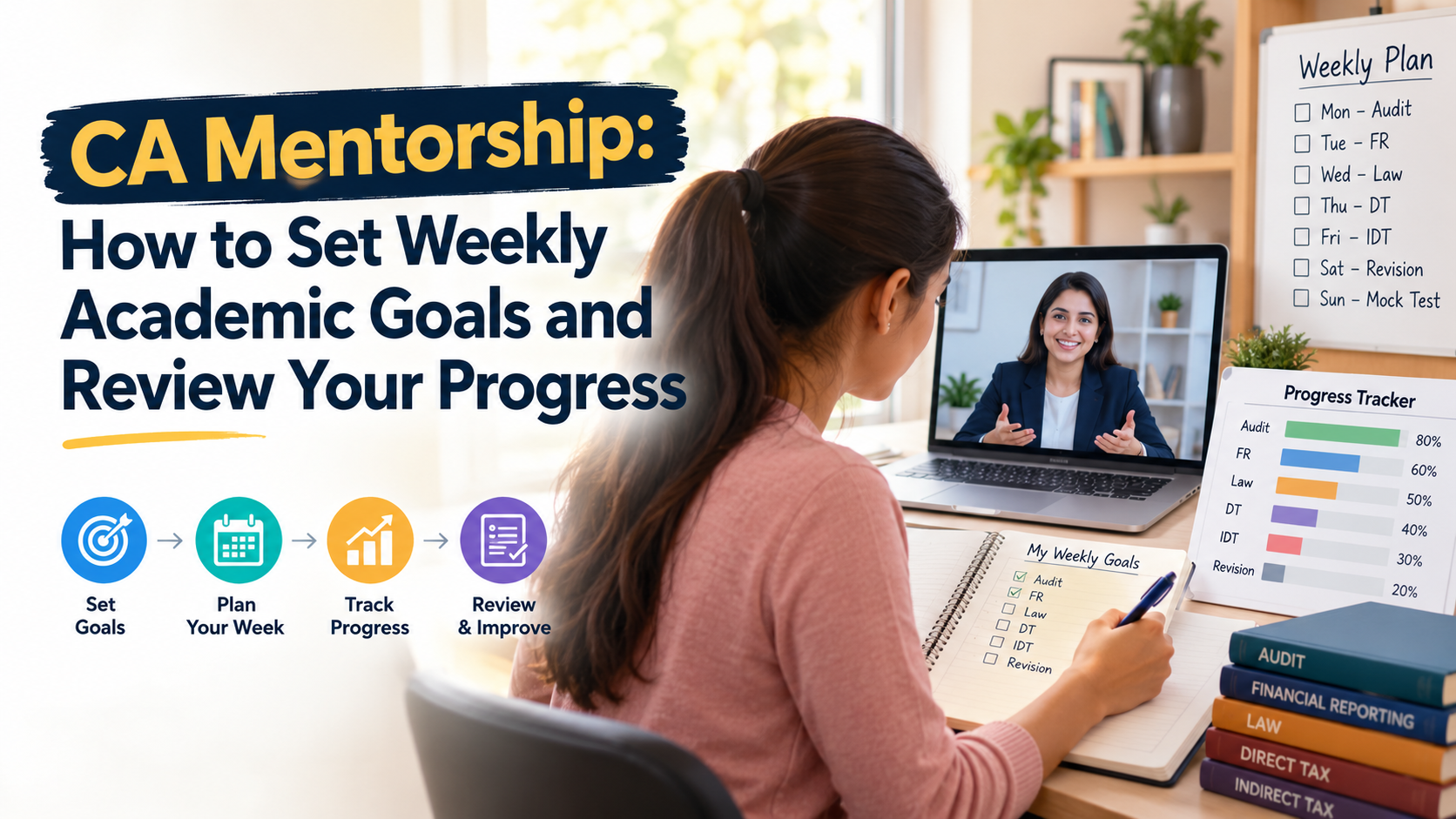

Table of contentsShowHide
- 1.What a CA Mentor Can and Cannot Do
- 2.Assess Your Current Syllabus Coverage
- 3.Review Subject-Wise Strength and Weakness
- 4.Calculate Your Realistic Study Capacity
- 5.Compare One-Group and Both-Group Strategies
- 6.Use a Readiness Scorecard
- 7.Use Mock Tests as Evidence, Not Prediction
- 8.Discuss Personal and Practical Constraints
- 9.Make a Decision With a Review Point
- 10.Questions to Ask Your CA Mentor
- 11.How CA Exams Test Series Can Help
- 12.Conclusion
Before deciding how to prepare, confirm the current examination scheme, group structure, eligibility requirements, and applicable syllabus from official ICAI information for your attempt. Exam rules and administrative details can change, so do not rely on an old timetable or a social media post.
This article focuses on planning rather than replacing official guidance. Once you know the relevant rules, assess whether your time and preparation support one group or a broader attempt strategy.
What a CA Mentor Can and Cannot Do
A mentor can help assess readiness, identify weak subjects, review practice results, and compare realistic preparation scenarios. They can challenge assumptions such as “I watched all the lectures, so I am ready” or “My friend is attempting both groups, so I should too.”
A mentor cannot guarantee a pass or remove the workload. The decision should be based on evidence and your circumstances, not pressure to choose the most ambitious option. A good mentor explains the reasoning and gives clear next steps.
Assess Your Current Syllabus Coverage
List every paper and divide it into topics or chapters. Mark each area as not started, currently learning, studied but not practised, practised, or revised and tested. This is more accurate than estimating that you are “70% prepared” without defining what it means.
Count topics as reasonably prepared only when you can solve questions or explain concepts without relying heavily on notes. If one group has substantial untouched material and the other is mostly revised, that difference matters.
Review Subject-Wise Strength and Weakness
Do not judge a subject only by whether you enjoy it. A paper may feel familiar because you recognise the lecture, yet still be difficult when solving questions independently. Review topic tests, written answers, time taken, and repeated mistakes.
Use a simple rating—strong, developing, or needs support—and add evidence beside it. “Strong” should mean you can complete a representative timed set with reasonable accuracy, not merely that the subject feels easy.
Calculate Your Realistic Study Capacity
Estimate focused hours available each week until the attempt. Include classes, work, travel, household duties, and rest. Then estimate how much time remains for learning, practice, revision, and mock tests across all papers.
Avoid a schedule that works only if you study far beyond your normal capacity. A mentor can compare a realistic one-group plan with a two-group plan and show what each would require.
Compare One-Group and Both-Group Strategies
Preparing for one group may allow deeper focus, more revision cycles, and more time to analyse tests in selected papers. Preparing for both may suit students with meaningful coverage across papers who can maintain regular practice. Neither strategy is automatically better for everyone.
Consider coverage, revision time, mock-test workload, and the risk of spreading effort too thinly. Use these factors as discussion points rather than a universal rule; your official exam rules and personal situation matter.
Use a Readiness Scorecard
For each paper, record syllabus coverage, ability to recall concepts, independent question practice, recent test performance, and revision status. Avoid adding the ratings into a single score without reviewing the details: a low result in a critical paper may matter more than several strong ratings elsewhere.
Ask your mentor to identify the biggest risk under each plan. If attempting both groups means multiple papers receive only one rushed revision, that is important evidence. If one group is well prepared and the other has a credible plan, the assessment may look different.
Use Mock Tests as Evidence, Not Prediction
Mock tests reveal how preparation holds up under time limits. They show whether you understand questions, select suitable methods, present answers clearly, and complete the paper. Use more than one assessment where possible because a single result may reflect a particular question mix.
Analyse why marks were lost. A concept gap may need focused learning; poor recall may need spaced revision; slow completion may need timed sets. Decide based on whether there is time to address the issues, not only the headline score.
Discuss Personal and Practical Constraints
The best strategy is one you can carry out consistently. Consider work, family responsibilities, finances, travel, access to classes, and support. If your routine is unpredictable, a plan with fewer competing priorities may be more sustainable. If you have protected study time and substantial coverage, a broader plan may be feasible.
Share constraints honestly. A plan should not assume responsibilities will disappear or that you can study without adequate sleep.
Make a Decision With a Review Point
Set a date to review the strategy before the final stretch. Use checkpoints such as syllabus coverage, completion of revision, and performance in representative tests. If evidence shows the plan is no longer realistic, discuss adjustments early rather than waiting until the exam is close.
Changing strategy should not be a reaction to one poor score. Look for patterns across preparation evidence and agree on what would justify a change.
Questions to Ask Your CA Mentor
Ask which papers pose the greatest risk, what evidence supports the recommendation, how much time revision needs, and what the weekly schedule would look like under each option. Also ask which warning signs should trigger a review and what you should complete before the next check-in.
These questions make advice transparent and actionable. Leave the conversation understanding not only what the mentor recommends, but why the strategy fits your situation.
How CA Exams Test Series Can Help
Timed practice gives evidence about application, answer writing, accuracy, and timing. Use chapter tests after relevant learning and broader mocks when coverage is sufficient. Review the script and record next actions instead of focusing only on the score.
CA Exams Test Series can be one resource in your preparation. Choose tests that fit your syllabus stage and leave time for feedback and follow-up.
Conclusion
A CA mentor can help you decide between Group 1 and Group 2 preparation by organising evidence: syllabus coverage, subject-wise performance, available hours, revision needs, and practical commitments. Use official exam information, realistic estimates, and timed practice. The goal is not to choose the most ambitious plan; it is to choose one you can execute consistently.
Frequently Asked Questions
Can a CA mentor decide which group I should attempt?
A mentor can help compare options using syllabus coverage, test results, available time, and personal constraints. The final decision should be yours, supported by current official exam rules and a realistic plan.
Should I prepare for Group 1 and Group 2 together?
It depends on current coverage, study capacity, and revision needs. Preparing for both may be feasible with broad preparation already in place, while uneven coverage may call for a more focused approach.
What should I show a mentor before choosing a group?
Share a paper-wise syllabus tracker, recent test results, weak topics, weekly study availability, and fixed responsibilities. This helps the mentor base guidance on evidence rather than general assumptions.
Are mock test marks enough to decide?
No. Review marks alongside question completion, accuracy, time management, recall, and mistake types. A score is more useful when you understand why it happened and whether there is time to improve.
What if I am strong in some subjects but weak in others?
Map strengths and weaknesses by paper and chapter. Estimate the time needed to address weak areas, then compare that workload with your available study hours before choosing a strategy.
Can I change my group preparation strategy later?
Review your strategy as preparation develops, while following applicable exam rules. Set a review date and clear indicators rather than reacting to one difficult test.
How much revision time should I reserve?
Reserve enough time to revisit covered topics, practise exam-style questions, and analyse timed tests. The amount varies, so estimate it from your tracker and actual practice speed.
Should I follow my friends’ group strategy?
Use friends’ experiences as context, not as a decision rule. Their coverage, available hours, strengths, and responsibilities may differ. Decide using your own evidence.
What if my mentor recommends a plan I cannot follow?
Explain which assumptions do not fit your schedule and ask for a revised version. Effective guidance should account for realistic study capacity, buffer time, and priorities.
How can CA Exams Test Series help with this decision?
Chapter tests and mocks can reveal readiness, weak areas, and time-management issues across papers. Use results alongside syllabus coverage and mentor discussion.