Table of contentsShowHide
- 1.Start with an honest subject-wise assessment
- 2.Consider difficulty, syllabus size and current progress
- 3.Use a priority score to guide your timetable
- 4.Allocate time differently for practical subjects
- 5.Allocate time for theory-oriented subjects
- 6.Build revision into the timetable from the beginning
- 7.Use focused study blocks and realistic daily targets
- 8.Review mock-test performance before changing hours
- 9.Example of a flexible weekly allocation
- 10.Adjust the strategy as the examination gets closer
- 11.Quick Reference Table
- 12.How CA Exams Test Series Can Support Your Preparation
A CA study timetable can look balanced on paper and still fail in practice. Giving every subject the same number of hours may not work because subjects differ in difficulty, syllabus size, question style and the student’s level of preparation. Some topics need concept building, while others need repeated problem-solving or frequent revision.
A better time-allocation strategy considers both the demands of each subject and your current performance. This guide explains how to assess your priorities, divide study hours, protect revision time and adjust the plan as the examination approaches.
Start with an honest subject-wise assessment
List every subject and divide its syllabus into completed, in progress and not started. For each chapter, record your understanding, ability to solve questions and confidence in recalling key points. Avoid marking a chapter complete merely because you have watched a lecture or read it once.
Use evidence from question practice and tests. A chapter that has been studied but cannot be applied independently still needs work. This assessment helps you identify where time is actually required instead of allocating hours based only on how comfortable a subject feels.
Consider difficulty, syllabus size and current progress
Three factors should influence your time allocation: how much content remains, how difficult it is for you and how well you can currently perform. A large subject may need more total time, while a smaller but weak subject may need focused sessions.
Also consider the nature of the paper. Practical subjects often need regular question practice. Theory-oriented subjects need reading, recall and answer writing. A subject you enjoy should not automatically receive more time than a subject where your performance is weak.
Use a priority score to guide your timetable
A simple priority score can help compare topics. Rate each chapter from one to three for difficulty, preparation gap and importance in your study plan. Add the scores and review the highest totals first. This is a planning aid, not a prediction of examination questions or a replacement for the official syllabus.
You can also classify chapters as high priority, medium priority and maintenance. High-priority chapters need concept work and practice. Medium-priority chapters need completion and revision. Maintenance chapters need shorter recall sessions and occasional questions so that they are not forgotten.
Allocate time differently for practical subjects
Practical subjects usually require a cycle of concept learning, worked examples and independent questions. Avoid spending the entire session watching solutions. After understanding the method, close the solution and attempt a similar question yourself.
Plan regular practice rather than leaving all numerical work for weekends. Short daily sessions can keep calculation methods familiar, while longer sessions can be used for full-length questions and mixed practice. Include time to review workings and identify recurring mistakes.
Allocate time for theory-oriented subjects
Theory subjects need structured reading, recall and answer-writing practice. Divide a chapter into manageable sections and identify the key concepts, technical terms and application points. After reading, close the material and reproduce the outline from memory.
Use writing practice to improve relevance and presentation. Attempt questions that require explanation, distinction or application. Review whether your answer addresses the specific demand of the question instead of including unrelated material. Regular short revision sessions help keep earlier chapters active.
Build revision into the timetable from the beginning
A common planning mistake is to schedule only first-time study and assume revision can be fitted in later. Reserve time every week for older chapters. Use brief sessions for formulas, provisions and summaries, and longer blocks for mixed questions or mock tests.
As the exam approaches, gradually shift the balance from learning new material to revision and application. The exact shift depends on how much syllabus remains. Avoid abandoning unfinished areas too early, but also avoid delaying all revision until the final days.
Use focused study blocks and realistic daily targets
Divide available study time into focused blocks with short breaks. Each block should have a measurable task, such as completing a subtopic, solving a set of questions or revising a specific chapter. A target such as “study tax for three hours” is less useful than a defined outcome.
Place demanding work during the part of the day when your concentration is strongest. Use shorter blocks for recall, formula review or checking errors. Leave some flexibility for difficult topics that take longer than expected, and avoid planning every minute without a buffer.
Review mock-test performance before changing hours
A mock test can show whether your time allocation is producing results. Look at subject-wise accuracy, questions left incomplete, time spent on different sections and topics where marks were lost. Separate knowledge gaps from time-management issues.
If you know the method but take too long, practise timed sets. If you choose the wrong method, revisit concepts. If you forget a rule, schedule recall and spaced revision. Change your timetable based on these findings rather than reacting to one disappointing score without analysis.
Example of a flexible weekly allocation
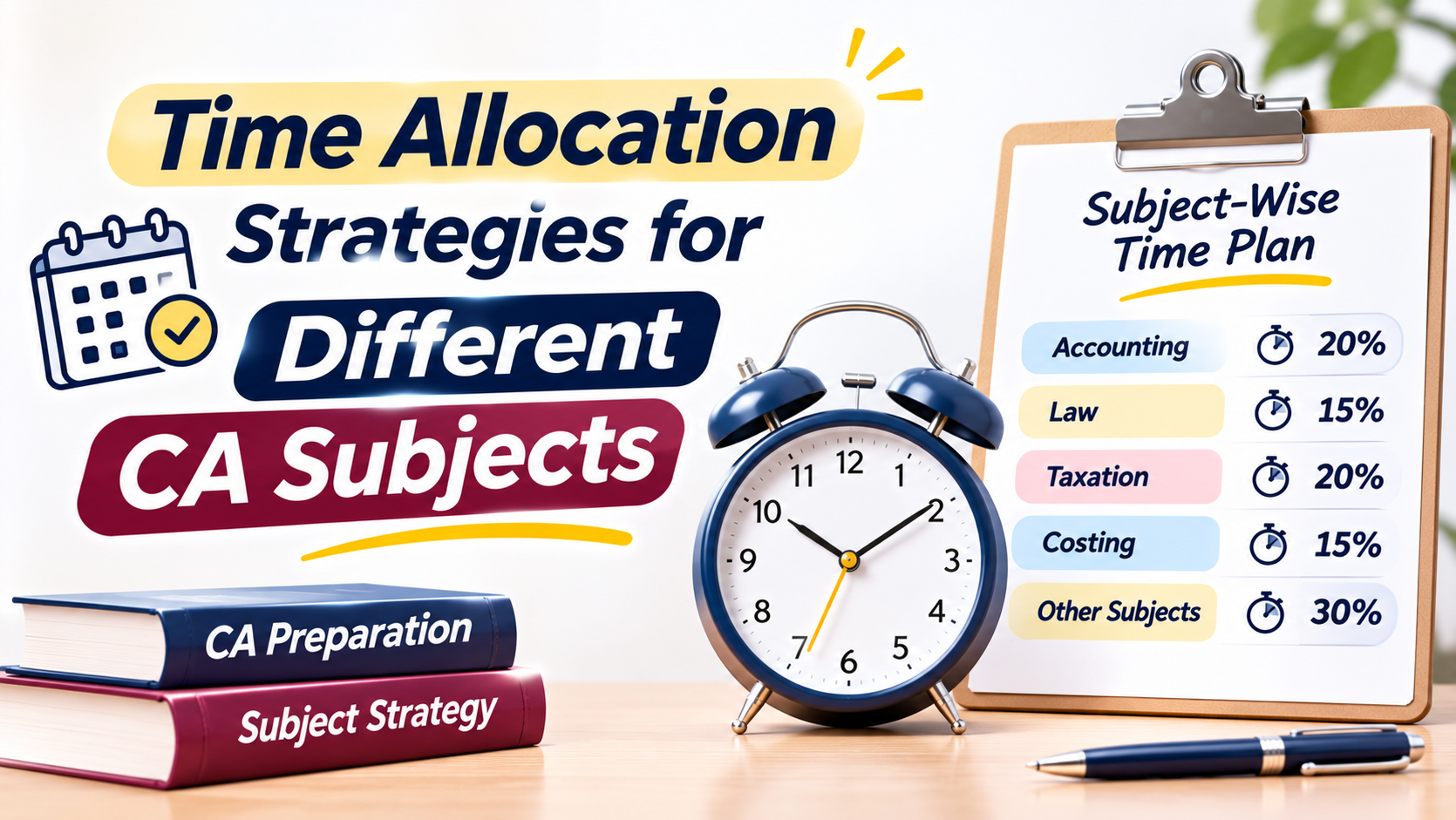
Suppose you have 30 focused study hours available in a week. You might allocate 10 hours to a subject with a large unfinished portion, 8 hours to a difficult practical subject, 6 hours to a theory subject, 3 hours to cumulative revision and 3 hours to a test and its analysis. This is only an illustration; your own split should reflect your course level, subject combination and progress.
Review the allocation every week. If a subject improves, move some time to a weaker area. If a test reveals a serious gap, add a targeted session. Keep the plan flexible enough to respond to evidence.
Adjust the strategy as the examination gets closer
In the early stage, focus on building understanding and completing the syllabus systematically. In the middle stage, increase question practice and begin cumulative revision. In the final stage, use concise notes, marked questions, mock tests and error logs.
Do not make major timetable changes every day. Review progress at a fixed weekly time and make limited adjustments. Protect rest and avoid sacrificing all breaks to create unrealistic study hours. Consistency and a clear priority order are more useful than an elaborate schedule that is constantly rewritten.
Quick Reference Table
| Study need | Suggested time approach | What to measure |
|---|---|---|
| Unfinished difficult topics | Longer focused blocks | Topics completed and questions solved |
| Practical subject practice | Frequent, consistent sessions | Accuracy, method selection and speed |
| Theory subject revision | Short recall plus answer writing | Recall quality and answer relevance |
| Older chapter revision | Weekly spaced sessions | Retention and mixed-question performance |
| Mock tests and analysis | Dedicated test plus review time | Time use, accuracy and recurring errors |
How CA Exams Test Series Can Support Your Preparation
A structured CA Exams Test Series can help you check how well you understand and apply the concepts you have studied. Use sectional and full-length tests to practise within time limits, review the solutions and identify recurring gaps. Test performance should guide your next revision steps, while the prescribed syllabus and official study material remain the foundation of preparation.
Frequently Asked Questions
How many hours should I study each CA subject daily?
There is no universal daily hour requirement. Divide your available study time according to syllabus progress, difficulty and performance, while ensuring that every subject receives regular attention and revision.
Should I give equal time to all CA subjects?
Equal time may not suit every student. A subject with a larger unfinished syllabus or weaker performance may need more hours, while a stronger subject may need shorter maintenance and revision sessions.
How do I decide which CA subject to study first?
Start with your current preparation status and identify subjects with major gaps or difficult topics. Plan demanding work when your concentration is strongest and rotate subjects to maintain continuity.
How much time should I keep for revision?
Include revision from the beginning rather than waiting until the syllabus is complete. Reserve weekly sessions for older topics and increase revision and practice time as the examination approaches.
How should I divide time between practical and theory subjects?
Practical subjects need regular independent question-solving, while theory subjects need structured reading, recall and answer writing. Adjust the balance based on your subject combination and performance.
Should I study one subject for an entire day?
A full-day subject focus can be useful for completing a difficult topic, but many students benefit from rotating subjects. A mix can reduce monotony and keep previously studied material active.
How can I manage multiple CA subjects without confusion?
Use a weekly plan with clear subject blocks, chapter-level targets and revision slots. Track completion and avoid switching tasks repeatedly within a single focused session.
When should I take mock tests?
Begin topic or sectional tests as you complete portions of the syllabus. Add full-length mock tests when you have sufficient coverage, then analyse the results and use them to adjust your preparation.
What should I do if one subject is taking too much time?
Identify whether the delay comes from weak concepts, slow question-solving or an unrealistic target. Break the topic into smaller tasks, seek clarification where needed and review the weekly allocation.
Can CA Exams Test Series help with time management?
CA Exams Test Series can help you practise under timed conditions and review how you use the available time. Analyse unfinished questions, accuracy and weak topics before adjusting your study timetable.