Table of contentsShowHide
- 1.Start with an Honest Review of Your Current Preparation
- 2.Classify Topics by Understanding and Exam Readiness
- 3.Use Mock Test Performance to Set Priorities
- 4.Prioritize According to the Time Left Before the Examination
- 5.Balance Difficult, Important and Time-Consuming Chapters
- 6.Build a Weekly Priority Plan
- 7.Use a Simple Priority Matrix for Daily Decisions
- 8.Avoid Common Mistakes While Prioritizing the Syllabus
- 9.How CA Exams Test Series Can Support Your Preparation Review
- 10.Review and Update Your Priorities Every Week
- 11.Conclusion
Preparing for a CA examination involves more than completing chapters one after another. The syllabus is extensive, subjects demand different kinds of practice, and the time available before an attempt is limited. A student who studies every topic for the same number of hours may spend too much time on familiar areas while leaving important weaknesses unresolved.
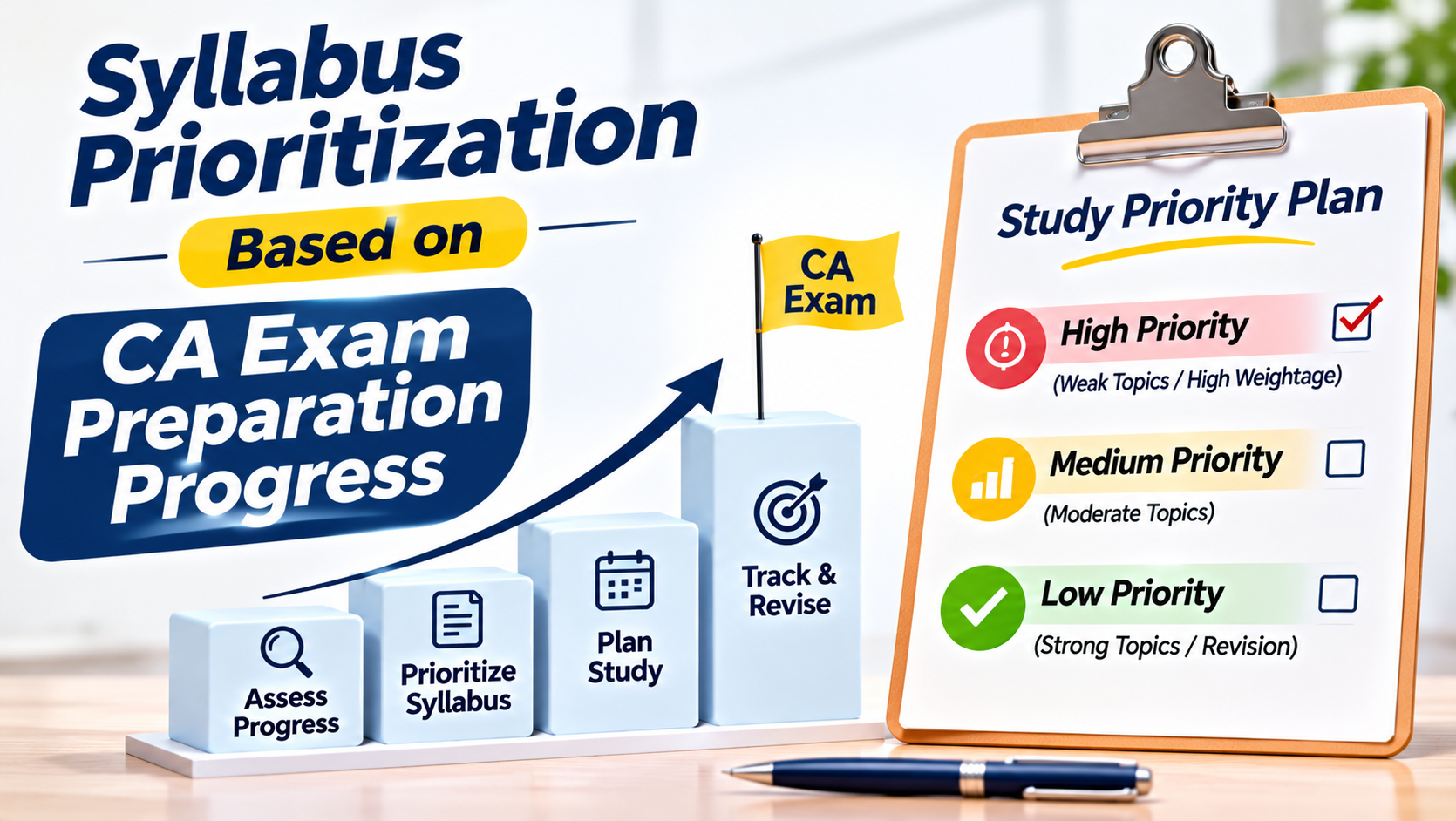
Syllabus prioritization helps you decide what deserves attention now, what needs regular revision and what can be scheduled for later. The decision should be based on your actual preparation progress rather than a fixed timetable copied from another student. Your level of understanding, question-solving accuracy, revision history and performance in mock tests should guide the next step.
The purpose is not to skip topics casually. It is to use available study time intelligently while maintaining coverage of the applicable ICAI syllabus. A clear priority system makes preparation more balanced and reduces last-minute pressure.
Start with an Honest Review of Your Current Preparation
Before changing your timetable, take stock of where you stand in every subject. List all chapters and divide them into three broad groups: completed and understood, studied but not yet confident, and not started or substantially incomplete. Be honest while assigning a status. Watching a lecture or reading a chapter once does not automatically mean that you can solve its questions independently.
For each chapter, record the date of your last revision, whether you have attempted questions without looking at the solution, and how accurately you performed. This quick audit gives you a realistic picture of your preparation. It also prevents a common mistake: treating syllabus coverage as the same thing as exam readiness.
Use a simple tracker with columns for chapter, first study, question practice, revision, test score and next action. Update it after each study session or weekly review. The tracker need not be complicated; it only needs to show what you know and what you should do next.
Classify Topics by Understanding and Exam Readiness
A useful way to prioritize is to classify every topic by both understanding and performance. A chapter may feel familiar but still produce errors when you attempt a full question. Another chapter may be conceptually clear but need more speed practice. These situations require different actions.
High confidence:** You can explain the concept, recall the relevant provisions or formulas, and solve a range of questions with reasonable accuracy. Keep these topics active through spaced revision and mixed practice rather than repeatedly relearning them from the beginning.
Partly understood:** You understand the basic idea but struggle with adjustments, application, exceptions or lengthy questions. These topics usually deserve focused practice and a short review of the underlying concept.
Low confidence or untouched:** You cannot explain the topic clearly, have not studied it, or depend heavily on solutions. Give these areas structured learning time. Break large chapters into smaller sections and build understanding before moving to advanced questions.
This classification should be reviewed regularly. A topic can move from low confidence to partly understood and eventually to high confidence as your preparation improves.
Use Mock Test Performance to Set Priorities
Mock tests and chapter-wise tests provide evidence about how well you can apply what you have studied. After each test, do more than note the marks. Identify why marks were lost. Common reasons include a concept gap, incorrect interpretation, forgotten formula, calculation error, incomplete presentation, poor time management or leaving a question unattempted.
A concept gap requires learning or relearning. A recall problem calls for active recall and spaced revision. A calculation or presentation issue needs targeted question practice. If you repeatedly run out of time, practise timed sets and review how long you spend on each question.
Maintain an error log with the question or topic, reason for the mistake, correct approach and date for reattempt. Revisit the same question after a few days without looking at the solution. If you can solve it correctly, the correction is more likely to have become part of your working knowledge.
Do not let one poor test define your ability. Look for patterns across several tests and use the results to adjust your plan.
Prioritize According to the Time Left Before the Examination
The right priority changes as the examination approaches. Early in preparation, the main goal is to build conceptual understanding and cover the syllabus in a planned sequence. In the middle phase, question practice and revision become more important. During the final phase, the focus should shift towards recall, exam-style practice, error correction and consolidating topics already studied.
If several months remain, avoid spending all your time on easy chapters simply because they create a feeling of progress. Allocate consistent time to difficult areas while continuing to move through the syllabus. If only a few weeks remain, identify essential pending coverage, revise high-value concepts and practise questions under time limits. Do not attempt to learn every unfamiliar topic in depth at the cost of revising the rest of the syllabus.
The exact schedule depends on your CA level, attempt, applicable syllabus and personal circumstances. Always check the latest ICAI study material, announcements and examination guidance for your attempt.
Balance Difficult, Important and Time-Consuming Chapters
A chapter should not be prioritized on a single factor alone. Consider three things together: your current command over it, its relevance within the applicable syllabus and the time required to improve. A difficult topic that repeatedly causes errors may need attention even if it takes longer to master. A topic you already know well may need only a short revision session.
Avoid assuming that a chapter can be ignored because it appears lengthy or challenging. Likewise, do not allocate excessive time to one familiar area simply because solving its questions feels comfortable. Aim for a balanced plan that protects overall syllabus coverage and addresses individual weaknesses.
For practical subjects, include time for full-format questions and working notes. For theory-heavy areas, practise structured answers, key terms and application to case scenarios. For subjects involving calculations and interpretation, combine concept review with repeated problem-solving.
Build a Weekly Priority Plan
Convert your chapter audit into a weekly plan. Select a small number of priority outcomes for each subject rather than writing a long list of vague tasks. For example, an outcome might be to revise a specific chapter, solve a defined set of questions and attempt a short timed test.
A practical weekly structure can include three types of sessions. First, learning sessions for topics that are incomplete or weak. Second, practice sessions for topics that are understood but not yet reliable under exam conditions. Third, revision sessions for topics that are already covered and need to remain fresh.
Keep some flexible time for unexpected backlogs and test analysis. A timetable that is full from morning to night can fail as soon as one task takes longer than expected. Review progress at the end of the week and move unfinished tasks forward deliberately. Do not simply copy every missed task into the next day; decide whether it is still the highest priority.
Use a Simple Priority Matrix for Daily Decisions
When you are unsure what to study next, use a four-part decision method. Give each chapter a rating for confidence and urgency. Low-confidence topics that are important for the upcoming preparation stage should receive focused attention. High-confidence topics should remain in the revision cycle. Topics that are neither urgent nor weak can be scheduled after immediate gaps are addressed.
| Topic status | Recommended action | How to check progress |
|---|---|---|
| Not studied or very weak | Learn in smaller sections and solve basic questions | Explain the concept and attempt questions independently |
| Studied but inaccurate | Review errors and practise targeted questions | Improve accuracy in a fresh question set |
| Understood but slow | Complete timed practice and improve question selection | Compare time taken and accuracy |
| Strong and recently revised | Use spaced revision and mixed tests | Retain accuracy after a gap |
This matrix is a guide, not a substitute for understanding the syllabus. Adjust it according to the subject and the requirements of your examination.
Avoid Common Mistakes While Prioritizing the Syllabus
One frequent mistake is repeatedly changing the study plan after every difficult question. A challenging question may reveal a gap, but it does not always mean the entire chapter must be restarted. Diagnose the exact issue before changing your schedule.
Another mistake is prioritizing only by perceived weightage or predictions. Past trends can help you understand the nature of examinations, but they cannot guarantee what will appear in your attempt. Do not leave syllabus areas untouched based only on assumptions about likely questions.
Students also sometimes confuse long study hours with measurable progress. Track completed questions, revision quality, accuracy and the ability to recall concepts without notes. Finally, avoid postponing revision until the whole syllabus is complete. Without planned revision, earlier chapters can become unfamiliar by the time you reach the final stage.
How CA Exams Test Series Can Support Your Preparation Review
A structured test series can help turn your preparation progress into measurable information. Chapter-wise tests show whether you can apply a topic after studying it. Subject-level tests help you identify gaps across chapters, while full-length mock examinations provide practice with timing, question selection and answer presentation.
Use test feedback as a planning tool rather than treating marks as the only measure of progress. Note recurring errors, compare performance across attempts and schedule specific corrective practice. Reattempting questions after reviewing the feedback helps you check whether the weakness has actually improved.
CA Exams Test Series can be included in a preparation routine as a way to practise exam-style questions and review performance. Choose tests that match the applicable syllabus and examination pattern, and leave enough time to analyse each attempt. A test without analysis offers only a score; a test followed by correction can guide your next study cycle.
Review and Update Your Priorities Every Week
Your priority list should change as your preparation develops. At the end of each week, check which topics moved forward, which tasks remained incomplete and whether test performance improved. If a weak chapter is now reliable, reduce its study time and maintain it through revision. If a previously strong topic begins producing errors, bring it back into focused practice.
Keep the next week's plan realistic. Include revision of older chapters, current syllabus coverage and practice tests. Set measurable targets and avoid filling every available hour. Consistency is more useful than repeatedly creating an ambitious timetable that cannot be followed.
Most importantly, judge progress by what you can recall and apply independently. A completed checklist is useful, but the real goal is being able to handle unfamiliar questions with a clear method and sound understanding.
Conclusion
Syllabus prioritization based on CA exam preparation progress helps you direct effort where it can make the greatest difference. Begin with an honest chapter audit, classify topics by confidence, analyse mock test errors and adapt your plan to the time remaining. Keep strong areas in the revision cycle while giving weak topics focused attention.
There is no single priority order that works for every CA student. Your own preparation record should guide your decisions. With regular review, targeted practice and a realistic timetable, you can make syllabus coverage more systematic and enter the examination better prepared.
Frequently Asked Questions
What is syllabus prioritization in CA exam preparation?
Syllabus prioritization means deciding which CA topics need immediate study, focused practice or revision based on your understanding, test performance, syllabus coverage and the time remaining before the examination.
How should I prioritize CA subjects when I have limited time?
Review your progress in every subject, identify weak and incomplete chapters, and balance them with regular revision of stronger topics. Use timed practice and test analysis to decide where additional effort is needed.
Should I study difficult CA chapters first?
Start difficult chapters early enough to understand them, but do not ignore the rest of the syllabus. Give extra time to topics that are both weak and important while maintaining regular progress in other subjects.
How often should I update my CA study priorities?
Review your priorities weekly and make smaller adjustments after tests. A weekly review is frequent enough to respond to progress without changing your entire timetable after every challenging study session.
Can mock tests help me decide what to revise?
Yes. Mock tests reveal whether errors come from weak concepts, poor recall, calculation mistakes, presentation or time management. Use this feedback to select specific topics and skills for your next revision sessions.
Should I revise completed chapters before finishing the full syllabus?
Yes. Schedule short, regular revision sessions while continuing syllabus coverage. This helps prevent earlier topics from becoming unfamiliar and reduces the amount of relearning required near the examination.
How do I know whether a chapter is fully prepared?
You should be able to explain its key concepts, recall relevant provisions or formulas, solve different question types independently and perform reasonably well in a timed test without relying on solutions.
Is it safe to skip low-priority topics in CA exams?
Avoid skipping topics solely because of predictions or past trends. Prioritization should help manage time, not replace syllabus coverage. Check the current ICAI syllabus and make informed decisions about the depth and timing of study.
What should I do if my mock test scores are not improving?
Analyse repeated errors, identify whether the cause is conceptual or practical, and create targeted correction sessions. Reattempt similar questions after a gap and monitor accuracy, not just the overall score.
How can CA Exams Test Series help with syllabus planning?
A suitable test series provides chapter-wise and full-length practice that can highlight preparation gaps. Reviewing the feedback and scheduling corrective practice can help you decide which topics need more attention.