Table of contentsShowHide
- 1.Begin With a Quick Readiness Check
- 2.Prioritise Core Concepts and Frequently Practised Areas
- 3.Revise Actively, Not by Rereading Everything
- 4.Use a Mistake Log as a Revision Map
- 5.Practise Under Realistic Time Limits
- 6.Final-Week Revision Table
- 7.Balance Coverage and Depth
- 8.Prepare a Final Review Sheet
- 9.Use CA Exams Test Series Strategically
- 10.The Day Before the Examination
- 11.During the Exam: Keep Your Plan Simple
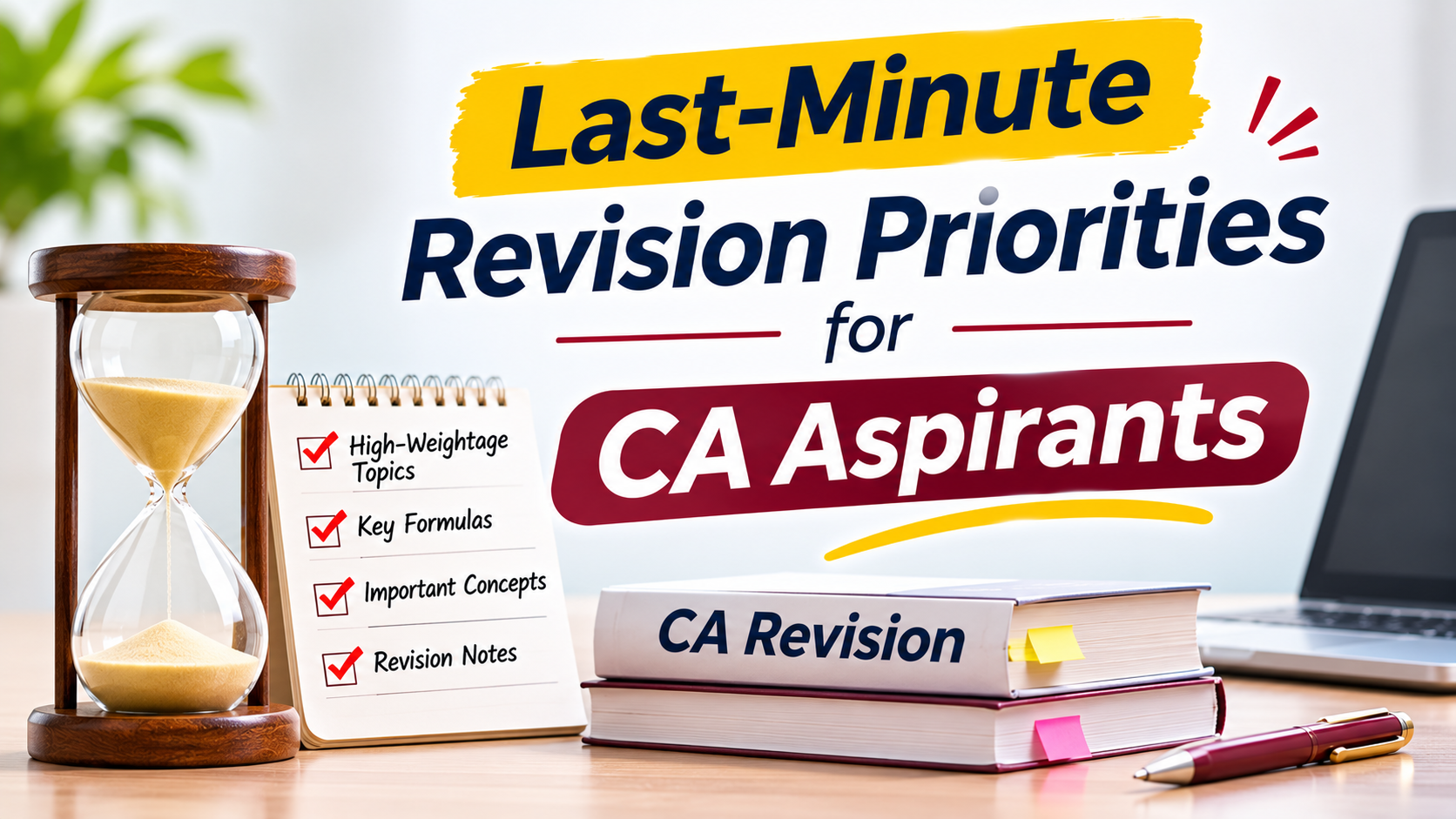
The final days before a CA examination can feel stressful because the syllabus may seem larger than the time left. Trying to reread every chapter from the beginning often creates more pressure and leaves too little time for question practice. A clear revision order helps you use the remaining days more effectively.
Your goal now is to strengthen what you have studied, correct recurring mistakes and practise answering within the exam limit. The exact priority will depend on your CA level, paper, syllabus coverage and personal weaknesses, so use the plan below as a framework rather than a rigid rule.
Begin With a Quick Readiness Check
List the chapters you have completed, those that need revision and any areas you have not studied adequately. Check the applicable syllabus and upcoming paper schedule. This short audit helps you avoid spending the final days on familiar material while ignoring a major gap.
Divide remaining tasks into three groups: must-revise concepts, question practice and low-confidence areas that need focused repair. Keep the list short enough to act on. If you create a huge list with no time allocation, it can increase anxiety without improving preparation.
Prioritise Core Concepts and Frequently Practised Areas
Start with concepts that support many question types, important methods, key provisions and topics where your past practice shows repeated errors. Use the current syllabus and relevant official material to guide your choices. Past-paper patterns can inform revision, but they cannot guarantee what will appear.
Do not completely ignore a chapter only because you believe it is low-weightage. If time is short, make a sensible coverage decision: revise its core ideas and practise representative questions rather than spending the entire day on one difficult subtopic.
Revise Actively, Not by Rereading Everything
Read a small section, close the notes and recall the main points. Write the steps of a calculation, explain a rule aloud or solve a question without looking at the answer. Active recall helps reveal what you actually remember and what still needs attention.
Use concise revision sheets created during preparation, if you have them. If you do not, make short notes now only for items that are genuinely useful: formulae, key distinctions, steps, common errors and concepts that are easy to confuse. Avoid rewriting full chapters at this stage.
Use a Mistake Log as a Revision Map
Review errors from mock tests, chapter tests and homework. Group them by cause: concept not understood, formula forgotten, calculation error, question misread, incomplete answer, poor presentation or time shortage. This list is often more useful than choosing revision topics randomly.
Practise a small number of questions that target each recurring error. After correcting one, attempt a similar question later without help. The aim is to change the habit that caused the mistake, not simply to read the solution and move on.
Practise Under Realistic Time Limits
Timed practice helps you decide how long to spend on each question, when to move on and how to keep answers clear under pressure. If a full paper is appropriate and you have enough time to review it, attempt one under exam-like conditions. Otherwise, use timed sections or selected questions.
Do not take several full mock tests back-to-back without analysis. A test consumes time and energy; its value comes from reviewing the result, understanding lost marks and correcting weaknesses. Choose practice that produces useful feedback rather than chasing a large test count.
Final-Week Revision Table
| Period | Main priority | Practical task |
|---|---|---|
| 7–5 days before | Coverage and weak areas | Review the syllabus checklist and core concepts |
| 4–3 days before | Question practice | Solve selected questions and correct recurring errors |
| 2 days before | Timed practice and consolidation | Attempt a paper or timed sections; review mistakes |
| 1 day before | Light revision and logistics | Review concise notes and prepare exam essentials |
| Exam day | Execution | Read instructions, pace answers and check key work |
Use this example to structure the last week. Adapt it to the number of papers, the time remaining and your syllabus progress.
Balance Coverage and Depth
Students sometimes spend too long perfecting a familiar chapter because it feels comfortable. Others try to learn an entire unfamiliar module in the final evening. Neither approach is ideal. Allocate time according to importance, current understanding and the amount of work needed to improve.
For a strong topic, a brief recall session and selected questions may be enough. For a weak but important topic, return to the core concept and practise representative problems. For a topic you cannot master fully in the time available, learn the most useful fundamentals without sacrificing every other subject.
Prepare a Final Review Sheet
Create one compact checklist for the paper: formulae or key rules, formats, steps that are easy to forget, common errors and any important points you consistently miss. Keep it short enough to review quickly. The sheet should complement your main notes, not replace them.
Use it in several short sessions rather than reading it once on the last night. Mark items you can recall confidently and return to the ones that remain difficult. Avoid adding too much new information just because there is space on the page.
Use CA Exams Test Series Strategically
CA Exams Test Series can be useful in the final stage when the tests match your syllabus and exam format. Choose a mock or a focused practice paper based on the time remaining. Review your performance, note repeated errors and schedule a correction session before taking another test.
If a mock score is lower than expected, treat it as diagnostic information rather than a prediction of your actual result. Identify whether the issue was knowledge, timing, accuracy or presentation. Use the remaining time to address the most important cause.
The Day Before the Examination
Keep the day before the paper focused and calm. Review concise notes, correct recurring mistakes and check the exam instructions, required documents and permitted items. Avoid starting a large new resource or comparing predictions with other students late into the evening.
Prepare your travel and exam-day arrangements in advance. Eat normally, stay hydrated and protect sleep. An exhausted student may struggle to retrieve knowledge even after many additional hours of reading, so rest is part of preparation rather than wasted time.
During the Exam: Keep Your Plan Simple
Read the instructions carefully, scan the questions as permitted and manage time according to marks and requirements. Start with a question you can approach confidently if the paper format allows flexibility. Keep workings and theory answers organised, and leave a little time to check important calculations and incomplete parts.
If a question feels unfamiliar, do not assume the whole paper will be difficult. Identify what the question is asking, apply the concepts you know and move on if you become stuck. A calm, structured approach helps you make better use of the preparation you have completed.
Frequently Asked Questions
What should I revise first in the final days before a CA exam?
Begin with core concepts, important methods and the mistakes that repeatedly cost you marks. Check your syllabus coverage and use relevant official material. Then practise representative questions under realistic time limits.
Should I study new chapters at the last minute?
Study a new topic only after considering its importance, your current coverage and the time available. Learn core fundamentals where useful, but do not sacrifice revision of everything you already know to chase one difficult chapter.
How many mock tests should I take before the CA exam?
Quality matters more than quantity. Choose a number that leaves enough time to analyse mistakes and correct them. A well-reviewed mock or timed section can be more useful than several papers attempted without review.
Is it better to revise notes or solve questions?
Use both. Concise notes refresh concepts, while questions show whether you can apply them. The closer you get to the exam, the more important it becomes to combine quick recall with exam-style practice.
What should I do if I forget formulae during revision?
Write the formula from memory, check it against your trusted notes and solve a question that uses it. Revisit it after a short gap. This is more effective than repeatedly reading the formula without testing recall.
Should I study all night before the CA exam?
Avoid making an all-nighter your plan. Sleep supports attention and recall. Use the final evening for light revision, exam logistics and rest rather than trying to cover a large amount of unfamiliar material.
How can I reduce panic before the exam?
Break the remaining work into short, specific tasks and focus on the next action rather than the entire syllabus. Review what you know, practise calmly and avoid unverified predictions or stressful comparisons with other students.
What is the best way to use a mistake log?
Group mistakes by cause, choose the most important recurring issues and practise questions that target them. Reattempt incorrect questions without looking at solutions to check whether the underlying problem has been corrected.
Can CA Exams Test Series help with last-minute revision?
A syllabus-aligned test can help you practise timing and identify remaining weaknesses. Choose tests strategically and leave enough time to review feedback and correct errors before the examination.