Table of contentsShowHide
- 1.What Subject-Wise Weightage Means
- 2.Start With the Current ICAI Syllabus
- 3.How to Analyse Weightage Without Over-Relying on Predictions
- 4.A Practical Method for Allocating Study Time
- 5.Sample Weekly Planning Table
- 6.Combine Weightage With Personal Strengths and Weaknesses
- 7.Use Mock Tests to Check Whether the Plan Works
- 8.How CA Exams Test Series Can Support Your Plan
- 9.Common Weightage-Planning Mistakes
- 10.A Final Checklist Before the Exam
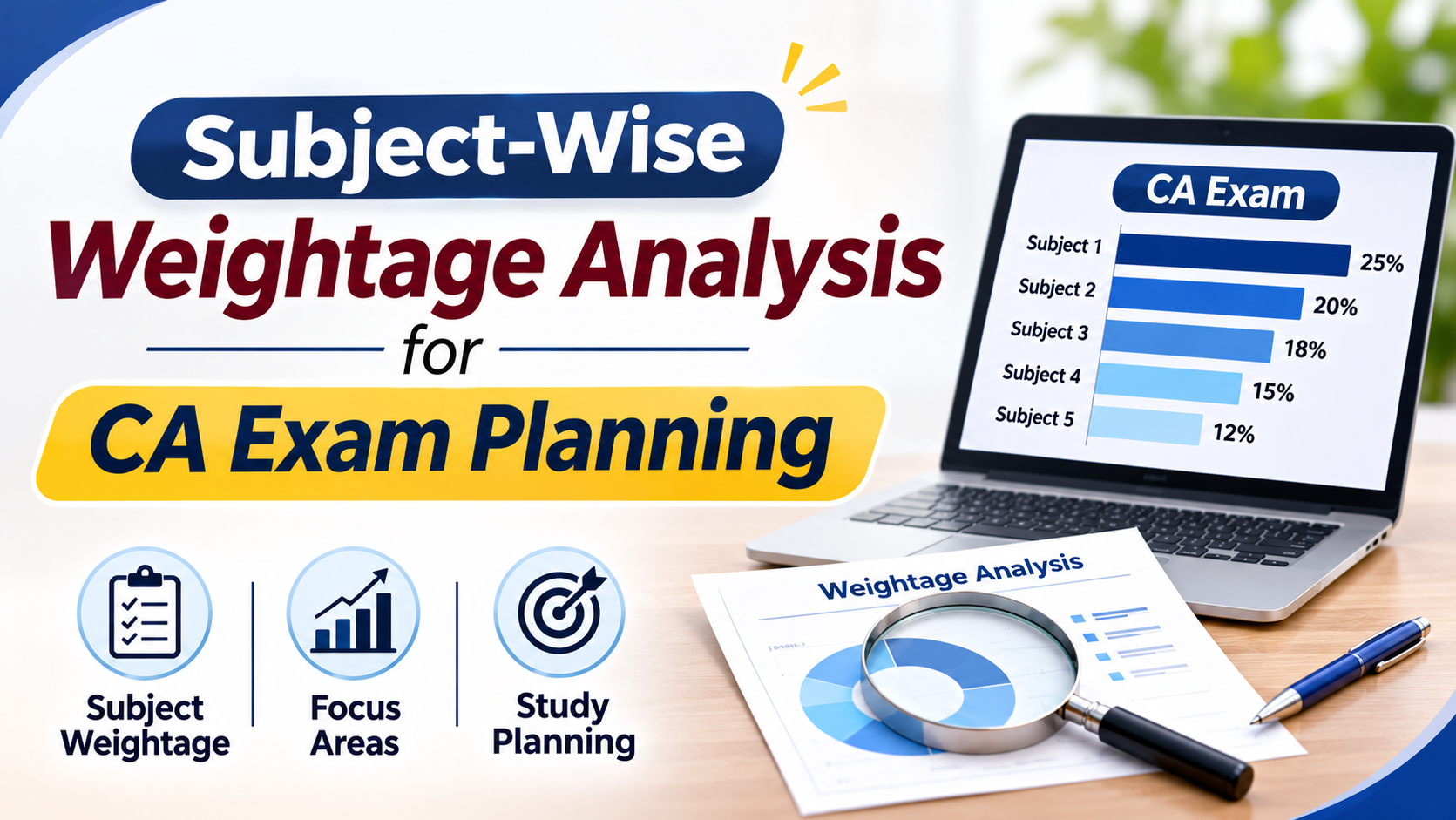
Preparing for a CA examination involves more than completing every chapter once. Students must decide how much time to give each subject, which topics need deeper practice, and when to revise. A subject-wise weightage analysis can help turn a broad syllabus into a practical study plan.
Weightage is a planning aid, not a promise about the next paper. The Institute of Chartered Accountants of India (ICAI) can change the mix of questions, and a topic that carried fewer marks in an earlier attempt may still matter. Use past papers and the current syllabus to guide your preparation, while keeping every examinable area in view.
What Subject-Wise Weightage Means
Subject-wise weightage refers to the marks or approximate share of an examination associated with a subject, chapter, unit, or question type. At the subject level, it helps students divide their overall study time between papers. At the chapter level, it can help identify areas that regularly feature in question papers and areas that need extra practice.
Weightage can be understood from official question papers, suggested answers, mock test papers, and the applicable syllabus. Do not rely on a single unofficial chart. First confirm that the paper, syllabus and exam scheme match your own attempt; older papers may follow a different structure.
Start With the Current ICAI Syllabus
Before allocating hours, download the current syllabus and exam guidance from ICAI. Make a checklist of subjects, modules and chapters. Mark topics as completed, partly understood, or not started. This gives you a more realistic picture than planning from memory or copying another student's timetable.
Next, group topics by the kind of work they require. Some areas demand conceptual understanding, some need repeated numerical practice, and others require accurate recall of provisions, formats or definitions. This classification matters because two chapters with similar marks may need very different preparation methods.
How to Analyse Weightage Without Over-Relying on Predictions
Review several relevant past papers rather than one attempt. Record the chapters tested, question styles, marks, and whether the question required a short concept, a full calculation, or an integrated answer. Use a simple spreadsheet to track the pattern. A range is more useful than a claim that a chapter will definitely carry a fixed number of marks.
Then compare the pattern with the current syllabus and recent official material. Treat repeated appearance as a reason to practise a topic carefully, not as permission to skip everything else. The purpose of analysis is to improve your allocation of time and practice, not to predict the paper with certainty.
A Practical Method for Allocating Study Time
Start by assigning a baseline share of time to every subject so that no paper is neglected. Then adjust the remaining hours according to syllabus size, your current performance, the amount of practice required and the time left before the examination. A difficult paper may deserve more hours even if its apparent weightage is not the highest.
Use a weekly review to move time where it is needed. If mock-test results show repeated mistakes in a high-priority topic, schedule a focused practice session. If a topic is consistently accurate, use shorter revision sessions to maintain recall instead of repeatedly studying it from scratch.
Sample Weekly Planning Table
| Planning area | What to review | How to use it |
|---|---|---|
| Syllabus coverage | Current syllabus and module checklist | Prevent unplanned gaps |
| Past papers | Several relevant attempts | Identify recurring formats, not guaranteed marks |
| Personal performance | Test scores and mistake log | Give extra time to weak areas |
| Timed practice | Chapter tests and full papers | Improve speed, accuracy and presentation |
| Final revision | Short notes and error list | Reinforce recall without neglecting coverage |
The table below is an example of how to structure a week. It is not an official ICAI weightage chart. Replace the subject labels and hours with the papers and workload relevant to your level and attempt.
Combine Weightage With Personal Strengths and Weaknesses
Past-paper frequency alone does not tell you where you will gain the most from another hour of study. A student who understands a chapter but loses marks through presentation needs timed answer-writing practice. A student who cannot explain the underlying concept needs to return to the study material before attempting more questions.
Maintain a mistake log after every practice session. Categorise errors as conceptual, calculation, memory, interpretation, presentation or time-management mistakes. This makes the next study session specific: instead of writing 'revise taxation', you might write 'practise set-off questions and check working-note presentation'.
Use Mock Tests to Check Whether the Plan Works
Mock tests reveal whether your preparation translates into marks under time pressure. Take chapter tests while learning, mixed-topic tests during revision, and full-length papers as the exam approaches. Follow the relevant paper duration and instructions, and attempt the test without checking notes.
After the test, review the answer—not only the score. Compare your method with the suggested answer where available, identify marks lost through incomplete workings or unclear explanations, and redo the question after a short gap. A test without review provides limited value; the analysis is where much of the learning happens.
How CA Exams Test Series Can Support Your Plan
A structured CA Exams Test Series routine can help students practise consistently, check time management and identify gaps before the actual examination. Choose tests that align with the applicable syllabus and paper format. Use evaluation and feedback, where provided, to understand whether the problem lies in knowledge, accuracy, answer structure or speed.
Keep your own judgement at the centre of the plan. Test results should help you decide the next action, not simply create a ranking to worry about. Schedule a correction session after each test and revisit the same error type in the next paper.
Common Weightage-Planning Mistakes
One frequent mistake is skipping a chapter because it appeared rarely in older papers. Another is giving all subjects identical time despite different levels of difficulty. Students also sometimes spend too long building elaborate timetables and too little time answering questions. Keep planning simple and revise it based on evidence.
Avoid treating unofficial predictions as guarantees. Do not use weightage to replace the prescribed study material, amendments, or current examination instructions. A sensible plan balances coverage, practice, revision and rest.
A Final Checklist Before the Exam
Confirm that you have covered the applicable syllabus, reviewed important concepts, practised representative questions and completed timed papers. Prepare a short list of recurring mistakes and the steps you will use to avoid them. Reserve time for a final revision rather than filling every remaining hour with new material.
Most importantly, judge your plan by progress. If your accuracy improves, your answers become clearer and you can finish within the time limit, the plan is working. Subject-wise weightage is useful when it supports these outcomes—not when it becomes a shortcut around understanding.
Frequently Asked Questions
Should CA students prepare only high-weightage chapters?
No. High-weightage topics deserve planned attention, but relying only on them is risky because question patterns can change. Cover the prescribed syllabus, then use weightage and your performance data to decide where extra practice is most useful.
How can I find reliable subject-wise weightage?
Begin with the current ICAI syllabus, official question papers and suggested answers. Review several relevant attempts and cross-check the exam scheme. Treat third-party weightage charts as estimates, not official guarantees.
Does chapter weightage remain the same in every attempt?
No. The mix of questions can change between attempts, and integrated questions may test more than one chapter. Use historical patterns to guide practice rather than to predict exact marks.
How often should I update my CA study plan?
Review it once a week and after each meaningful mock test. Update the plan when your scores, available hours or syllabus progress change. Small adjustments are usually more practical than rebuilding the timetable every day.
Should weak subjects receive more study time?
Usually, yes, especially when mistakes are repeated and the paper requires substantial practice. Balance that extra time against the need to maintain stronger subjects so that one paper does not consume the entire schedule.
Are mock tests useful before completing the syllabus?
Yes. Chapter-wise and topic-wise tests can reveal misunderstandings while you still have time to correct them. Full-length tests become increasingly important as coverage improves and you need to practise the complete paper under time limits.
How many past papers should I analyse?
There is no universal number. Review several papers that match your syllabus and exam scheme, and look for broad patterns. The current syllabus and official guidance should take priority over very old papers.
What should I do after a low mock-test score?
Analyse each lost mark, classify the error and make a short correction plan. Relearn concepts where necessary, redo incorrect questions and take another timed test after practising the relevant skills.
Can CA Exams Test Series help with exam planning?
A relevant test series can provide regular practice and help you assess timing, accuracy and answer presentation. Use its feedback alongside ICAI material and your own error log to decide what to revise next.