Table of contentsShowHide
- 1.What CA Exam Evaluation Is Designed to Assess
- 2.Read the Question Before Writing
- 3.How to Present Practical Answers
- 4.How to Present Theory Answers
- 5.Suggested Answers: How to Use Them Properly
- 6.A Simple Evaluation Practice Table
- 7.Understanding Common Reasons for Losing Marks
- 8.Time Management During the Paper
- 9.Using CA Exams Test Series for Feedback
- 10.Build an Evaluation Habit Early
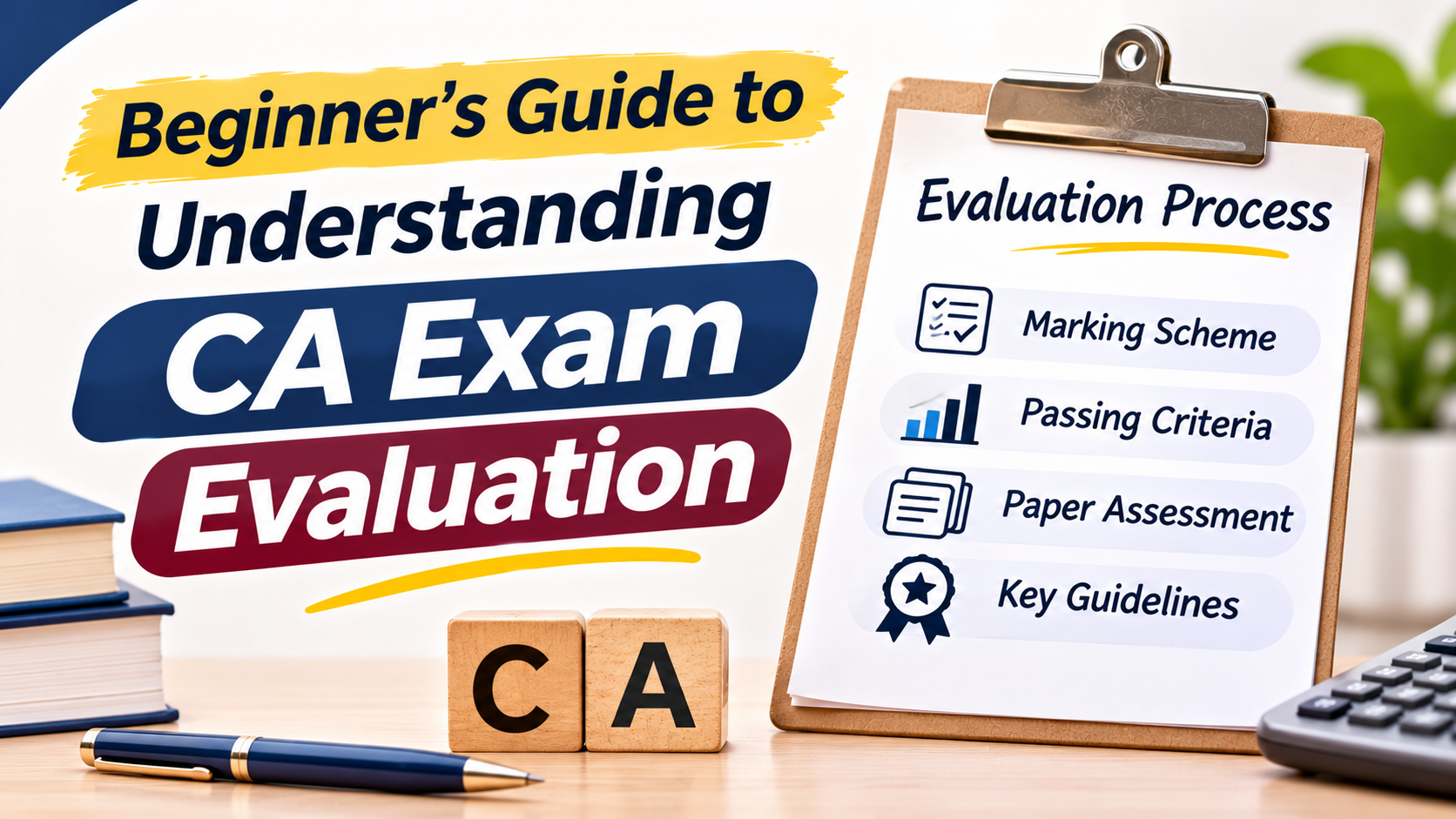
For a student beginning CA exam preparation, evaluation can feel like a mystery. You may know a concept but still lose marks because your answer is incomplete, your workings are unclear, or you spend too much time on one question. Learning how evaluation works in practice can make preparation more focused.
The safest approach is to study the applicable ICAI instructions, practise with official question papers and suggested answers, and use feedback to improve your technique. A suggested answer is a learning reference, not a promise that every examiner must award marks in exactly the same way.
What CA Exam Evaluation Is Designed to Assess
An examination checks whether you can apply the knowledge required by the syllabus. Depending on the paper, this may involve explaining a concept, applying a legal or accounting provision, performing calculations, interpreting information, or reaching a justified conclusion. Correct final answers matter, but the route you take to reach them may also matter.
Evaluation should not be approached as a game of guessing keywords. Build answers that address the question asked, show the relevant method and communicate the result clearly. Read the current paper instructions carefully because requirements can differ across subjects and question types.
Read the Question Before Writing
Many avoidable mistakes begin with misreading the requirement. Words such as explain, calculate, discuss, compare, advise and state ask for different kinds of responses. Underline the action word and identify the facts or data the examiner expects you to use before drafting the answer.
Check the marks assigned and divide your time accordingly. A short question usually does not need a long essay, while a multi-part practical question may require several steps. Answer every part that is asked and label sub-parts clearly so the structure is easy to follow.
How to Present Practical Answers
In numerical papers, write the relevant formula or approach, show important workings, use clear labels and state the final answer in the requested form. If assumptions are necessary and permitted, state them briefly. A correct number with unexplained or disorganised workings may make it harder to demonstrate the method you used.
Keep calculations readable and check signs, units, totals and carry-forward figures. When a question has multiple adjustments, use a logical sequence instead of squeezing everything into one line. Practise the same presentation style repeatedly so it becomes natural under exam conditions.
How to Present Theory Answers
A strong theory answer directly responds to the requirement, explains the relevant principle and applies it to the facts where the question calls for application. Use short paragraphs, meaningful headings and concise points when they improve clarity. Avoid copying large sections of notes without explaining why they answer the question.
Where the paper requires a conclusion, make it explicit. In case-based questions, connect the rule or concept to the facts provided. Memorised language is useful only when you understand it well enough to apply it accurately.
Suggested Answers: How to Use Them Properly
Suggested answers help you understand a sound approach to a question and compare your method, coverage and presentation. They can reveal missing steps, overlooked adjustments and ways to organise an answer. Use the relevant official material for your exam scheme and syllabus wherever available.
Do not judge your answer solely by whether its wording matches the suggested answer. There may be different valid ways to explain a concept or solve a problem. Focus on whether your reasoning is correct, the required points are covered and your conclusion follows from the work shown.
A Simple Evaluation Practice Table
| Review point | Questions to ask yourself | Next action |
|---|---|---|
| Requirement | Did I answer every part asked? | Underline command words before writing |
| Accuracy | Are the concept and calculations correct? | Relearn the rule or redo the calculation |
| Working | Can a reader follow my method? | Show essential steps and labels |
| Presentation | Is the answer organised and readable? | Use headings, formats and clear conclusions |
| Timing | Did I finish within the limit? | Practise timed sets and pacing |
After each test, review the answer using a consistent checklist. This turns feedback into a plan for the next practice session.
Understanding Common Reasons for Losing Marks
Students often lose marks through incomplete requirements, calculation slips, missing working notes, vague explanations, weak application to case facts or failure to finish the paper. These problems are not always solved by reading more chapters. Some require timed writing practice and a deliberate checking routine.
Separate knowledge gaps from execution gaps. If you did not know the rule, revisit the concept. If you knew it but failed to mention a key step, practise structured answers. If you ran out of time, work on question selection and pacing rather than simply writing faster.
Time Management During the Paper
Before starting, scan the paper as permitted by the instructions and note how the marks are distributed. Plan a realistic time limit for each question, including a little time for checking. Do not allow one difficult question to consume the time needed for several manageable questions.
If you get stuck, write down the parts you can solve, where the format allows it, and move forward. Return later if time remains. Practise this decision-making in mock tests so it does not feel unfamiliar on exam day.
Using CA Exams Test Series for Feedback
CA Exams Test Series practice can help beginners become familiar with timed answer writing and develop a repeatable review process. Choose tests that match your level and syllabus. After each attempt, record two or three improvements rather than trying to fix every weakness in one sitting.
Track whether the same issue appears in later tests. If presentation is improving but time management is still weak, your next practice should focus on completing a paper within the limit. Progress becomes easier to see when feedback leads to a specific action.
Build an Evaluation Habit Early
Do not wait until the final revision stage to learn how to write answers. Begin with short topic tests, compare your work with appropriate reference answers, and practise correcting mistakes. Over time, you will develop a clearer sense of how much detail a question needs and how to communicate your reasoning.
Evaluation is only one part of exam success; understanding the subject remains essential. Combine concept learning, written practice, revision and feedback. That balanced routine is more reliable than memorising model answers without learning how to apply them.
Frequently Asked Questions
Does CA exam evaluation award marks for workings?
For many practical questions, workings help demonstrate the method and make the answer understandable. Follow the subject's requirements and practise showing essential steps clearly instead of writing only a final figure.
Should my answer match the suggested answer word for word?
No. Use suggested answers to understand the expected coverage and method. Focus on correct reasoning, relevant points and clear application. Different wording may communicate the same valid idea when it is accurate and complete.
How can beginners improve CA answer writing?
Start with short, timed questions. Read the requirement carefully, structure the response, show essential workings and review mistakes against relevant reference material. Repeat the process so clarity and pacing improve together.
Why do I lose marks even when I understand the chapter?
You may be missing a step, misreading the requirement, presenting unclear workings or running out of time. Review the exact reason for each lost mark and practise that skill rather than rereading the whole chapter automatically.
Are headings necessary in theory answers?
Headings can improve readability when they organise a longer answer, but they should not replace substance. Use a clear structure, address the question directly and include the relevant principle, application and conclusion where required.
What should I do if I cannot solve a question?
Avoid spending too long on one question. Complete the parts you can answer, where appropriate, and return if time remains. After the test, study the missing concept and practise a similar question.
How should I check a numerical answer?
Review the main formula, signs, units, totals and important carry-forward figures. Compare your workings with a trusted reference answer and note the type of error so you can prevent it in future attempts.
When should I begin mock tests?
Begin topic-level tests as you study chapters, then introduce mixed-topic and full-length tests as coverage improves. Early practice reveals gaps while there is still time to correct them.
Can CA Exams Test Series help beginners?
A suitable test series can give beginners structured question practice and a way to review timing and presentation. Use the feedback with your study material and official guidance to make targeted improvements.