Table of contentsShowHide
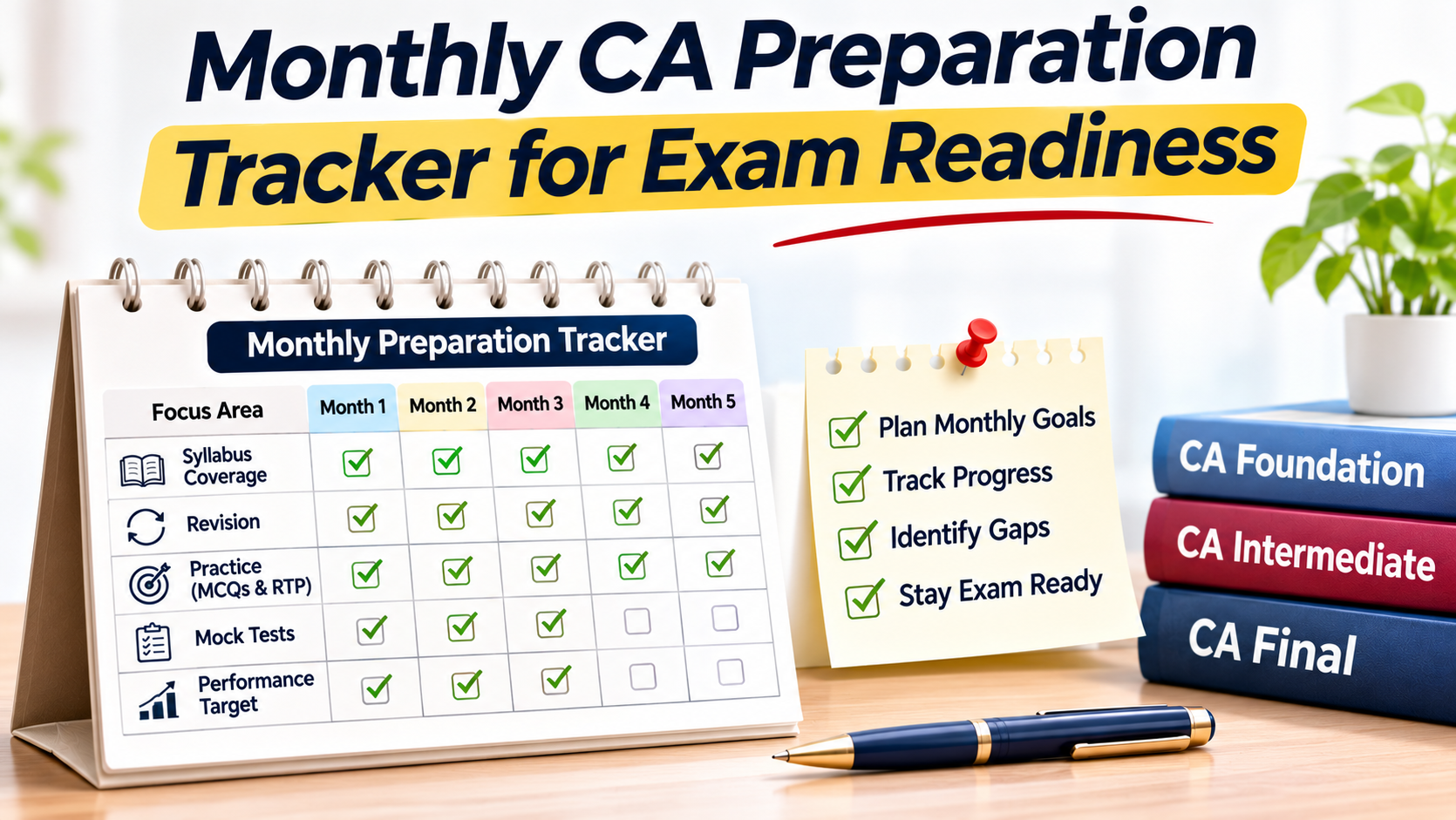
A monthly preparation tracker helps CA aspirants see whether their study routine is translating into exam readiness. A student may spend many hours studying and still have unfinished revision, weak question accuracy or poor time management.
A useful tracker measures syllabus coverage, conceptual understanding, question practice, revision status and test performance. Review it each month and use the results to plan the next one.
Why Use a Monthly Tracker?
A monthly tracker shows whether study activity is translating into exam readiness. Hours and completed chapters do not always reveal weak recall, low question accuracy or poor time management. Tracking several areas together helps you identify gaps early and plan the next month more realistically.
Use the tracker as a decision tool, not a source of pressure. A missed target tells you that the workload, method or schedule may need adjustment. It does not mean your whole preparation strategy has failed.
Monthly CA Preparation Tracker Template
Update this table during the month and review it at the end. Set targets based on your current syllabus and available time.
| Area | Monthly target | Evidence to record | Next action |
|---|---|---|---|
| Syllabus coverage | Selected chapters or units | Topics learned and pending | Finish or reprioritise |
| Concept clarity | Explain key concepts independently | Recall checks and doubts | Relearn weak concepts |
| Question practice | Topic-wise and mixed questions | Accuracy and error types | Practise similar questions |
| Revision | Review old and recent topics | Review dates and recall quality | Schedule next review |
| Mock tests | Sectional or full-length tests | Score, timing and feedback | Target weak areas |
| Presentation | Practise complete answers | Structure and working notes | Improve format and timing |
Set Realistic Monthly Targets
Start with the time remaining before your attempt and the topics still incomplete. Divide the work into monthly targets, then break those into weekly tasks. Leave time for difficult chapters, revision and test analysis. If every available hour is allocated, your plan has no room for delays.
Make targets specific. Instead of “complete taxation,” list the units to cover, questions to solve and revision to finish. Separate essential targets from optional tasks so that important learning and revision are protected when your schedule changes.
Measure Learning, Not Just Completion
A chapter is not fully ready simply because you read it or watched a lecture. Check whether you can explain the main idea, recall key rules or formulas and solve a representative question without help. If not, mark the topic as still learning or practice required.
Use simple ratings such as strong, partial and weak recall. Strong topics need periodic review; partial topics need practice; weak topics may need the concept explained again. Record the exact gap, such as a forgotten condition or incorrect adjustment, so the next session has a clear purpose.
Track Test Performance and Mistakes
Record more than the score. Note whether you finished within time, which questions were incomplete and where marks were lost. Classify mistakes into concept gaps, forgotten details, calculation errors, misreading, timing and presentation. Each type points to a different corrective action.
CA Exams Test Series can be part of the monthly cycle: attempt a timed test, review the evaluation and add weak topics to the tracker. Avoid taking multiple tests without analysing the results. The aim is to improve performance, not merely collect scores.
Conduct a Monthly Review
Compare planned work with what was completed. Review coverage, retention and application together: coverage shows how much you studied, retention shows what you can recall after a gap, and application shows whether you can solve questions or write complete answers.
Choose a small number of priorities for the next month. If you select too many, the plan may become scattered. Schedule the most important gaps first while keeping regular subject rotation in place.
Adjust the Next Month’s Plan
If coverage is behind, prioritise essential topics and decide which optional tasks can move. If coverage is strong but recall is weak, add spaced revision. If you know the material but lose marks under time pressure, practise timed sections and analyse your attempt order.
As the exam approaches, shift the tracker from broad syllabus coverage toward revision, mixed practice and exam simulation. Verify syllabus and amendment-sensitive information against current official resources.
Signs of Progress Toward Exam Readiness
Readiness is not one number. Positive signs include recalling concepts after a gap, choosing the right method for mixed questions, finishing a reasonable amount of work within time and explaining mistakes accurately. Your performance should become more consistent across subjects and tests.
A strong score on one mock test does not prove every topic is secure, and one low score does not mean you are unprepared. Look at patterns across several attempts and use them to decide where the remaining time will have the greatest value.
Final Thoughts
A monthly tracker turns preparation into a clearer picture of progress. Record coverage, recall, question accuracy, revision and test performance, then use that evidence to update the next month’s targets. Keep the process simple enough to maintain consistently.
Frequently Asked Questions
1. How can I improve my CA preparation routine?
Set measurable weekly targets, combine learning with independent question practice and review mistakes regularly. Use a tracker to identify weak areas and adjust the next week’s schedule instead of relying only on study hours.
2. Should I follow the same timetable throughout preparation?
No. Early preparation needs more concept building, while later stages need more revision, mixed questions and timed tests. Review your progress regularly and adjust the balance as the exam approaches.
3. How important is revision for CA exams?
Revision helps you recall topics after a gap and identify what you have forgotten. Include short review sessions throughout preparation rather than waiting until the entire syllabus is complete.
4. When should I start solving exam-style questions?
Start with basic topic-wise questions as soon as you understand a concept. Gradually add mixed and timed questions as syllabus coverage improves, making sure you analyse errors after each practice session.
5. How do I know whether a chapter is complete?
Check whether you can explain its main concepts, recall important rules or formulas and solve representative questions independently. If you still need the solution for every step, the chapter needs more practice.
6. How should I use mock-test feedback?
Classify mistakes by cause, such as concept gaps, calculation errors, timing or presentation. Schedule a focused correction session and then attempt similar questions to confirm that the problem has been addressed.
7. Should I study every subject every day?
Not necessarily. A weekly subject rotation can work well if every paper returns regularly and older topics are revised. Allocate more time to weak areas without leaving other subjects untouched for too long.
8. What if I miss my study targets?
Identify why the target was missed and reduce or rearrange the workload realistically. Protect core learning, revision and question practice rather than carrying an impossible backlog into every new week.
9. Are these study-hour or timeline suggestions official ICAI rules?
No. They are planning examples only. Always check the current ICAI syllabus, official examination schedule and instructions for your level and attempt before finalising your preparation plan.
10. How can CA Exams Test Series support preparation?
A test series can provide structured exam-style practice and feedback on timing, accuracy and presentation. Use the results to prioritise revision and practise weak areas rather than focusing only on the score.