Table of contentsShowHide
- 1.Understand what you need to remember
- 2.Exercise 1: The five-minute closed-book recall
- 3.Exercise 2: Turn headings into questions
- 4.Exercise 3: Use flashcards with care
- 5.Exercise 4: Explain a concept in simple language
- 6.Exercise 5: Build concept maps and comparison charts
- 7.Exercise 6: Practise mixed and cumulative questions
- 8.Exercise 7: Use spaced repetition and short review blocks
- 9.Build a balanced memory routine for CA subjects
- 10.Support memory with healthy study habits
- 11.Quick Reference Table
- 12.How CA Exams Test Series Can Support Your Preparation
CA candidates have to remember concepts from several subjects while also learning how to apply them to practical and case-based questions. Long study hours alone do not guarantee strong memory. The way information is processed, retrieved and revised makes a meaningful difference.
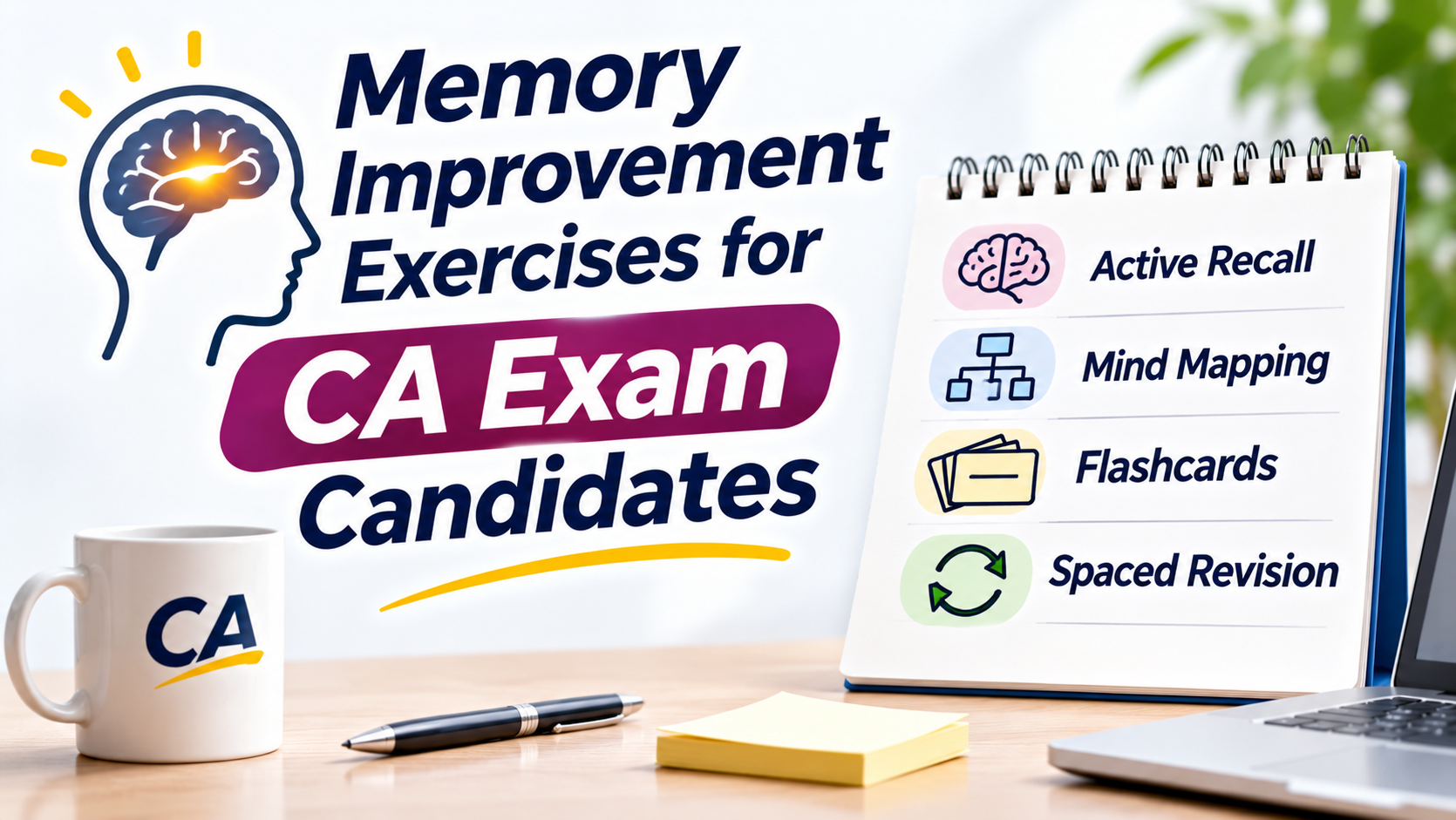
Memory can be strengthened through regular practice. Short recall drills, explanation exercises, flashcards and mixed-question sessions help students move beyond passive reading. The exercises in this guide can be included in a daily routine without requiring extra study resources or complicated systems.
Understand what you need to remember
Not every topic should be memorised in the same way. Some areas require exact technical terms, some require understanding a sequence, and others require repeated numerical practice. Before choosing an exercise, identify the learning task. Are you trying to recall a definition, distinguish two provisions, remember a formula or apply a method?
This distinction prevents wasted effort. A formula is best strengthened through retrieval and use in questions. A lengthy chapter may be easier to remember through a concept map and self-explanation. A provision with conditions and exceptions may need a structured prompt card.
Exercise 1: The five-minute closed-book recall
At the end of a study session, close your notes and spend five minutes writing everything important that you remember. Use headings such as key concepts, formulas, conditions, exceptions and examples. Do not worry about making the first attempt perfect.
Open your material afterwards and use a different mark for missing points and incorrect points. Revisit only those gaps, then try to recall them again. This exercise is useful because it quickly shows the difference between what feels familiar and what you can actually retrieve.
Exercise 2: Turn headings into questions
Convert each chapter heading and subheading into a question. For example, a heading about a method can become: What is the purpose of this method? What are its steps? When is it used? What changes if one assumption is different? Answer the questions without looking at the text.
This method is particularly useful for theory and law topics, but it also works for practical subjects. For a numerical chapter, ask yourself what information is needed, which formula applies and what checks should be made before finalising the answer.
Exercise 3: Use flashcards with care
Flashcards work best when each card tests one clear point. Put a question, formula prompt or short scenario on one side and the answer on the other. Avoid putting an entire page of notes on a card. For a provision, one card might ask for its key conditions while another asks about an exception.
Sort cards into groups such as needs practice, improving and confident. Review the difficult group more frequently, but continue testing the confident group occasionally. Digital or paper cards can both work; the important part is attempting the answer before turning the card over.
Exercise 4: Explain a concept in simple language
Choose a topic and explain it aloud as if teaching a student who has not studied it. Use a simple example, describe the logic and identify where the concept is applied. If you cannot explain a step clearly, return to that part of the material.
Avoid simplifying technical rules so much that their meaning changes. After the explanation, check the prescribed material for exact terminology, conditions and exceptions. This exercise helps reveal gaps in understanding that memorising a sentence may hide.
Exercise 5: Build concept maps and comparison charts
A concept map connects a central topic with related ideas. It can show how a rule leads to a treatment, how a calculation is structured or how different chapters connect. Comparison charts are useful when two concepts look similar but have different conditions or outcomes.
Keep the visual notes selective. Use them to show relationships, not to reproduce every paragraph. For example, a tax topic may be organised around applicability, conditions, computation and exceptions. A financial reporting topic may use a comparison of recognition, measurement and disclosure.
Exercise 6: Practise mixed and cumulative questions
When a chapter is first completed, questions are usually easier because the topic is fresh. After some time, solve questions from multiple chapters without being told which method to use. This requires you to identify the relevant concept before applying it.
Start with a small mixed set and increase the difficulty gradually. After checking the answers, note whether the error was caused by forgetting a rule, selecting the wrong method or making a calculation mistake. Mixed practice helps make recall more flexible and closer to the demands of an examination.
Exercise 7: Use spaced repetition and short review blocks
Revisit important material at increasing intervals rather than leaving it untouched until the final month. A simple routine could include a next-day review, a review later in the week and another review after a few weeks. The exact schedule should depend on your recall and the amount of syllabus remaining.
Short review blocks can fit into a busy day. For example, use 10 to 15 minutes to recall formulas or answer flashcards, then use a longer session for application questions. Consistency matters more than building a complicated timetable that is difficult to follow.
Build a balanced memory routine for CA subjects
A balanced routine should combine recall, understanding and application. A theory session might include a concept explanation, a provision checklist and a short written answer. A practical session might include formula recall, a worked example from memory and independent question practice.
Do not use memory exercises as a substitute for completing the syllabus. They are tools to strengthen learning already being developed. Use official study material and attempt-specific updates as the reference point, especially in subjects where amendments or technical requirements matter.
Support memory with healthy study habits
Sleep, breaks and a manageable study routine support attention and learning. Avoid repeatedly extending study hours when concentration has dropped sharply. Take short breaks between focused sessions, stay hydrated and maintain a realistic schedule. If you are consistently unable to concentrate, review your workload and study environment rather than assuming that you simply need to work harder.
Keep the phone away during focused blocks and decide in advance what you will complete. A clear task such as recalling one topic and solving three questions is easier to begin and evaluate than a vague target to study for several hours.
Quick Reference Table
| Exercise | Suggested use | Best suited for |
|---|---|---|
| Closed-book recall | 5 minutes after a topic | Key points, formulas and provisions |
| Question prompts | At the end of each subtopic | Theory and conceptual learning |
| Flashcards | 10 minutes daily | Definitions, conditions and short facts |
| Teach-back | Once or twice per chapter | Concept clarity and logical sequences |
| Mixed questions | Weekly | Application and topic identification |
| Spaced review | At planned intervals | Long-term retention |
How CA Exams Test Series Can Support Your Preparation
A structured CA Exams Test Series can help you check how well you understand and apply the concepts you have studied. Use sectional and full-length tests to practise within time limits, review the solutions and identify recurring gaps. Test performance should guide your next revision steps, while the prescribed syllabus and official study material remain the foundation of preparation.
Frequently Asked Questions
Can memory be improved for CA exams?
Memory can be strengthened through repeated retrieval, spaced revision, explanation and application. A consistent method helps students identify weak areas and retain concepts more effectively than relying only on repeated reading.
Which exercise is best for CA students?
Closed-book recall is a useful starting point because it shows what you can retrieve independently. Combine it with question practice, flashcards and explanation exercises to address different types of learning.
Do flashcards work for CA preparation?
Flashcards can help with formulas, definitions, conditions and short technical points. Keep each card focused, attempt the answer before checking it and review difficult cards more frequently.
How can I remember CA Law provisions?
Break provisions into their key elements, conditions, exceptions and consequences. Test each part using prompts, then practise writing answers with accurate terminology and application to the facts.
How often should I do memory exercises?
Use short exercises regularly. A brief recall session after studying and planned reviews during the week can be more manageable and effective than occasional long memorisation sessions.
Is writing better than reading for memory?
Writing from memory can reveal gaps that reading may hide. However, both methods have a role: read to understand, retrieve information without notes and write or solve questions to test application.
How do I remember formulas in practical subjects?
Understand what each formula measures, write it from memory and use it in different questions. Record common conditions and units, and revisit formulas that you repeatedly forget or apply incorrectly.
Can teaching a topic improve retention?
Explaining a topic in your own words can reveal whether you understand its logic. Check the explanation against the prescribed material afterwards so that technical terms and important exceptions remain accurate.
Does lack of sleep affect exam preparation?
Insufficient sleep can affect attention and the ability to learn and recall information. A sustainable study routine should include adequate rest rather than depending on repeated late nights.
How can CA Exams Test Series support memory practice?
CA Exams Test Series can give students opportunities to retrieve and apply concepts in timed conditions. Review the feedback, identify weak topics and practise those areas again as part of a broader revision plan.