Table of contentsShowHide
- 1.What concept clarity means in CA studies
- 2.What rote learning means
- 3.Where rote learning is useful
- 4.Why concept clarity is essential for practical papers
- 5.Why theory papers also need understanding
- 6.A practical method to combine understanding and memory
- 7.Use examples to test whether a concept is clear
- 8.Common mistakes students make
- 9.How to balance the two approaches across a study week
- 10.Choose methods according to the CA subject
- 11.Quick Reference Table
- 12.How CA Exams Test Series Can Support Your Preparation
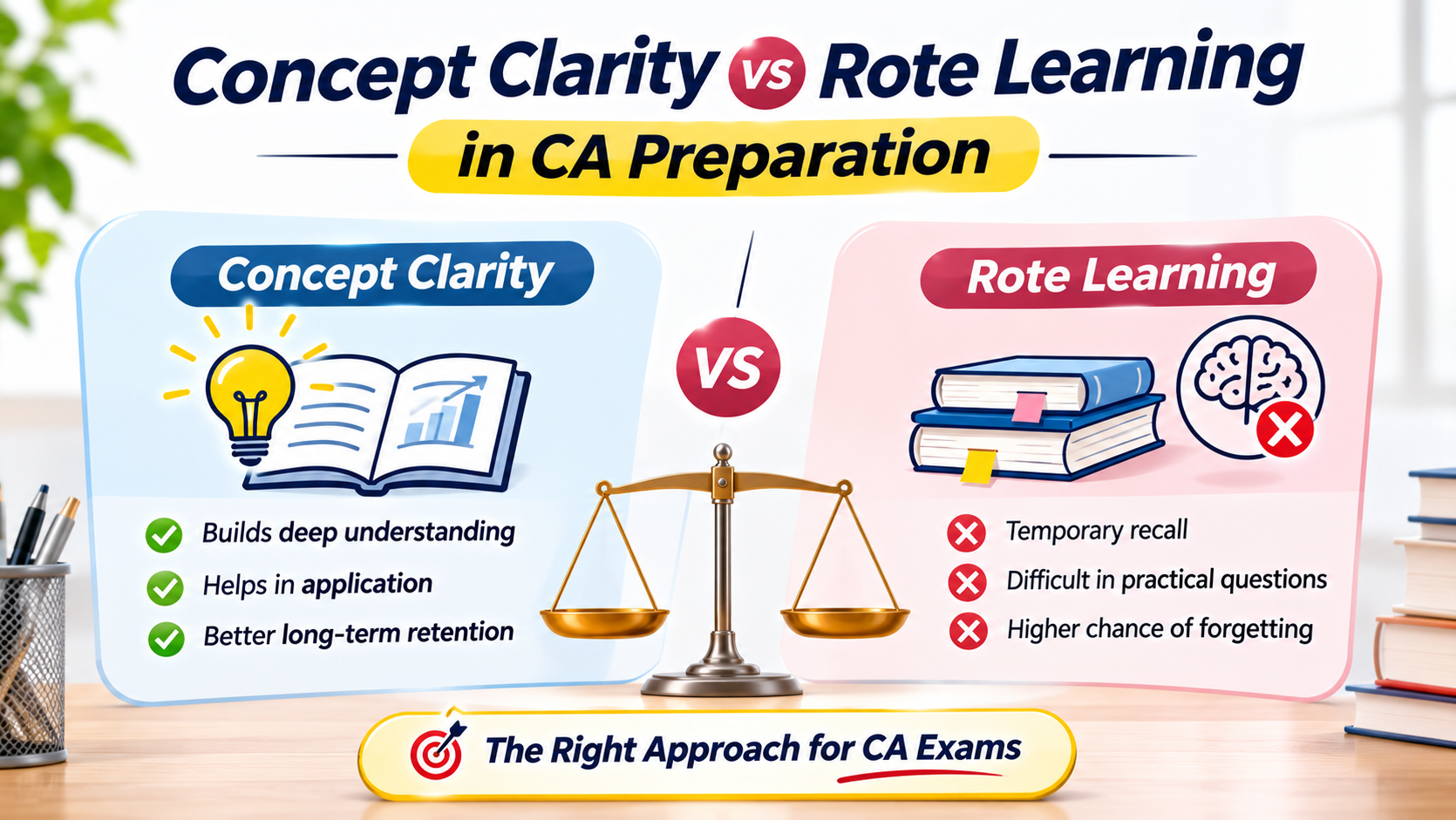
CA examinations test more than the ability to repeat information. Students must understand concepts, remember technical requirements and apply them to questions that may present information in an unfamiliar way. This is why the debate between concept clarity and rote learning matters.
Memorisation has a place in CA preparation, but it is most useful when supported by understanding. This article explains where each approach helps, where it can fail and how to combine them for practical and theory-oriented subjects.
What concept clarity means in CA studies
Concept clarity means understanding why a rule, method or treatment works and when it should be applied. A student with conceptual clarity can explain the logic, identify relevant facts in a question and adapt the method when the information changes.
For example, in a practical subject, knowing a formula is not enough if you cannot identify the correct inputs or explain the effect of a changed assumption. In a theory subject, understanding the purpose and structure of a provision makes it easier to apply the rule to a case.
What rote learning means
Rote learning is memorising information through repetition, often without fully understanding its meaning or connection to other ideas. It may help with exact terminology, definitions, lists, formula structures and technical details that must be recalled accurately.
The limitation appears when a question is framed differently from the example memorised. A student may remember a solved answer but struggle to decide which principle applies to a new situation. Memorised material can also be confused when similar concepts are studied close together.
Where rote learning is useful
Some CA content requires precise recall. Students may need to remember definitions, section references where relevant, conditions, exceptions, formulae, standard terminology and prescribed presentation formats. Repetition and short recall drills can help retain these details.
The key is to connect each item with its meaning and use. Instead of memorising a list without context, understand what each point represents and test it through a question. This makes recall more meaningful and reduces the risk of mixing up similar provisions.
Why concept clarity is essential for practical papers
Practical papers often require students to select a method, interpret information and complete a sequence of calculations. A memorised solution format may not work if the question changes the data or combines two chapters.
Conceptual understanding helps you identify the underlying issue, choose the right treatment and explain your workings. After understanding the method, repeated practice builds speed and accuracy. Both are necessary: understanding without practice can be slow, while memorised steps without understanding can break down in unfamiliar questions.
Why theory papers also need understanding
Theory-oriented papers are not simply memory tests. Questions may ask students to explain, distinguish, discuss or apply a rule to given facts. A strong answer needs accurate technical content as well as logical organisation.
Understanding helps you select relevant points and avoid writing everything you remember about a topic. Memorisation supports the accurate use of key terms and requirements. Practise writing answers that directly address the question, use suitable headings and explain the application clearly.
A practical method to combine understanding and memory
Begin with the prescribed study material and identify the purpose of the topic. Read the explanation carefully, work through examples and ask why each step is required. Then create a short summary of the essential rules, conditions or formulas.
Close the material and reproduce the main points. Next, solve or write a question without looking at the solution. Check your response, identify gaps and revisit only the areas that need attention. This sequence links understanding, memory and application instead of treating them as separate activities.
Use examples to test whether a concept is clear
After studying a concept, create a simple example and change one fact. Ask yourself whether the treatment changes and why. If the answer changes, identify the condition that caused the difference. This is particularly useful for tax provisions, accounting treatments and legal applications.
Do not rely only on examples that repeat the textbook illustration. Attempt questions from different sources permitted for your preparation, including relevant official practice material. The aim is to check whether you can recognise the concept when the wording or facts are different.
Common mistakes students make
One common mistake is memorising a solved question line by line without understanding the reason behind each adjustment. Another is spending too long reading explanations but avoiding independent practice. Students may also make extensive notes that consume time without improving recall.
A better approach is to keep notes selective, explain the logic in your own words and solve questions independently. When an answer is wrong, diagnose the reason. A knowledge gap needs concept review; a recall gap needs retrieval practice; an application gap needs varied questions.
How to balance the two approaches across a study week
Allocate time for understanding new topics, memorising essential details and testing application. For example, a study block can begin with concept learning, continue with a short recall exercise and finish with questions. A weekly review can include mixed questions and a check of previously weak areas.
The balance will differ by subject and by your current preparation stage. A difficult new chapter may need more explanation and examples. A familiar chapter may need faster recall and timed practice. Use test performance and syllabus progress to adjust the balance.
Choose methods according to the CA subject
In Accounting and other practical papers, understand the principles and then practise full solutions. In Taxation, understand the logic of provisions and computation before memorising rates, limits and exceptions applicable to the attempt. In Law, learn the structure and application of provisions, then strengthen exact terminology through recall and writing.
In audit and other descriptive subjects, understand the objective behind a requirement and practise presenting the relevant points. In subjects involving standards, use comparison charts to distinguish similar treatments. Always confirm the syllabus and amendments relevant to your examination attempt.
Quick Reference Table
| Learning requirement | Best approach | How to test it |
|---|---|---|
| Understanding a new concept | Read, question the logic and study examples | Explain it in your own words |
| Remembering technical details | Recall drills, flashcards and repetition | Reproduce details without notes |
| Applying a rule | Varied and case-based questions | Solve an unfamiliar question |
| Improving exam performance | Timed practice and answer review | Analyse accuracy, coverage and time |
How CA Exams Test Series Can Support Your Preparation
A structured CA Exams Test Series can help you check how well you understand and apply the concepts you have studied. Use sectional and full-length tests to practise within time limits, review the solutions and identify recurring gaps. Test performance should guide your next revision steps, while the prescribed syllabus and official study material remain the foundation of preparation.
Frequently Asked Questions
Is concept clarity more important than rote learning in CA?
Concept clarity is essential for applying knowledge, while memorisation supports accurate recall of technical details. Strong preparation combines both rather than depending entirely on either approach.
Can I pass CA exams by memorising answers?
Memorising selected points may help, but relying only on fixed answers is risky. Questions can test application and understanding, so practise adapting concepts to different facts and question formats.
Does CA preparation require memorisation?
Yes. Students need to remember formulas, definitions, conditions, technical terms and other prescribed details. Memorisation becomes more useful when you understand what the information means and where it applies.
How can I develop concept clarity in CA subjects?
Study the prescribed material carefully, ask why each step is required, work through examples and explain the concept in your own words. Then solve questions independently to check your understanding.
How do I know whether I have understood a chapter?
You should be able to explain its main ideas without notes, identify when they apply and solve questions with changed facts. If you can only follow a solved example, more practice is needed.
Which method is better for CA Law?
Use understanding to learn the purpose and application of provisions, and memorisation to retain important technical wording and conditions. Practise structured answers that apply the relevant rule to the facts.
Which method is better for CA Accounting?
Understand the accounting treatment and reasoning first, then memorise essential formats or formulas and practise varied questions. Independent problem-solving is important for developing accuracy.
How can I avoid rote learning while making notes?
Write short explanations of the logic, include one useful example and record only essential technical details. Use questions and self-explanations to check understanding instead of copying whole paragraphs.
Can mock tests reveal weak conceptual understanding?
Yes. Repeated errors in selecting a method, interpreting facts or applying a rule can indicate a conceptual gap. Review the reasoning behind the correct answer, not just the final result.
How can CA Exams Test Series help build conceptual application?
CA Exams Test Series can provide structured questions and timed practice. Use the results to identify whether errors arise from weak concepts, recall or execution, then plan targeted study and another practice attempt.