
Table of contentsShowHide
- 1.Why online classes need a structured timetable
- 2.Start with your exam date and syllabus position
- 3.Allocate time between lectures and self-study
- 4.A sample daily schedule
- 5.A schedule for students managing college or work
- 6.Organise subjects in a weekly rotation
- 7.Plan revision after every lecture
- 8.Use tests to measure progress
- 9.Manage recorded lectures and backlogs
- 10.How CA Exams Test Series fits into the schedule
- 11.Review and improve the timetable
Online CA classes make it possible to learn from home and access lectures according to a planned timetable. However, having recorded lessons, live sessions and digital study material available does not automatically create a productive routine. Students still need to decide when to attend classes, revise and solve questions independently.
A useful schedule balances lecture time with active study. This guide explains how to plan a daily and weekly routine for CA Foundation, Intermediate and Final preparation while leaving room for college, work and personal responsibilities.
Why online classes need a structured timetable
Online learning provides flexibility, but flexibility can become a problem when every lecture is postponed. Without fixed study blocks, students may spend hours watching lessons and leave little time for revision or question practice. A timetable turns a large syllabus into manageable daily tasks.
Build the schedule around what you can understand, recall and apply. A lecture is one part of learning; revisiting the concept and attempting questions make that learning usable in an examination.
Start with your exam date and syllabus position
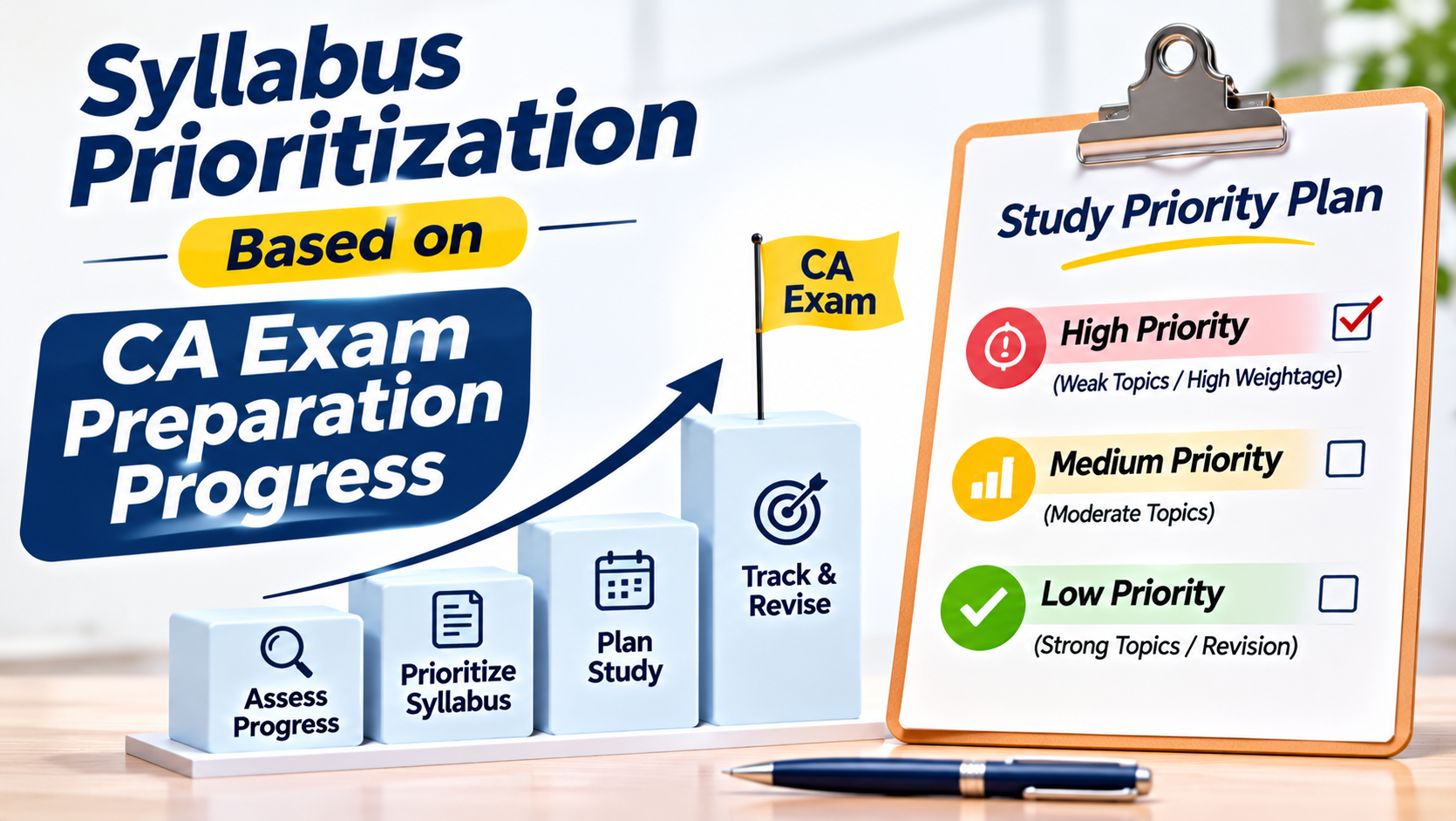
Write down the examination month, subjects and chapters already completed. Divide the remaining syllabus into weekly topics and include revision and testing periods. Do not assign every available day to new lectures.
Your plan should reflect your current position. A student beginning a subject needs more concept-learning time, while someone nearing the examination may need more revision, past-paper practice and timed tests. Reassess the plan every week.
Allocate time between lectures and self-study
After a lecture, reserve time to review the topic, summarise concepts, note doubts and solve relevant questions. This follow-up shows whether you understood the class or merely followed the teacher's explanation while watching.
Give self-study substantial space in the weekly plan. Practical papers need problem-solving time, while law and theory-heavy areas need repeated recall and written practice. Adjust the balance to the subject and your familiarity.
| Preparation factor | What to focus on |
|---|---|
| Planning | Set realistic daily and weekly targets. |
| Concepts | Understand the reason behind each method or rule. |
| Revision | Revisit completed topics at planned intervals. |
| Practice | Solve questions under suitable time limits. |
| Assessment | Analyse mistakes and take corrective action. |
A sample daily schedule
Begin with a focused revision block, attend or watch a class during another study period and then solve questions from that lecture. After a break, use a separate block for another subject. End the day by revisiting key points and noting tomorrow's first task.
Treat timings as a framework, not a compulsory formula. Put demanding problem-solving in the hours when you concentrate best. Protect sleep and meal breaks; a schedule that cannot be sustained will quickly fail.
A schedule for students managing college or work
Students with college or employment should plan around fixed commitments first. Use available weekday hours for focused tasks rather than filling every gap with a long lecture. A shorter session with a clear outcome can be more useful than exhausted study.
Use weekends for longer lectures, chapter tests and backlog recovery, but retain time for rest and planning. If a class is missed, assign it a specific recovery slot instead of allowing the backlog to grow without a deadline.
Organise subjects in a weekly rotation
Rotate subjects so that each receives attention several times during the week. Avoid studying one subject for many consecutive days and then leaving it untouched for a long period. Repeated contact helps keep earlier topics active.
Give extra sessions to subjects where test performance shows weakness, but do not abandon stronger subjects. A balanced weekly plan protects existing strengths while giving difficult areas enough deliberate practice.
Plan revision after every lecture
Keep a short post-lecture routine: review class notes, close the material and recall the main points, then attempt questions without looking at the solution. Mark unclear steps and revisit them before the next class.
Schedule a second revision after a few days and another review later in the month. Use written answers or self-quizzing for theory and fresh problems for practical subjects. Rereading alone may create familiarity without reliable recall.
Use tests to measure progress
Include chapter tests after completing topics and cumulative tests after covering groups of chapters. Full-length mock examinations should become part of the plan as syllabus coverage improves. Tests reveal whether you can retrieve and apply knowledge within a time limit.
After each attempt, classify errors as concept gaps, calculation mistakes, misreading, weak presentation or poor time allocation. Assign a corrective task to repeated errors. A schedule with no time to review test performance is incomplete.
Manage recorded lectures and backlogs
Recorded lectures help when a live class is missed or a concept needs another explanation. They can also create a backlog if students keep postponing them. Set a weekly limit for pending lectures and prioritise essential lessons.
Do not let lecture completion become the only measure of progress. If you have watched many hours but have not revised or solved questions, pause new videos and bring learning up to date. The goal is exam readiness, not playlist completion.
How CA Exams Test Series fits into the schedule
Enter mock tests and evaluated practice into the timetable as fixed activities. Reserve time for the test and for analysing the result. This turns assessment into a learning cycle rather than a one-time score check.
CA Exams Test Series can complement online classes with examination-style practice and performance review. Keep tests aligned with syllabus coverage and use feedback to adjust the following week's lecture, revision and question-practice blocks.
Review and improve the timetable
At the end of each week, compare planned tasks with completed work. Identify whether delays came from unrealistic workload, difficult topics, distractions or unexpected commitments. Make practical changes instead of rewriting the entire timetable after one difficult day.
Track chapters revised, questions solved, tests attempted and errors corrected. These measures give a clearer picture than study hours alone. A timetable should guide your effort while remaining flexible as the examination approaches.
Frequently Asked Questions
How many hours should I study with online CA classes?
Hours depend on your course level, syllabus position and commitments. Plan enough time for lectures, revision, question practice and tests rather than measuring preparation only by screen time.
Should I make notes while watching online CA lectures?
Make concise notes of explanations, important steps and doubts. Avoid copying every slide word for word. Review notes after class and use them for independent question practice.
How do I balance online classes and self-study?
Set fixed lecture slots and separate blocks for revision and solving questions. Review each class soon after attending it so that self-study does not keep getting postponed.
Is a daily timetable better than a weekly timetable?
Use both. A weekly plan sets subject priorities and targets, while a daily timetable assigns tasks. The weekly plan also allows adjustments when unexpected commitments arise.
How can working students follow an online CA study schedule?
Build the timetable around work hours and use focused sessions on weekdays. Reserve longer blocks for weekends, but include rest and a realistic backlog limit.
When should I start taking mock tests?
Begin chapter-wise tests after completing topics. Add cumulative and full-length tests as syllabus coverage improves, leaving time to analyse mistakes and revise weak areas.
What should I do if I miss an online CA class?
Use the recording or authorised catch-up option and assign it a specific completion slot. Avoid allowing several missed lectures to accumulate without a weekly recovery plan.
How often should I revise topics taught online?
Review soon after the lecture, revisit after a few days and schedule further revision. Use active recall and fresh questions to check whether you can apply the concept.
Can I study two CA subjects in one day?
Yes. Studying two subjects can create variety and maintain continuity. Choose subjects based on energy levels, workload and your weekly rotation.
How can CA Exams Test Series support online preparation?
A test series adds timed practice and performance feedback. Use results to identify weak topics, improve presentation and plan targeted revision.