Table of contentsShowHide
- 1.Understanding offline CA coaching
- 2.What independent study involves
- 3.Compare both preparation methods
- 4.Choose based on your learning style
- 5.Subject difficulty and the need for guidance
- 6.Discipline, consistency and accountability
- 7.Cost, travel and time considerations
- 8.Can students combine coaching and self-study?
- 9.The role of mock tests and performance analysis
- 10.A practical decision framework
Choosing between offline CA coaching and independent study is an important decision for Foundation, Intermediate and Final students. Classroom coaching offers a fixed routine and direct interaction, while self-study gives students greater control over pace, resources and daily planning. Neither approach guarantees success on its own.
The right choice depends on your learning habits, subject knowledge, access to guidance, available time and ability to stay consistent. This comparison looks at the practical differences and explains how students can combine the strengths of both methods.
Understanding offline CA coaching
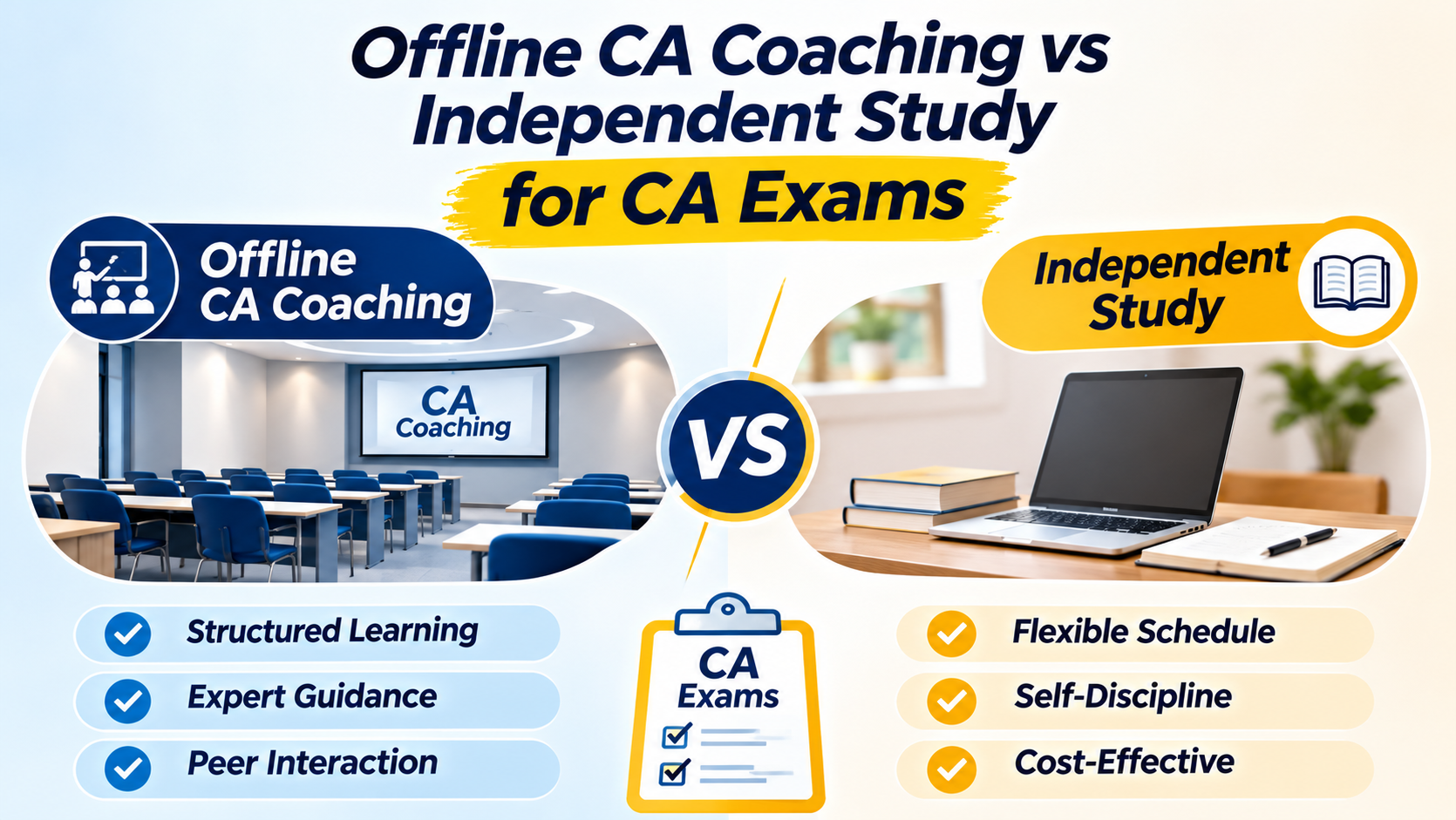
Offline coaching follows a structured timetable in a physical classroom. Students attend scheduled lectures, interact with faculty and can ask questions during or after class. The classroom environment may create routine because learning takes place at a fixed time and location.
Attendance alone does not mean a topic has been mastered. Students still need to revise class content, solve questions and identify doubts independently. Travel time, batch pace and teaching quality are important factors when evaluating a coaching option.
What independent study involves
Independent study means planning and completing preparation without relying on regular classroom teaching. Students use applicable study material, reference books, recorded explanations where available, past examination questions and their own revision notes.
This approach offers flexibility, but requires planning and honest self-assessment. Students must recognise when they do not understand a concept and seek reliable help rather than repeatedly reading the same material without progress.
Compare both preparation methods
Classroom coaching may suit students who benefit from live explanations, fixed class timings and regular interaction. Independent study may suit students who organise preparation well, prefer their own pace or have constraints that make daily attendance difficult.
Compare more than tuition fees. Consider travel, access to doubt-solving, class size, teaching quality, material, test frequency and the time each method leaves for self-study. The best choice is the one that supports consistent learning.
| Preparation factor | What to focus on |
|---|---|
| Planning | Set realistic daily and weekly targets. |
| Concepts | Understand the reason behind each method or rule. |
| Revision | Revisit completed topics at planned intervals. |
| Practice | Solve questions under suitable time limits. |
| Assessment | Analyse mistakes and take corrective action. |
Choose based on your learning style
If you learn effectively when a teacher explains difficult concepts and answers questions immediately, classroom coaching may provide useful support. Students who can read a topic, identify doubts and practise independently may be comfortable with self-study.
Do not select a method only because friends have chosen it. Attend a demonstration class if possible and review the teaching approach. For self-study, test your discipline with a short weekly plan before committing to a full preparation cycle.
Subject difficulty and the need for guidance
Different subjects can require different levels of support. A student may be confident in one paper but need detailed explanations for another. Practical subjects may demand demonstrations and problem practice, while theory papers may require help with interpretation and answer structure.
Your method can vary by subject. You may attend coaching for difficult topics and independently revise familiar areas. Ensure that every subject receives adequate coverage, revision and assessment.
Discipline, consistency and accountability
Classroom coaching provides external structure through attendance and scheduled lessons. This can help students who struggle to begin studying independently. However, class attendance must be supported by personal revision, homework and question practice.
Self-study requires students to create accountability through weekly targets, a chapter tracker, fixed hours and regular tests. If targets are repeatedly missed, reduce the workload or seek guidance instead of ignoring the pattern.
Cost, travel and time considerations
Offline coaching may involve tuition, transport, accommodation or other expenses. Calculate the complete cost and compare it with the support you will receive. A nearby class with a suitable timetable may be more practical than a heavily promoted option requiring long travel.
Independent study can reduce some direct expenses, but students may still spend on books, online resources, test series or doubt-solving. Poor planning also has a cost if it leads to wasted time. Compare overall value, not only the headline fee.
Can students combine coaching and self-study?
A blended approach can work when each method has a clear purpose. Use coaching to understand concepts and clarify difficult areas. Use independent study to revise the lesson, solve questions, prepare short notes and test recall.
Be careful not to overload the day with multiple classes and too little practice. If you attend several lectures but cannot complete revision, reduce additional inputs and consolidate what you have already learned.
The role of mock tests and performance analysis
Whichever method you choose, regular assessment is essential. Tests reveal whether you can apply concepts without a teacher's explanation and within the time available in the examination. They also show whether presentation, accuracy and question selection are improving.
CA Exams Test Series can form part of the independent practice component through planned mock attempts and performance review. Use feedback to identify specific improvements, then discuss difficult concepts with a teacher or resolve them through reliable study material.
A practical decision framework
Choose offline coaching when you need regular teaching, direct interaction and a classroom environment, provided faculty and timings meet your needs. Choose independent study when you can plan consistently, understand material and access reliable support. A blended method may suit students who need guidance only in selected areas.
Review the decision after a few weeks using syllabus coverage, revision completion, question accuracy, test performance and unresolved doubts. If the method is not producing progress, adjust it early. The objective is effective preparation, not loyalty to one format.
Frequently Asked Questions
Is offline coaching necessary to clear CA exams?
Offline coaching is not compulsory for every student. Success depends on understanding the syllabus, consistent self-study, revision and examination practice. Coaching can provide structure when useful.
Can I prepare for CA exams through self-study alone?
Yes, if you follow the applicable syllabus, use reliable resources, resolve doubts and maintain a consistent routine. Regular tests help check whether independent learning is effective.
Which is better: CA coaching or self-study?
Neither method is universally better. Compare your learning style, need for guidance, schedule, budget and ability to remain disciplined before deciding.
Is offline CA coaching worth the cost?
It may be worthwhile when teaching quality, doubt support and a practical timetable justify the total expense. Consider fees, travel and revision time before enrolling.
How can self-study students clear their doubts?
Use authoritative study material and reliable explanations. Write down the exact step or concept you do not understand so that questions can be resolved efficiently.
Can I take coaching only for difficult CA subjects?
A subject-wise approach can work if you independently manage the remaining papers. Keep consistent revision and practice for every subject in your overall timetable.
Does offline coaching improve discipline?
Fixed class timings can create routine and accountability. Students must still complete revision and question practice outside class because attendance alone does not establish exam readiness.
What should I check before joining CA coaching?
Review faculty, teaching approach, batch size, schedule, doubt support, study resources, tests, fees and travel. A demonstration class can help assess suitability.
Are mock tests useful for self-study students?
Yes. Mock tests help evaluate concept application, speed, accuracy and presentation. Reviewing errors after each test is as important as attempting the paper.
How can CA Exams Test Series help students using either method?
A structured test series provides examination-style practice and feedback whether a student attends coaching or studies independently. Use the analysis to plan targeted revision.