
Table of contentsShowHide
- 1.Understand What the Question Is Asking
- 2.Use a Clear Answer Structure
- 3.Use Technical Keywords Accurately
- 4.Apply the Concept to Case-Based Questions
- 5.Write Concisely Without Losing Meaning
- 6.Manage Time Across the Paper
- 7.Make Presentation Easy to Evaluate
- 8.Learn From the Test Series Evaluation
- 9.Build a Chapter-Wise Practice Routine
- 10.A Practical Answer-Writing Checklist
- 11.Conclusion
Knowing Audit concepts is important, but marks also depend on how clearly you communicate them in an examination. Answers that are vague, poorly structured, or disconnected from the question can hide what you know. A planned approach helps you present the relevant point, explain it accurately, and reach a clear conclusion.
A CA Inter Audit Test Series gives you a way to practise that approach under timed conditions. By reviewing your answers, identifying missing points, and improving presentation over several attempts, you can make your writing more precise without trying to memorise every answer word for word.
Understand What the Question Is Asking
Before writing, identify the instruction in the question. Words such as explain, discuss, state, describe, distinguish, and comment call for different styles of response. If the question asks you to comment on a situation, simply reproducing a definition may not answer the actual requirement.
Identify the concept being tested, the facts provided, and the action requested. Then build your answer around those points. This prevents long introductions that consume time but do not address the question.
Use a Clear Answer Structure
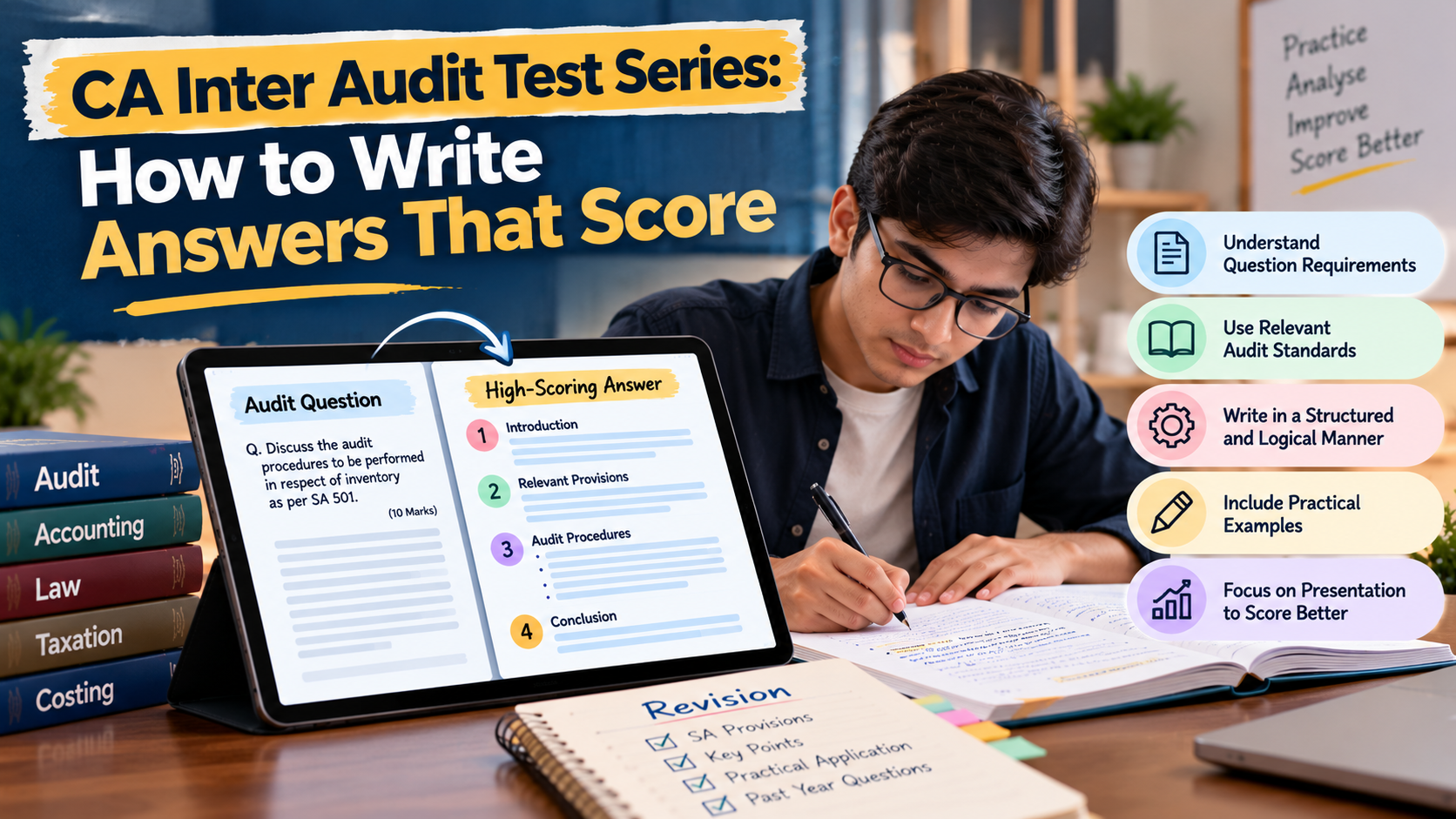
A practical Audit answer usually has three parts: the relevant principle, its application or explanation, and a conclusion where the question requires one. For a direct theory question, use a short opening statement followed by the important points. For a case-based question, connect the rule to the facts rather than writing a general note only.
Use headings when they improve navigation. A heading should tell the examiner what the next part covers, not merely repeat “Answer”. Short paragraphs and numbered points make the response easier to follow. Avoid turning every sentence into a separate bullet; use a format that suits the question.
For a case-based answer, state the relevant concept, explain how it applies to the facts, and give a supported conclusion. This keeps the response focused and demonstrates understanding rather than recall alone.
Use Technical Keywords Accurately
Audit answers often require precise technical language. Learn the important terms and understand what they mean instead of inserting them mechanically. A keyword used in the wrong context may weaken an otherwise correct explanation.
During revision, create a compact keyword sheet for each chapter. Include the concept, its meaning in your own words, common distinctions, and an example of how it may appear in a question. After attempting a test, compare your response with the applicable study material or suggested answer and identify which essential terms you omitted or misunderstood.
Apply the Concept to Case-Based Questions
Case-based questions test whether you can recognise a principle in a practical situation. First identify the relevant fact, then state the applicable concept, explain how it relates to the fact, and conclude logically. Do not assume the examiner will infer the connection from a general definition.
For example, if a scenario describes a control weakness, identify the weakness clearly, explain the relevant audit implication, and state the appropriate response only to the extent supported by the question and applicable syllabus. Avoid adding unrelated facts or conclusions that the question does not support.
Write Concisely Without Losing Meaning
Long answers are not automatically better answers. Repeating the same point in different words takes time away from other questions. A concise answer can be complete when it covers the relevant principle, required explanation, and application.
Use one main idea per paragraph. Remove filler phrases and avoid writing a broad background section before reaching the point. Practise expressing a concept in a few clear sentences, then expand only when the marks and question requirement justify more detail.
Manage Time Across the Paper
Time management begins before the examination. During practice, calculate a rough time budget according to the marks allocated and the total writing time. Keep a small reserve for reading the paper, checking unanswered parts, and correcting obvious omissions. Follow the current official examination instructions for the applicable attempt.
Do not spend too long perfecting one answer while leaving another incomplete. If a question is taking longer than planned, write the relevant points you can support and move on. Full-paper practice helps you discover whether your timing is realistic.
Make Presentation Easy to Evaluate
Legible handwriting, spacing, headings, and orderly numbering can help the examiner follow your reasoning. Leave enough space between answers and label sub-parts correctly. If you use underlining, reserve it for key terms or headings rather than decorating every line.
Presentation should support content, not replace it. A beautifully formatted answer that misses the requirement will still be weak. Practise a consistent style that you can reproduce at examination speed without spending extra time on cosmetic details.
Learn From the Test Series Evaluation
A mock test is useful only when you analyse the result. After each attempt, classify lost marks: concept gap, missing keyword, incomplete application, misread requirement, weak structure, time pressure, or careless omission. Different causes require different fixes.
Maintain an error log with four fields: question or topic, what went wrong, the correct approach, and the next practice action. Revisit repeated errors after a few days. Do not merely read the model answer and move on; close it and rewrite the weak section from memory.
Build a Chapter-Wise Practice Routine
Start with a chapter test after studying a topic. Once you can explain the concepts and attempt questions, mix questions from earlier chapters so retrieval becomes less dependent on chapter order. Later, move to full-paper attempts under timed conditions.
Use the current ICAI syllabus and applicable study material as the base for topic coverage. Check the instructions for your exam attempt before relying on older notes or question banks. A CA Exams Test Series can provide a regular practice structure, but improvement depends on honest attempts and careful review.
A Practical Answer-Writing Checklist
Before submitting a practice answer, ask: Did I answer the exact requirement? Have I stated the relevant principle? Did I apply it to the facts where needed? Are the technical terms accurate? Is the conclusion supported? Have I avoided unnecessary repetition? Did I leave any sub-part unanswered?
Use this checklist after practice, not as a reason to overthink every sentence during the actual paper. With repetition, the sequence should become natural and help you write with greater control.
Conclusion
Scoring better in CA Inter Audit Test Series requires more than recalling theory. Understand the requirement, organise the answer, use technical language correctly, apply concepts to the facts, and manage time. A consistent test-and-review routine helps you identify the exact writing habits that need improvement.
Frequently Asked Questions
How can I improve my CA Inter Audit answer writing?
Read the question requirement carefully, structure the answer with relevant headings, use technical terms accurately, and apply concepts to case facts. Review each test to identify missing points, weak application, repetition, and time-management problems.
Is a CA Inter Audit Test Series useful for answer presentation?
Yes. Timed tests let you practise structuring answers under exam conditions. Reviewing evaluated answers can reveal whether your headings, explanations, keywords, and conclusions are clear and relevant to the question.
Should I write Audit answers in paragraphs or points?
Use the format that best communicates the answer. Short paragraphs work for explanations, while numbered points can make lists and distinctions clearer. Avoid excessive bullets and ensure each point contains a meaningful idea.
How important are keywords in Audit answers?
Keywords help express technical concepts precisely, but they must be used correctly and supported by an explanation. Memorising terms without understanding their meaning can lead to vague or inaccurate answers.
How should I answer case-based Audit questions?
Identify the key facts, state the relevant principle, apply it to the situation, and provide a supported conclusion when required. A general definition alone may not address the practical issue raised.
How can I avoid writing too much in Audit?
Answer the exact requirement, use one main idea per paragraph, and remove repeated explanations. Match the depth of your response to the marks and the question’s wording rather than writing everything you know.
How should I review a mock test?
Classify each lost mark by cause, record the correct approach, and write a specific next action. Reattempt weak questions after a short gap instead of only reading the suggested answer.
Should I practise full papers or chapter tests first?
Begin with chapter tests while learning concepts, then combine earlier topics and progress to full papers. This sequence builds understanding first and later develops retrieval, timing, and paper-wide planning.
How can I manage time in the Audit exam?
Use timed practice and plan a realistic allocation based on marks and official exam instructions. Avoid over-polishing one answer, keep track of unanswered parts, and reserve a little time for checking.
How can CA Exams Test Series support Audit preparation?
Use CA Exams Test Series as a structured opportunity to practise questions, assess answer presentation, and review recurring errors. Pair test attempts with syllabus-based study and a written plan for correcting weaknesses.


