
Table of contentsShowHide
- 1.What Is a Chapter-wise Test Series for CA Final?
- 2.Why a Subject-by-Subject Plan Works
- 3.How to Plan Chapter-wise Tests for Each CA Final Subject
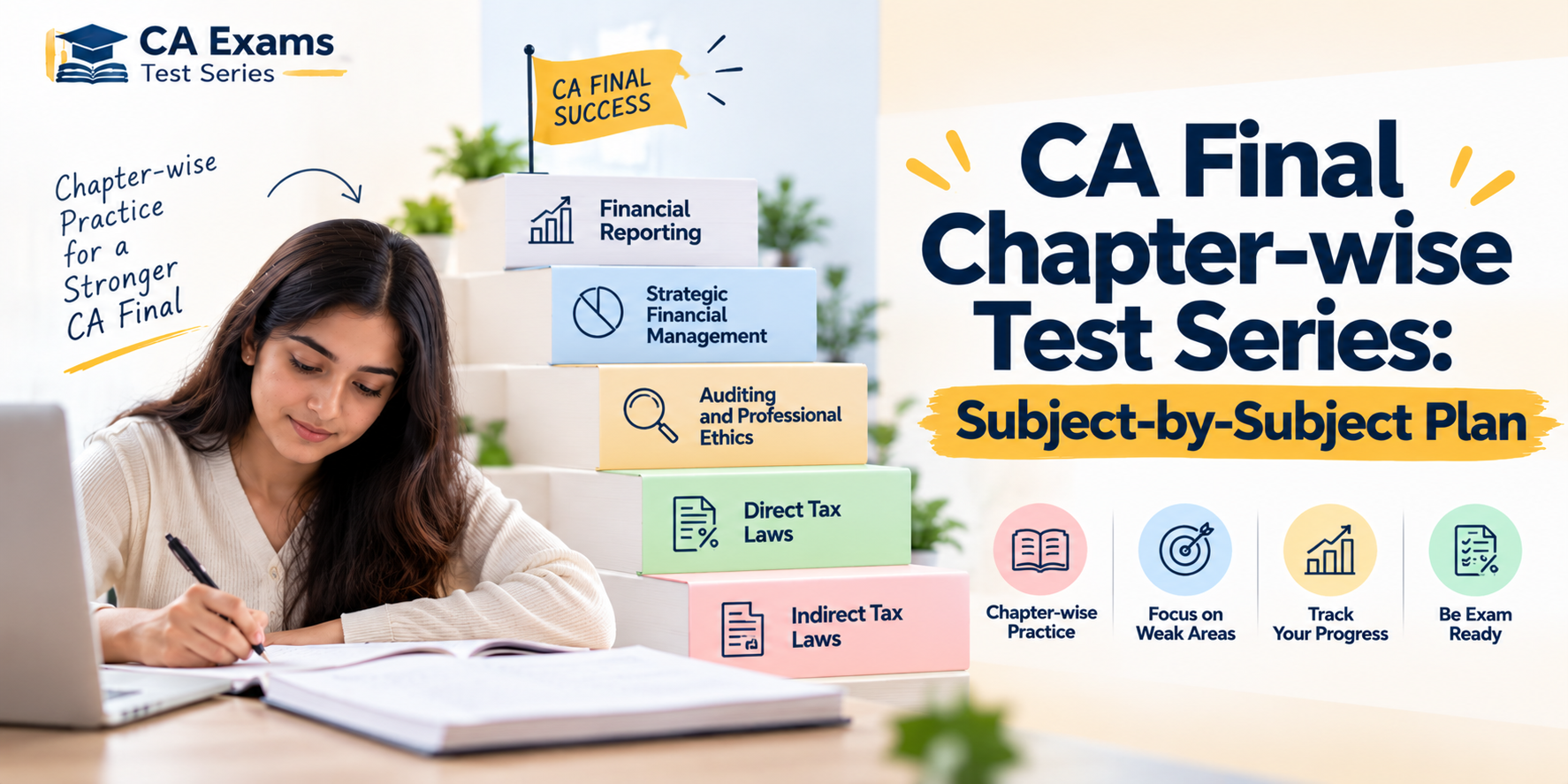
- 4.Financial Reporting: Test Concepts and Application
- 5.Strategic Financial Management: Build Calculation Accuracy
- 6.Advanced Auditing, Assurance and Professional Ethics: Practise Structured Answers
- 7.Direct Tax Laws and International Taxation: Link Rules with Questions
- 8.Indirect Tax Laws: Practise the Application of Provisions
- 9.A Sample Subject-by-Subject Test Schedule
- 10.How Often Should You Take Chapter-wise Tests?
- 11.How to Analyse Each Test and Track Progress
- 12.When to Move from Chapter-wise Tests to Full-length Mocks
- 13.How CA Exams Test Series Can Fit into Your Routine
- 14.Common Mistakes to Avoid
- 15.Conclusion
Preparing for CA Final can feel difficult when several subjects and large chapters need attention at the same time. Studying one topic after another is important, but students also need a way to check whether they can apply what they have learned. Chapter-wise tests provide that checkpoint and make revision more focused.
A practical CA Final Chapter-wise Test Series plan lets you test each subject soon after studying it, revisit weaker areas, and gradually move towards mixed-topic and full-length papers. The aim is not to take a test after every page. It is to use practice at the right time, learn from mistakes, and build confidence across the syllabus.
What Is a Chapter-wise Test Series for CA Final?
A chapter-wise test series divides practice into manageable sections. Instead of attempting a complete paper immediately, you answer questions from a specific chapter or a group of related topics. This makes it easier to identify whether a problem comes from understanding, recall, calculation, or answer presentation.
Chapter-wise tests are especially useful during the first round of revision. They allow you to check a topic while the concepts are still familiar and correct mistakes before they become repeated habits. As preparation progresses, these tests should be combined with cumulative practice and full-syllabus mocks.
Why a Subject-by-Subject Plan Works
A subject-by-subject plan gives each paper a clear practice routine. Without one, students may spend too much time testing their strongest subject and leave difficult or less familiar areas until the final weeks. A simple schedule helps you spread practice across subjects while keeping time for revision.
The plan should remain flexible. Some chapters need more questions because they involve complex applications; others may need short recall checks. Use the syllabus, your preparation progress, and the mistakes you make to decide how much practice each chapter needs.
How to Plan Chapter-wise Tests for Each CA Final Subject
Start by listing the chapters in each subject and marking your status: not started, studied once, revised, or ready for testing. After completing a chapter and reviewing the core concepts, attempt a short test without notes. If the chapter contains lengthy practical questions, include timed problem-solving rather than relying only on quick recall questions.
Once you have tested a chapter, record the result and the errors you made. Do not judge readiness only by a score. Check whether you could explain the reasoning, complete the working, follow the question requirement, and finish within a reasonable time.
Financial Reporting: Test Concepts and Application
For Financial Reporting, use chapter-wise practice to check whether you can apply accounting standards and solve questions with a clear sequence of workings. After studying a topic, attempt a mix of conceptual and practical questions where relevant. Pay attention to adjustments, presentation, and the reasoning behind each step.
During review, note whether mistakes came from misunderstanding a standard, overlooking a detail in the question, or making a calculation error. Rework incorrect questions after a short gap. As more chapters are completed, add mixed tests so you practise identifying which concepts apply without being told the chapter name.
Strategic Financial Management: Build Calculation Accuracy
For Strategic Financial Management, chapter-wise tests can help you practise formulas, calculations, and interpretation. Keep a concise formula or method sheet, but attempt the test without relying on it unless the practice exercise specifically allows reference material.
Review the full method, not just the final answer. A correct formula with an incorrect substitution or calculation can still lead to a wrong result. Record recurring calculation errors and practise similar questions under a time limit. Mixed-topic tests later help you select the appropriate method when the question does not identify it directly.
Advanced Auditing, Assurance and Professional Ethics: Practise Structured Answers
For Advanced Auditing, Assurance and Professional Ethics, testing should include recall as well as answer-writing practice. After revising a chapter, answer questions in your own words while retaining the key technical points and required terminology. Avoid memorising long paragraphs without understanding the underlying principle.
Use feedback or model answers to check whether your response addresses the exact requirement. If you miss key points, revise them and practise writing a concise, organised answer. Short recall tests can help maintain earlier chapters, while timed written answers help you practise presenting knowledge clearly.
Direct Tax Laws and International Taxation: Link Rules with Questions
For Direct Tax Laws and International Taxation, chapter-wise practice can help you connect provisions with the facts given in a question. After studying a topic, solve questions that require you to identify the applicable rule, apply it to the facts, and reach a reasoned conclusion.
Keep your practice aligned with the syllabus and amendments applicable to your examination attempt. During review, separate errors caused by forgetting a provision from errors caused by applying it incorrectly. Revisit both categories, but use different methods: active recall for forgotten rules and additional case-based questions for application gaps.
Indirect Tax Laws: Practise the Application of Provisions
For Indirect Tax Laws, chapter-wise tests should help you identify the relevant provisions and apply them to the facts of a question. Use a mix of direct questions and practical scenarios, depending on the chapter. Check whether your answer includes the required reasoning rather than only a conclusion.
Maintain a list of provisions or topics that you repeatedly confuse. Revisit that list during spaced revision and solve fresh questions to confirm that the distinction is clear. Keep all practice material current for the applicable syllabus and exam attempt.
A Sample Subject-by-Subject Test Schedule
The following is a sample framework, not an official ICAI schedule. Adjust the timing and number of tests to your syllabus coverage, available hours, and exam date.
| Stage | Suggested test | Purpose |
|---|---|---|
| After completing a chapter | Short chapter-wise test | Check concept application and record errors |
| After 3–4 related chapters | Cumulative test | Practise recall across topics |
| During first revision | Chapter tests for weak areas | Correct repeated mistakes |
| After substantial syllabus coverage | Full-length mock | Check timing, coverage, and question selection |
| Final revision phase | Selective weak-topic tests plus mocks | Balance targeted correction with exam practice |
How Often Should You Take Chapter-wise Tests?
A short test after each substantial chapter can be a useful routine, but there is no need to test every small subtopic separately. If a chapter is short and straightforward, combine it with a related topic. If it is complex or repeatedly causes mistakes, divide it into smaller test sections.
Try to review a test before attempting another one on the same topic. This prevents you from repeating the same errors without correction. During revision, return to earlier chapters after a gap to check long-term recall, then use cumulative tests to practise moving between topics.
How to Analyse Each Test and Track Progress
After each attempt, classify mistakes into a few categories: concept gap, forgotten provision or formula, calculation error, misread requirement, incomplete answer, weak presentation, and time-management problem. This makes your next revision session specific rather than vague.
Keep an error log with the chapter, mistake, correction, and date for reattempting the question. Select two or three priority actions after each test. Rework the question without looking at the solution, and check whether the same mistake appears in later practice.
Track more than marks. Note whether you completed the test, how much time you needed, and whether you could solve questions independently. These measures often reveal useful progress even when scores vary between tests.
When to Move from Chapter-wise Tests to Full-length Mocks
Chapter-wise tests are most useful when you are learning and revising individual topics. Once you have covered a substantial part of a subject, add cumulative tests that combine older and newer chapters. This checks whether you can recall concepts without a chapter heading telling you what to use.
Full-length mocks become more valuable after meaningful syllabus coverage and revision. They test your ability to select questions, manage time, maintain concentration, and complete a paper. Keep chapter-wise tests for weak areas, but do not rely on them alone as the exam approaches.
How CA Exams Test Series Can Fit into Your Routine
CA Exams Test Series can be part of a structured practice routine when its available papers, solutions, and evaluation features fit your needs. Before choosing any test series, confirm that the material matches the syllabus and exam pattern for your attempt, and check what feedback is actually provided.
A test series should support your study plan, not dictate it blindly. Leave time to review each attempt, correct mistakes, and revise the relevant material. A large number of tests is not automatically better if you cannot analyse them properly. Choose a realistic schedule and use the results to guide your next steps.
Common Mistakes to Avoid
Do not postpone all testing until the syllabus is complete. Early chapter-wise practice can reveal gaps while there is still time to correct them. At the same time, do not mistake success on a familiar chapter test for readiness to handle a full paper with mixed topics.
Avoid reading the solution immediately after getting stuck during a timed attempt. Give yourself a fair chance to solve the question, then use the solution during review. Do not skip review because the score looks good, and do not keep taking tests without revising recurring mistakes.
Finally, avoid copying another student's timetable without considering your own progress. Your subject-wise plan should reflect which chapters are complete, where you lose marks, and how much time remains before the examination.
Conclusion
A subject-by-subject chapter-wise test plan can make CA Final preparation more manageable. Test chapters after studying them, revisit difficult topics, and gradually add cumulative and full-length practice. Use results to identify the cause of mistakes and plan targeted revision. With a consistent routine, a CA Final Chapter-wise Test Series becomes a tool for improving preparation rather than just counting test attempts.
FAQs
What is a CA Final chapter-wise test series?
It is a practice plan that provides tests by chapter or topic so students can check understanding and application before moving to broader revision and full-length mock papers.
When should I take a chapter-wise test for CA Final?
Take a test after completing and reviewing a substantial chapter. Attempt questions without notes, check your errors, and revisit the topic before moving to more advanced or mixed-topic practice.
Are chapter-wise tests enough for CA Final preparation?
No. They help strengthen individual topics, but students should also use cumulative tests and full-length mocks to practise recall across chapters, question selection, and exam-time management.
How should I plan tests for different CA Final subjects?
List chapters for each subject, mark your preparation status, schedule tests after study or revision, and reserve time for reviewing errors. Give extra practice to topics where mistakes recur.
How can I improve through checked test copies?
Review comments and marks, identify repeated errors, compare your answer with a reliable solution, and practise a similar question. Use the feedback to set specific goals for the next attempt.
How many chapter-wise tests should I attempt?
There is no fixed number for every student. Take enough tests to confirm that you can apply the concepts independently, and add more practice for difficult chapters or recurring weak areas.
Should I attempt full-length mocks after chapter-wise tests?
Yes. Once you have covered and revised a substantial part of the syllabus, add cumulative tests and full-length mocks to practise switching between topics and managing the whole paper.
What should I record after each chapter-wise test?
Record the chapter, result if available, time taken, main mistakes, and the correction you will make. Revisit the error log during revision and reattempt difficult questions after a gap.
Can CA Exams Test Series help organise my practice?
A test series can help structure practice if its papers and feedback suit your syllabus and needs. Check the available features, relevance, and evaluation method before building your schedule around it.
What is the best way to use the final weeks before CA Final?
Focus on targeted revision, mixed-topic practice, and full-length mocks when you can review them. Keep chapter-wise tests for persistent weak areas and avoid filling every day with tests.


