
Table of contentsShowHide
- 1.Map the syllabus and assess your current position
- 2.Set priorities without ignoring any paper
- 3.Build a subject rotation plan
- 4.Set a clear outcome for every session
- 5.Balance new learning with revision
- 6.Practise questions from every paper
- 7.Use mock tests to review the plan
- 8.Keep the weekly timetable flexible
- 9.Avoid common multi-paper planning mistakes
- 10.Use CA Exams Test Series as a checkpoint
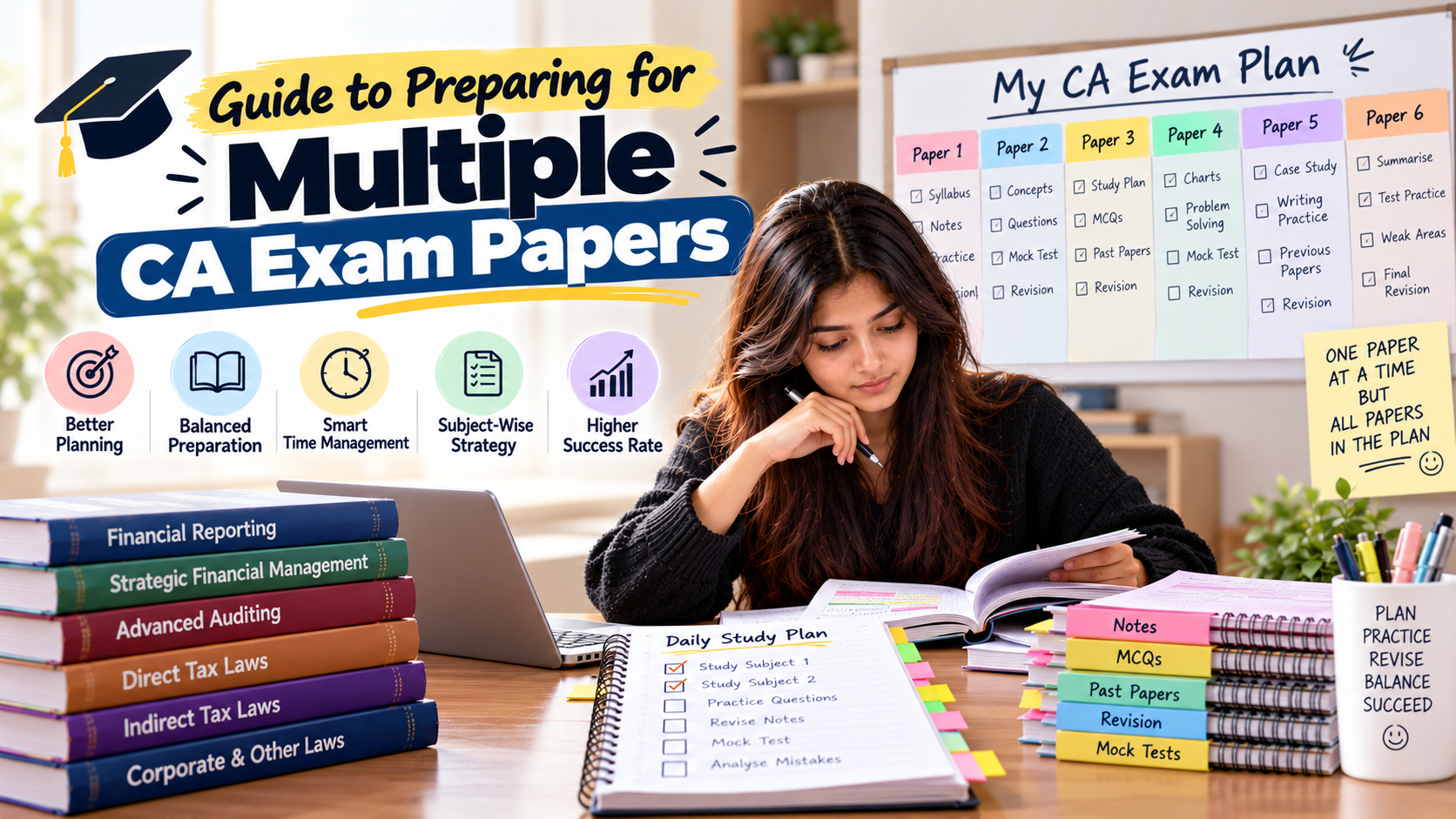
Preparing for multiple CA exam papers can feel overwhelming when each subject has a different syllabus, question style and level of difficulty. Spending too much time on one paper may leave another underprepared, while switching subjects without a plan can make study sessions feel scattered.
A balanced plan gives every paper a place in your week and includes revision and question practice. The right timetable depends on your exam level, available time and current preparation, but a few practical principles can help you organise the workload.
Map the syllabus and assess your current position
List every paper and the main chapters you need to cover. Mark each chapter as not started, in progress, revised or ready for practice. This overview shows where your time is needed instead of letting you study only the subjects that feel comfortable.
Assess topics honestly. Reading a chapter once does not necessarily mean you can recall it or solve questions from it. Break broad topics into smaller tasks and use your tracker to decide what deserves attention next.
Set priorities without ignoring any paper
Prioritise chapters according to syllabus progress, confidence, effort required and the time remaining. Difficult topics may need extra sessions, but easier papers should not disappear from the schedule simply because they seem manageable.
Review priorities every week. If one paper falls behind, give it extra time temporarily while retaining a minimum revision slot for the others. Avoid changing the whole timetable after one difficult question or one good score.
Build a subject rotation plan
A subject rotation plan spreads different papers across the week. You might place a demanding practical subject in a high-focus session, follow it with a theory paper and use a shorter block for recalling an older topic. Adapt the order to your energy and commitments.
Rotation does not mean changing subjects every few minutes. Give each session enough time to complete a meaningful task. The aim is to return to every paper regularly, not to create constant switching without measurable progress.
Set a clear outcome for every session
Write a specific result for each study block: understand a concept, solve a question set, recall a chapter outline or write a timed answer. A task with a clear finish point is easier to begin and assess than a vague instruction to study a subject.
Estimate time realistically and divide large chapters into smaller tasks. If a task repeatedly takes longer than expected, update your estimates. A useful timetable reflects the work involved instead of simply looking impressive.
Balance new learning with revision
It is tempting to spend every session finishing new chapters, but early topics can fade by the time the syllabus is complete. Add revision from the beginning, even if the first review is short.
Use recall questions, summary sheets and selected practice problems to revisit older material. If you cannot explain a concept or reproduce a method without looking, return to the source and schedule another review.
Practise questions from every paper
Question practice reveals whether you can apply what you have studied. For practical papers, solve questions independently and show workings. For theory papers, practise structured answers that address the command words and the exact requirement.
Start with chapter-wise questions while learning, then add mixed and timed practice as appropriate. Record recurring mistakes and revisit them after a gap. Check not only the final answer but also why the method works.
Use mock tests to review the plan
Mock tests show how well your knowledge holds up under time limits and whether your subject allocation is working. Attempt them under realistic conditions when appropriate for your preparation stage, then review the paper rather than focusing only on the score.
Look for patterns such as incomplete answers, weak chapters, calculation errors or poor time allocation. Convert each pattern into a specific task for the next week. A record of corrections across several tests is more useful than one score alone.
Keep the weekly timetable flexible
Set weekly goals for every paper, including learning, revision and practice. Leave buffer time for difficult topics, classes and unexpected responsibilities. A plan with no flexibility can fall apart after one missed session.
At the end of the week, compare planned work with completed work. Do not automatically move every missed task into the next day. Reassess its importance, shorten it if appropriate or place it in a realistic catch-up block.
Avoid common multi-paper planning mistakes
A common mistake is giving most of the week to a favourite subject because it feels productive. Another is allocating equal time to every paper even when preparation needs differ. A detailed timetable is not useful if completion is never tracked.
Use evidence to guide adjustments. If accuracy is low, return to concepts; if you understand the material but run out of time, practise pacing. The solution should match the reason for the problem.
Use CA Exams Test Series as a checkpoint
CA Exams Test Series can support your plan with structured practice and feedback. Schedule practice tests or question sets as checkpoints, then use the findings to decide which chapters and skills need attention in the coming week.
Keep test results alongside your subject tracker and error log. The aim is not to take tests for their own sake, but to make preparation more targeted. Use current official ICAI materials for syllabus and examination requirements.
Frequently Asked Questions
How should I prepare for multiple CA papers at once?
Create a subject-wise tracker, rotate papers across the week and include new learning, revision and question practice for each paper.
Should I study every CA subject daily?
Not necessarily. A weekly rotation can provide regular coverage without forcing you to switch subjects too frequently in a single day.
How do I decide which paper needs more time?
Consider syllabus progress, confidence, recurring mistakes and the time remaining, then review priorities each week.
How many subjects should I study in one day?
Choose a manageable number that allows meaningful work. It depends on your available hours and the type of tasks planned.
How can I avoid forgetting earlier chapters?
Schedule spaced revision and use recall questions or practice problems instead of relying only on rereading.
When should I begin mock tests?
Use topic-level practice early and introduce timed or full-paper tests when appropriate to your coverage and preparation stage.
What if I fall behind in one subject?
Give it a temporary priority boost while keeping short revision slots for other papers, then reassess your timetable.
How can I track progress across papers?
Maintain a tracker showing chapter status, questions attempted, errors and the next revision action for each subject.
Should theory and practical subjects use the same method?
Use a shared timetable but different practice methods: calculations and workings for practical papers, structured recall and writing for theory.
How can CA Exams Test Series help?
Practice tests and feedback can reveal weak areas, timing issues and recurring errors so you can adjust the next week's study plan.