Table of contentsShowHide
- 1.Understand before shortening a chapter
- 2.Make concise, structured notes
- 3.Test memory with active recall
- 4.Revise at spaced intervals
- 5.Practise answer writing
- 6.Let command words guide your response
- 7.Use memory cues and comparison tables
- 8.Combine revision with question practice
- 9.Use mock tests to improve timing
- 10.Plan a weekly theory revision cycle
- 11.Use CA Exams Test Series for feedback
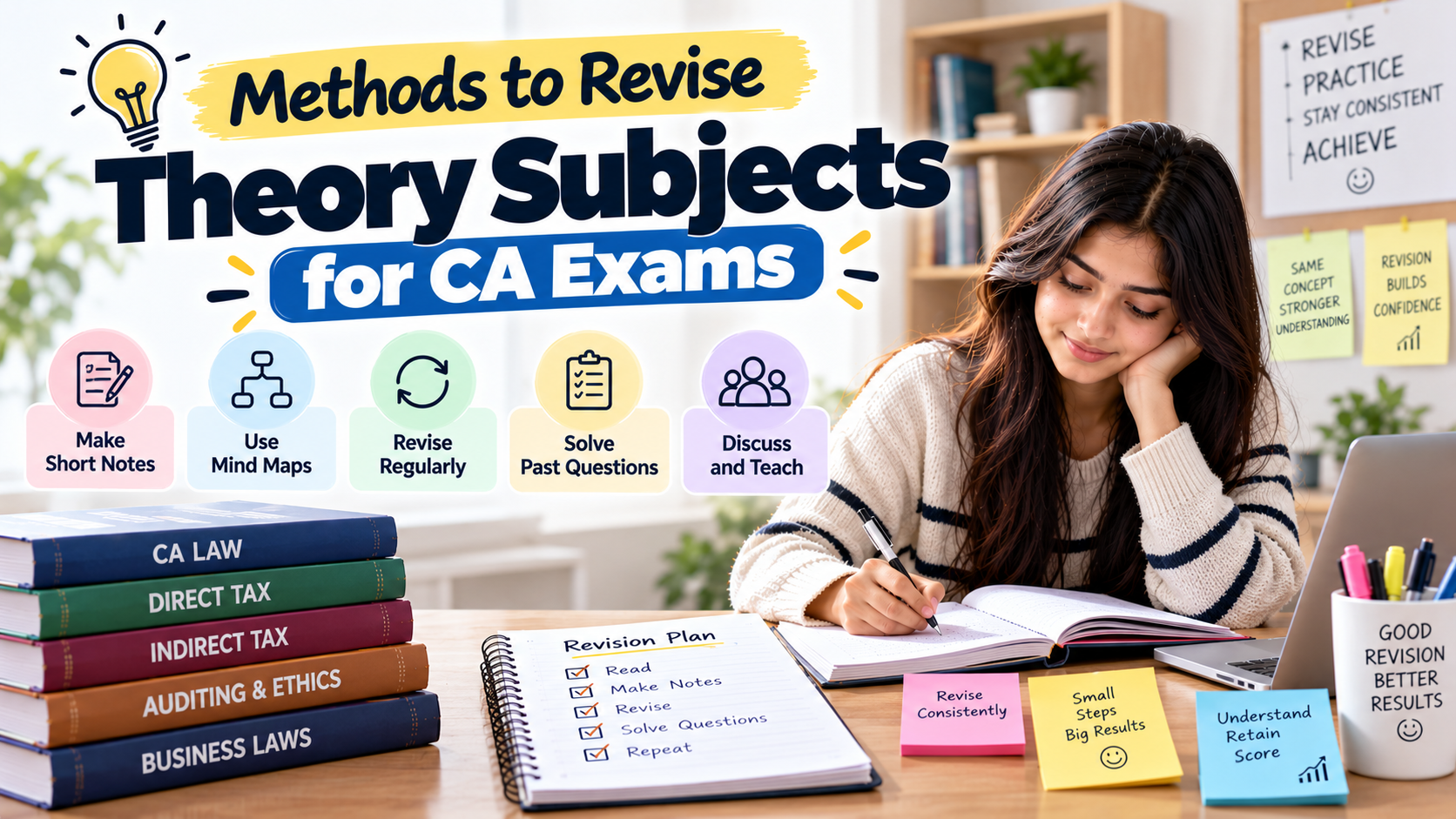
Theory subjects can be difficult to revise because students must remember definitions, explanations, distinctions and structured points while answering within a limited time. Re-reading chapters may feel comfortable but does not prove that information can be recalled independently.
An effective plan combines short summaries with active recall, written answers and spaced practice. It should help identify weak areas and direct you back to prescribed material when fuller explanations are needed.
Understand before shortening a chapter
Before making a summary, read the topic carefully and identify its main argument, key terms and supporting points. If you shorten material before understanding it, the result may be a list of phrases that are difficult to explain or apply in a question.
After learning the topic, write a short summary in your own words and compare it with the source. Preserve technical terms, conditions and distinctions that affect meaning. A useful revision sheet should help you rebuild the explanation, not simply remind you that you have seen the page before.
Make concise, structured notes
Organise notes around headings, definitions, key points, examples and exceptions where relevant. Use a consistent layout so you can find information quickly. For related concepts, a comparison table may be clearer than a long paragraph; for a process, a flowchart may work better.
Avoid copying entire chapters into a notebook. Select information that helps you recall and explain the topic. Add personal reminders for facts you frequently confuse, but keep the wording accurate and check it against the current prescribed material.
Test memory with active recall
Close the book and write the main headings, explain the concept aloud or answer a question from memory. Then compare your response with the source and identify missing points. This exposes gaps that passive reading can hide.
Start with short recall tasks and build toward full answers. If you cannot recall a section, review it briefly and try again after a gap. Track repeated omissions so your next session focuses on the areas that need the most attention.
Revise at spaced intervals
Spread revision across several sessions instead of trying to remember everything in one sitting. Review a new topic soon after learning it, revisit it later in the week and include it in mixed revision. This helps keep older material accessible while you move forward.
Use a simple schedule. Mark each topic as confident, needs review or not yet secure. Topics that remain difficult should return sooner; topics you recall accurately can be reviewed less often while you spend time on weaker areas.
Practise answer writing
Knowing a point and presenting it clearly are different skills. Practise answers with a beginning, logical sequence and direct conclusion. Where a question asks you to compare, explain, discuss or evaluate, shape the answer to match that instruction instead of writing everything you remember.
After writing, check relevance, completeness, terminology and time taken. Use headings or numbered points where they improve clarity, but avoid unnecessary content. If you missed key points, revise the underlying concept and write the answer again after a short gap.
Let command words guide your response
Pay attention to command words and the exact scope of the question. A request to compare needs similarities and differences; explain requires a clear account of how or why; discuss may require more than a definition. Identifying the task before writing keeps your answer focused.
Underline the key requirement and plan a few points before beginning. This short planning step can prevent irrelevant paragraphs and help you allocate time across the paper. After practice, compare the question with your answer to check whether every part was addressed.
Use memory cues and comparison tables
Memory cues can help recall a sequence or list, while comparison tables prevent similar concepts from blending together. Use them where they solve a real problem. A cue should prompt the correct content without changing the meaning or order of the original concept.
Practise reconstructing a table or list from memory, then use a question to apply the distinction. This is stronger than simply recognising a completed table because it tests both recall and understanding.
Combine revision with question practice
Use chapter questions to check whether you can apply material in the form expected by the examination. Begin with focused questions after a topic and later attempt mixed questions from several chapters. Mixed practice makes you identify the relevant concept without a chapter heading telling you what to use.
Review wrong answers and answers that were correct only by guessing. Note whether the problem was memory, misunderstanding, question interpretation or presentation. Each cause needs a different correction, so avoid writing the same generic reminder after every mistake.
Use mock tests to improve timing
Timed practice helps you decide how much detail to include and how to distribute time across questions. Attempt the paper under realistic conditions and avoid checking notes midway. Afterwards, review whether you left questions unfinished, wrote too much on one topic or missed easy points because of poor pacing.
Do not judge progress from a single score. Look for patterns across tests, including recall accuracy, relevance, answer structure and completion. Use those patterns to select the next topics for revision and practise the specific skill that is holding you back.
Plan a weekly theory revision cycle
Set weekly targets for new learning, active recall, written answers and older chapters. Give each subject a defined place in the plan, but adjust time based on syllabus coverage and performance. A weekly mixed session helps retain material from earlier study weeks.
At the end of the week, record what you completed and what needs another pass. Keep the list short enough to act on. If the same topic repeatedly remains unfinished, reduce the task size or change the method instead of carrying it forward unchanged.
Use CA Exams Test Series for feedback
CA Exams Test Series can provide a structured way to test recall and answer-writing under time limits. Use the results to identify whether you need to revise content, interpret questions more carefully or improve the organisation and completeness of your answers.
After reviewing a test, choose a few concrete actions. Revisit the relevant source, make a targeted correction to your notes and practise a similar question. This closes the loop between revision and performance.
Frequently Asked Questions
What is the best way to revise theory subjects for CA exams?
Combine concise notes, active recall, spaced revision, written answers and regular question practice.
Is rereading enough for theory subjects?
Rereading can support learning, but also test recall by explaining concepts or writing answers without notes.
How long should revision notes be?
Keep them short enough to review efficiently while preserving key terms, conditions and distinctions.
How can I remember long theory answers?
Learn the structure and main points, use recall prompts and practise rebuilding the answer with accurate terminology.
Should I practise writing theory answers?
Yes. Written practice helps organise ideas, address command words and manage time under examination conditions.
How often should I revise a theory chapter?
Revisit it across several sessions and include it in weekly mixed revision, with shorter gaps for topics you keep forgetting.
Are tables useful for theory revision?
They help compare similar concepts or organise categories, provided the wording remains clear and accurate.
How can mock tests improve theory performance?
They reveal gaps in recall, relevance, answer structure and time management that can guide targeted revision.
What should I do with mistakes from a theory test?
Identify the cause, review the relevant material and practise a fresh answer that addresses the same weakness.
How can CA Exams Test Series support theory revision?
It can offer structured practice and feedback to help target content gaps and improve answer-writing habits.