
Table of contentsShowHide
- 1.Why a Test Series Matters for CA Foundation
- 2.Paper-Wise Practice Plan for CA Foundation
- 3.Paper 1: Accounting
- 4.Paper 2: Business Laws
- 5.Paper 3: Quantitative Aptitude
- 6.Paper 4: Business Economics
- 7.A Practical Weekly Test Series Schedule
- 8.Sample Paper-Wise Practice Plan
- 9.How to Use CA Exams Test Series Effectively
- 10.Common Mistakes to Avoid
- 11.How to Plan the Final Weeks Before the Exam
- 12.Quick Checklist Before and After Every Test
- 13.Conclusion
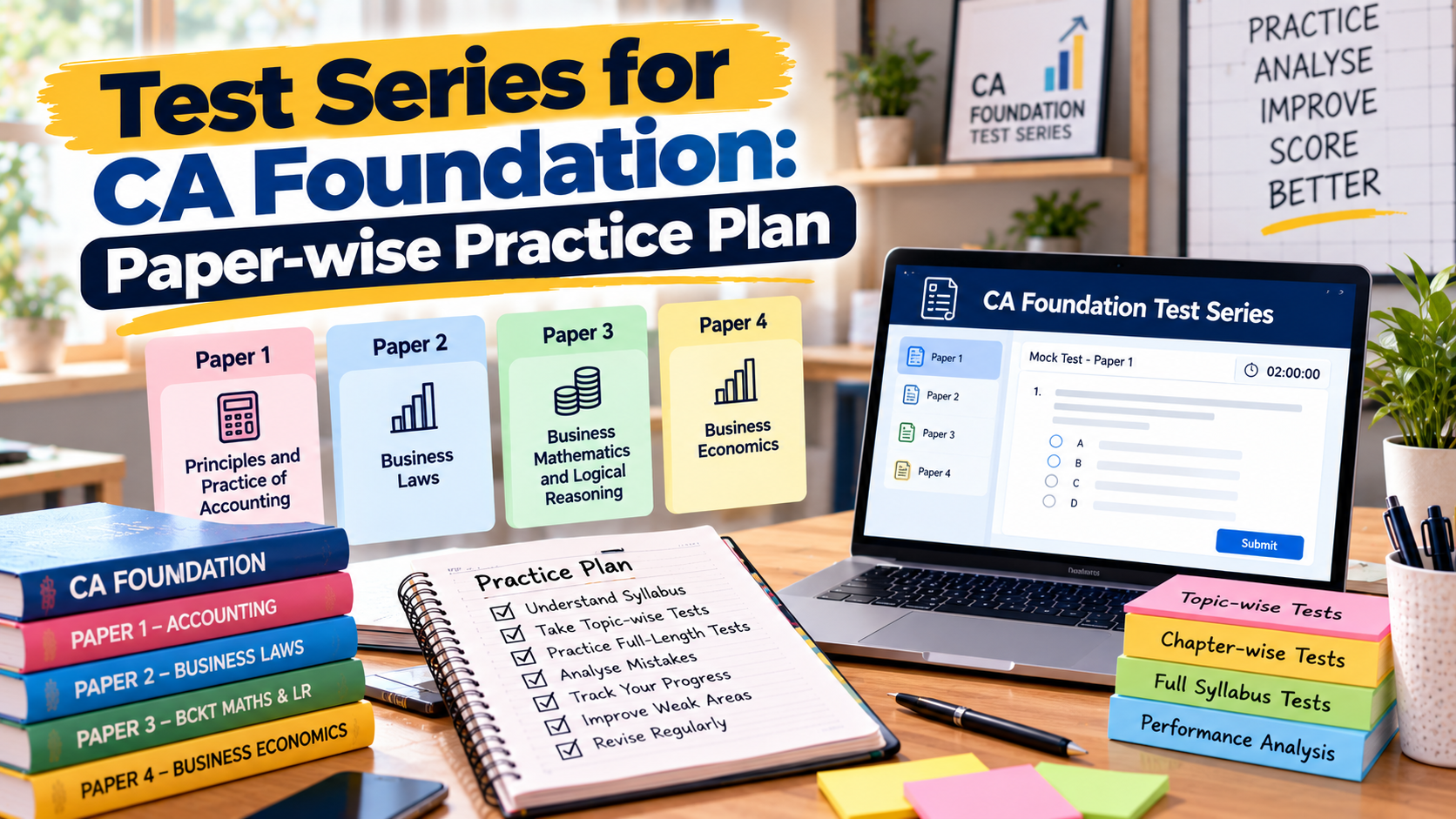
Preparing for the Test Series For CA Foundation exam is not only about finishing the syllabus. You also need to learn how to apply concepts, manage time, present answers clearly, and stay composed when a question looks unfamiliar. That is where a well-planned test series becomes useful. It gives your preparation a practical direction and helps you discover what needs attention before the actual examination.
A paper-wise practice plan makes this process easier to manage. Instead of attempting random tests whenever you find time, you can practise each paper with a clear purpose, review your mistakes, and return to weak areas before moving ahead. With CA Exams Test Series, students can use structured practice as part of a steady routine—not as a last-minute activity after the syllabus is complete.
Why a Test Series Matters for CA Foundation
Reading a chapter can create a sense of familiarity, but familiarity is not the same as being able to solve a question independently. A test checks whether you can recall the right concept, choose an appropriate method, and finish within the time available. It also exposes small gaps that may go unnoticed during passive revision.
Regular tests can help you build four important habits: retrieving information without looking at notes, applying concepts to new questions, allocating time across a paper, and reviewing errors honestly. These habits matter across all four CA Foundation papers, even though each paper requires a different style of preparation.
A test series is most useful when it becomes a feedback loop. Attempt a paper, check the result, identify why marks were lost, revise the relevant concept, and then solve a similar question again. Simply collecting scores without changing your study plan will not deliver the same benefit.
Another benefit is that tests make your preparation more objective. Instead of saying, “I have studied this chapter,” ask whether you can solve a fresh question from it without help. If you cannot, schedule a short revision block and retest the same skill later. This small change keeps your plan based on evidence rather than on how comfortable a chapter feels while reading.
Keep your expectations realistic as well. An early chapter test is a learning tool, not a final judgement of your ability. Scores may fluctuate because topics differ in difficulty and because you are still building familiarity with the paper. Track progress over time and look for fewer repeated errors, better completion, and more consistent answers.
Paper-Wise Practice Plan for CA Foundation
The four papers do not demand identical preparation. Accounting requires working accuracy and orderly presentation; Business Laws needs conceptual clarity and relevant legal wording; Quantitative Aptitude rewards repeated problem-solving; and Business Economics calls for understanding, recall, and careful interpretation. Plan practice according to these differences rather than using one test routine for every subject.
| Paper | Main Practice Goal | Useful Test Format |
|---|---|---|
| Accounting | Accuracy, working notes, and presentation | Chapter tests, mixed-topic tests, full papers |
| Business Laws | Understanding provisions and applying them | Short-answer and case-based tests |
| Quantitative Aptitude | Correct method, speed, and calculation accuracy | Timed topic sets and mixed tests |
| Business Economics | Concept recall and careful option analysis | Chapter quizzes and mixed objective tests |
Paper 1: Accounting
Accounting improves when you practise complete solutions, not just read solved examples. After studying a topic, close your notes and attempt questions from memory. Show working notes clearly, use proper formats, and check calculations at the end. If you repeatedly lose marks because of small errors, maintain a separate error log for calculations, adjustments, journal entries, and presentation.
Start with chapter-wise tests while learning the syllabus. Once you have covered a reasonable portion, combine related topics in mixed tests. In the later stage, attempt full-length papers under exam-like conditions. During review, distinguish between a concept gap and a careless mistake: each needs a different fix.
Paper 2: Business Laws
Business Laws requires more than memorising isolated lines. Focus on the meaning of a provision, its essential elements, and how it applies to a situation. While practising, read the facts carefully and identify what the question is actually asking before writing the answer. Use clear paragraphs and relevant legal terms, but avoid adding unrelated information simply to make an answer longer.
After each test, mark questions where you knew the topic but could not frame a complete answer. Revise the principle and practise writing a concise response in your own words. For case-based questions, check whether your answer connects the facts to the relevant provision and reaches a reasoned conclusion.
Paper 3: Quantitative Aptitude
Quantitative Aptitude combines numerical practice with logical reasoning and statistics. The most effective routine is frequent, focused practice. Short sessions several days a week usually make it easier to retain methods than one long session followed by a long gap. Keep a formula sheet, but use it as a revision aid rather than a substitute for solving questions.
During tests, record the type of error: choosing the wrong formula, misunderstanding the question, calculation slips, or spending too long on one problem. Practise similar questions after reviewing the mistake. Build speed gradually; rushing before accuracy is stable can reinforce the wrong method.
Paper 4: Business Economics
Business Economics tests how well you understand ideas and apply them to questions. Learn definitions and key relationships, but also practise explaining why a concept works and how one factor affects another. For objective questions, read every option carefully. Words such as “always,” “only,” or “most likely” can change what the question means.
Use chapter tests to identify topics that blur together, then create comparison notes for related concepts. In mixed tests, practise switching between topics without relying on chapter headings as clues. Review incorrect answers and write a one-line explanation of why the correct option fits better.
A Practical Weekly Test Series Schedule
Your schedule should fit your current stage of preparation. If you are still learning the syllabus, use short topic tests. If you have completed most chapters, add mixed-topic tests. Near the exam, prioritise full-length papers and revision based on your performance. Avoid trying to attempt every available test without leaving time to analyse it.
The sample plan below is flexible. Adjust it to your attempt date, coaching schedule, available hours, and the subjects that need the most work.
Try to protect a separate review slot after every substantial test. If you have only one hour available, it may be wiser to attempt a focused section and review it properly than to rush through a full paper without learning from the result. The schedule should support retention, not simply increase the number of completed tests.
Sample Paper-Wise Practice Plan
| Day | Practice Focus | Suggested Activity |
|---|---|---|
| Monday | Accounting | Attempt a chapter test and review working notes. |
| Tuesday | Business Laws | Practise case-based questions and revise missed provisions. |
| Wednesday | Quantitative Aptitude | Complete a timed numerical or reasoning set. |
| Thursday | Business Economics | Attempt objective questions and review confusing concepts. |
| Friday | Mixed revision | Revisit errors from the week and solve similar questions. |
| Saturday | Mock test | Attempt one paper or a suitable timed section, depending on syllabus coverage. |
| Sunday | Analysis and recovery | Analyse the test, update the error log, and plan next week. |
This is a sample structure, not a fixed timetable. Adjust it to your syllabus progress and available study hours.
How to Use CA Exams Test Series Effectively
Before each test, decide what you want to measure: conceptual understanding, recall, speed, accuracy, or paper management. Set a start time, keep the required materials ready, and avoid checking solutions midway. Treat the attempt seriously even if it is a chapter test. A realistic practice environment helps you notice habits that ordinary study sessions may hide.
After the test, review the paper before looking only at the total score. Categorise every lost mark as a concept gap, memory gap, calculation or reading error, incomplete answer, or time-management issue. Then select a specific action for each category. For example, revise a provision, redo five similar sums, practise answer structure, or complete a timed set.
CA Exams Test Series can be part of this cycle: attempt, evaluate, revise, and retry. The key is to turn evaluation into action. Keep your previous tests and error log together so you can see whether the same mistakes are becoming less frequent.
Use a simple performance tracker with the date, paper, score, completion status, main error types, and the next action. You do not need a complicated spreadsheet. A few honest notes are enough to show whether your accuracy is improving and which chapters keep returning to your weak-area list. Revisit this tracker at the end of each week and adjust the next week's practice accordingly.
Common Mistakes to Avoid
One common mistake is postponing tests until the entire syllabus is complete. This delays useful feedback and leaves little time to correct weaknesses. Another is attempting tests but not reviewing them. A score tells you what happened; an error analysis helps you understand why.
Students also sometimes compare scores from tests of different difficulty levels as if they were directly equivalent. Use marks as one signal, but pay attention to accuracy, question selection, completion, and the type of errors made. Avoid changing your entire timetable after one disappointing result. Look for patterns across several attempts before deciding what needs a bigger change.
Finally, do not sacrifice sleep and regular revision to complete a large number of mock tests. Practice is valuable when you can learn from it. A smaller number of well-reviewed tests is often more useful than a long list of attempts that receive no follow-up.
How to Plan the Final Weeks Before the Exam
In the final weeks, keep the plan realistic and focused. Use full-length mock papers to practise stamina and time allocation, then reserve enough time to revise the topics exposed by those papers. Revisit formulas, key legal concepts, accounting formats, and Economics concepts through short active-recall sessions. Do not spend all your time reading the material you already know well.
During the last few days, avoid making major changes to your method based on a single test. Review your error log, revisit high-priority weak areas, and practise selected questions to maintain confidence. Follow the official ICAI syllabus, exam instructions, and announcements for your attempt; use a test series as preparation support, not as a replacement for official guidance.
Also practise the practical details of sitting an examination: reading the instructions first, deciding when to move on from a difficult question, and leaving a little time to review your work where possible. These habits are easier to develop through timed practice than by thinking about them on exam day. Keep the final plan calm and repeatable.
Quick Checklist Before and After Every Test
Before starting, confirm that the test matches your current syllabus coverage, set a time limit, and keep distractions away. During the test, read instructions carefully and move on if a question is consuming too much time. After finishing, check the answer key or evaluation, record the reason for each important error, and schedule a follow-up revision session.
The follow-up is essential. Reattempt selected incorrect questions after a short gap without looking at the solution. If you can now solve them and explain the method, the review has done its job. If not, return to the underlying concept before trying another similar question.
Conclusion
A paper-wise practice plan helps turn Test Series For CA Foundation preparation into a measurable routine. Use topic tests to check understanding, mixed tests to improve recall, and full-length mocks to practise exam conditions. Most importantly, analyse every attempt and make a clear plan to correct recurring mistakes. With consistent practice and focused revision, CA Exams Test Series can support a more organised and confident approach to the examination.
Frequently Asked Questions
When should I start using a CA Foundation test series?
Start topic-wise tests as soon as you finish the first few chapters. You do not need to wait until the whole syllabus is complete. Add mixed-topic tests as coverage grows, then use full-length mock papers closer to the examination.
How many mock tests should I attempt for CA Foundation?
There is no single number that suits every student. Choose a manageable set of chapter tests, mixed tests, and full-length papers, leaving enough time to analyse each attempt and revise weak areas before moving to the next test.
Should I attempt paper-wise tests or full-length mocks first?
Begin with paper-wise and chapter-wise tests while learning the syllabus. Once you can handle individual topics, combine them in mixed tests. Full-length mocks are especially useful when you need to practise timing, stamina, and overall paper strategy.
How can a test series improve my CA Foundation score?
A test series gives you practice under time limits and reveals gaps in recall, application, accuracy, and presentation. The improvement comes from reviewing mistakes, revising the related concepts, and reattempting similar questions rather than from attempting tests alone.
What should I do after getting a low mock-test score?
Review the paper calmly and classify errors into concept gaps, memory issues, calculation mistakes, misreading, and time management. Pick two or three priorities, revise them, and practise similar questions. Use trends across multiple tests instead of judging yourself by one score.
Is a test series useful before completing the entire syllabus?
Yes. Topic-wise tests can help you check understanding early and prevent misconceptions from continuing. Just make sure each test matches the topics you have studied, and do not treat an incomplete-syllabus score as a prediction of your final result.
How should I practise Accounting for CA Foundation?
Solve questions without looking at worked examples, show working notes clearly, and check adjustments and calculations. Use chapter tests first and mixed or full-length papers later. Keep an error log for repeated mistakes and practise those question types again.
How can I prepare for Business Laws tests?
Understand the provision and its essential elements, then practise applying it to short situations. Write structured answers using relevant legal terms and a clear conclusion. After evaluation, focus on questions where you understood the topic but missed an important point.
Are timed mock tests necessary for Quantitative Aptitude?
Timed practice is useful because it helps you balance speed and accuracy. First learn the method correctly, then practise sets under time limits. Review whether errors came from formulas, calculations, question interpretation, or spending too long on one problem.
What makes CA Exams Test Series useful for preparation?
A structured test series can provide a regular practice routine and a way to identify topics that need attention. Its value depends on how consistently you attempt the tests, review the evaluation, revise weak areas, and apply those lessons in the next attempt.


